From chatbot to agentic platform: harness, memory and skills
An interface that produces text does not transform an organisation, and three building blocks make the difference: the harness, memory and skills.
Updated on 26 September 2026: MCP specification of 28 July 2026 added.

Assisted chat versus agentic AI
Assisted chat and an agentic platform differ on four points: who executes the task, what remains of the context from one session to the next, how procedures are reused, and the access channels.
| Assisted chat | Agentic platform |
|---|---|
| The user copies and pastes answers | The agent executes the task with its tools |
| Context is lost with every session | The agent keeps persistent memory |
| Every task starts from scratch | Procedures become reusable skills |
| A single access channel | Command line, desktop application, messaging |
What is a harness, and how does it turn a model into an agent?
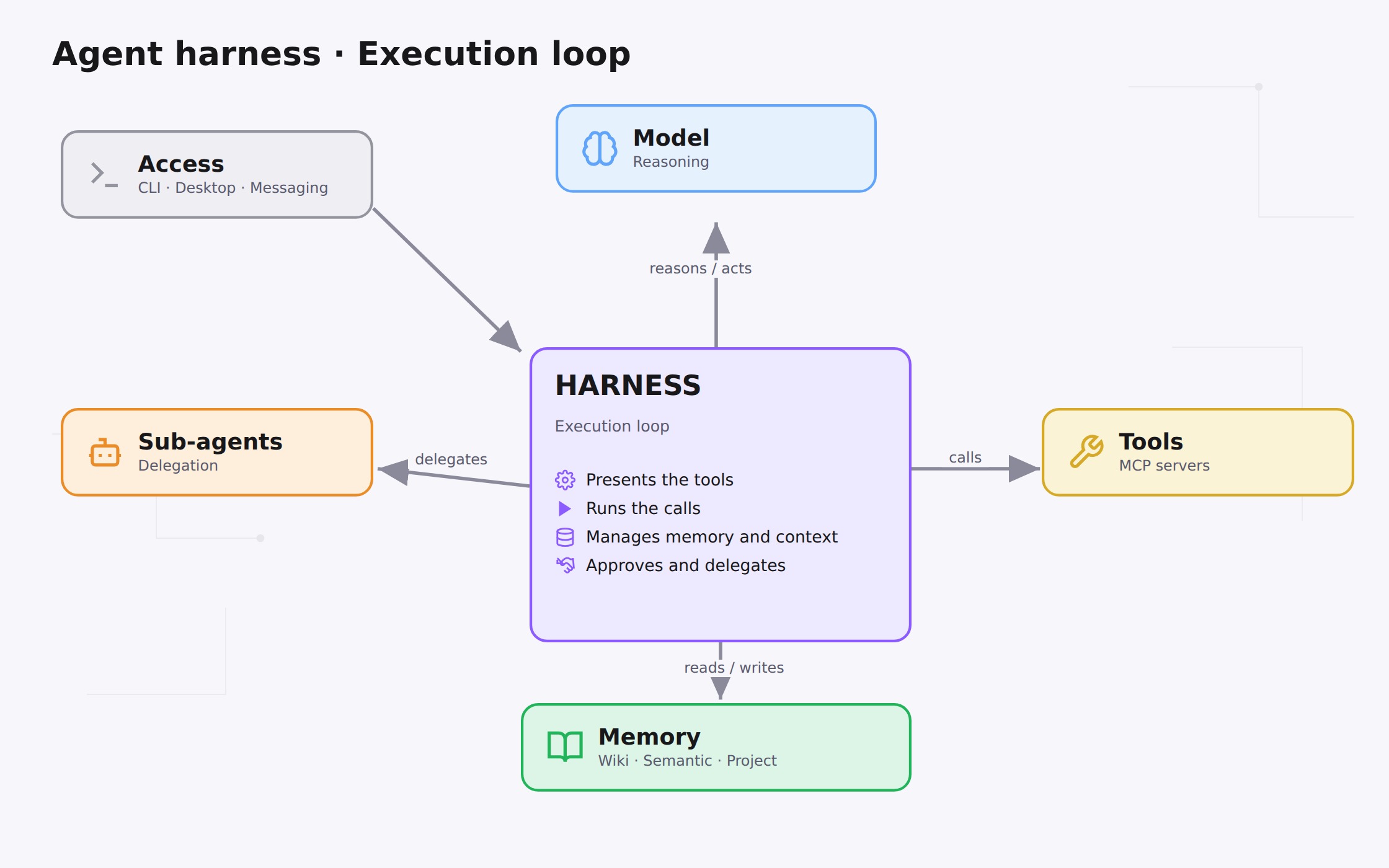
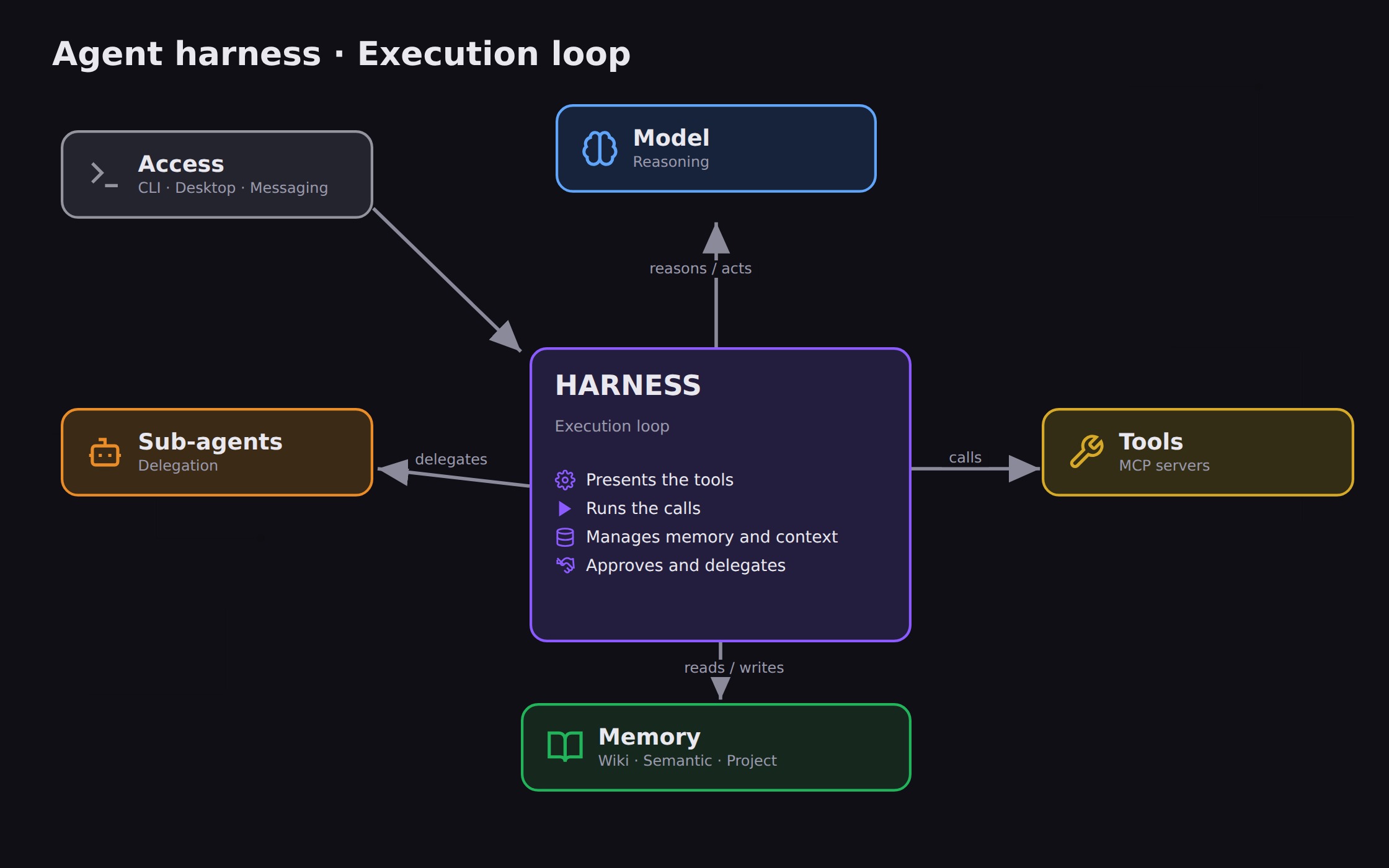
The harness is the execution loop around the model, where it presents tools, runs tool calls, manages context and memory, applies approval rules for sensitive actions and delegates to sub-agents to parallelise work. Without a harness, a model only produces text; with one, it acts on the system, under control.
The protocol linking the harness to its tools is moving fast: the MCP specification of 28 July 2026 adopts a stateless core and header-based routing, which gateways and application firewalls can filter without parsing request bodies. The TypeScript and Python SDKs have each passed one billion cumulative downloads, for close to half a billion downloads a month.
How does an agent's three-layer memory work?
The agent's memory works in three layers, a knowledge wiki, a semantic memory and a project memory, which it rereads at every session, so the organisation's context accumulates instead of being lost.
| Layer | Content | Use |
|---|---|---|
| Knowledge wiki | Structured pages: business, products, infrastructure | Consulted and enriched on every mission |
| Semantic memory | Atomic facts indexed by similarity | Automatic recall of relevant context |
| Project memory | Invariants and current state of each project | Loaded at session start |
Every durable fact learned during a mission is filed in the layer matching its scope, so that agents and humans consult the same sources.
Skills: procedures that improve on their own
A skill is a versioned procedure that the agent knows how to replay: when a task repeats, the agent captures it instead of rediscovering it, and a curator periodically reviews the skills and improves them based on real usage, so the platform becomes more capable every week, without a development project.
One access point for everyone, a single memory
The same engine serves the command line, the desktop application and messaging, so non-technical users have access to the same agents, the same memory and the same skills, with sensitive actions requiring approval before executing and the history staying centralised.
The useful strategy is not to add a chatbot, but to decide which tasks move to agents, and in what order.
Five patterns of an agentic platform in production
A demonstration becomes an agentic platform once it adopts five patterns proven in production: a supervising orchestrator, one agent per source, a right-sized model, cross-cutting middleware and persistent memory.
| Pattern | Role |
|---|---|
| Supervising orchestrator | A central conductor allocates the task and prevents infinite loops |
| One agent per source | Each data source has its own agent, prompts and model, which isolates and secures |
| Right-sized model | Each agent uses the least costly model able to handle its task |
| Middleware | A cross-cutting layer adds security control, error handling and human triggers without touching the agents |
| Persistent memory | Session memory and long-term memory keep context across sessions |
Human oversight of high-risk actions remains mandatory, which the AI Act makes unavoidable, and the semantic router directs each request to the right agent and the right execution location, and keeps sensitive content local.
Frequently asked questions
What is an agent harness?
The execution loop that presents tools to the model, runs the calls, manages memory, applies approvals and delegates to sub-agents.
Why three layers of memory?
To place each fact according to its scope: structured knowledge, semantic facts, project invariants. Context accumulates.
How do skills improve on their own?
The agent captures repeated tasks, and a curator periodically reviews them based on real usage.