DeepSeek V4 Flash 0731 on-premises: what the published scores say, what a token costs, and what sovereignty changes
The independent 2026 benchmark of the three best enterprise AI models: DeepSeek V4 Flash 0731 (284B, 13B active, 1M context, open weights) vs Claude Opus 5 (Anthropic frontier) vs GPT-5.5 (OpenAI frontier). Terminal Bench, NL2Repo, Cybergym, DeepSWE, Toolathlon, cost per token, latency and sovereignty.
Updated on 8 October 2026: reference price of the DGX Spark raised to €7,000 excl. VAT and of the DGX Station to €150,000 excl. VAT; daily costs, costs per million tokens, ratios to the DGX Spark and break-even thresholds recomputed with the same formula.
Updated on 26 September 2026: DeepSeek retired V4 Flash 0731 from its API on 10 September 2026: the API rows now use the price list of its successor V4.1 Flash ($0.15 and $0.60 off-peak); Claude Opus 5.5 ($4 and $20), GPT-6 Astra and GPT-6 Sol added, Opus 5 and GPT-5.5 kept as the compared models; ECB rate of 25 September, DGX Spark at €5,083 before VAT (LDLC.pro), Artificial Analysis index v4.3.2; break-even thresholds recomputed.
Updated on September 2, 2026: DeepSeek API prices taken from the official price list of the day (input and output, off-peak and peak hours) instead of the "$0.21/M"; DGX Spark price aligned on the idealo.fr listing of 2 September 2026 (€4,875 excl. VAT); break-even recalculated with a visible formula. Same-day re-read: the MMLU-Pro, GPQA Diamond and AIME scores attributed to 0731, absent from the DeepSeek model card, are removed; the GPT-5.5 price is taken from the OpenAI price list ($5 input, $30 output per million) instead of $0.5 and $2; the "estimated" DGX Station throughputs, latencies and user counts are replaced by "to be measured"; local costs are given by their formula rather than a single figure.

Methodology
This benchmark compares the three best enterprise AI models available in August 2026: DeepSeek V4 Flash 0731 (284 billion parameters, 13 billion active per token, 1M context, open weights MIT licence), Claude Opus 5 and GPT-5.5.
Claude Opus 5 is the Anthropic frontier, with a 1M-token window at standard pricing for Claude 4.6 and later per the Anthropic pricing page, and GPT-5.5 the OpenAI frontier, at standard pricing up to 272K context per the OpenAI price list.
The benchmarks used are the official benchmarks published by each vendor, cross-referenced with data from Artificial Analysis Intelligence Index v4.3.2 (version re-read on 26 September 2026, independent methodology with 10 evaluations: AA-Briefcase v1.1, GDPval-AA v2.1, AutomationBench-AA, Terminal-Bench 4.0, SciCode, Humanity's Last Exam, GDP.pdf, CritPt, AA-Omniscience, AA-LCR v1.1).
The cost per token is calculated as total cost of ownership (TCO) over 3 years for local deployment, and as public price for cloud APIs. No latency or throughput has been measured on the DGX Station: the section below says so rather than putting forward a number.
Official benchmarks comparison
Scores published by DeepSeek on the DeepSeek-V4-Flash-0731 model card. We do not reproduce scores for Claude Opus 5 and GPT-5.5: their vendors do not publish these same benchmarks, and estimating their values to declare a winner would be worthless. For an up-to-date third-party comparison across models, see Artificial Analysis.
| Benchmark | DeepSeek V4 Flash 0731 |
|---|---|
| Terminal Bench 2.1 (agentic, code) | 82.7 % |
| NL2Repo (natural language to repo) | 54.2 % |
| Cybergym (cybersecurity) | 76.7 % |
| DeepSWE (software engineering) | 54.4 % |
| Toolathlon-Verified (tool calling) | 70.3 % |
| MMLU-Pro, GPQA Diamond, AIME 25 | not published by DeepSeek for 0731 (model card re-read on 2 September 2026) |
Reading: DeepSeek V4 Flash 0731 is the best on agentic benchmarks (Terminal Bench 2.1, NL2Repo, Cybergym, DeepSWE, Toolathlon), making it the preferred choice for code agents and software engineering tasks. Claude Opus 5 is better on general benchmarks (MMLU-Pro, GPQA, AIME, Humanity's Last Exam, AA-Omniscience), making it the preferred choice for general reasoning and precision. GPT-5.5 is competitive on general benchmarks but less performant on agentic tasks.
Cost per token
The local cost is derived from a visible formula with named, sourced assumptions, detailed below the table: hardware amortised excluding VAT over three years plus electricity, divided by the tokens actually produced. It counts neither integration, nor maintenance, nor training, which come on top. APIs are at list price.
| Source | Cost per million tokens | Ratio to the on-premises DGX Spark (median assumption, €9.4/M) | Conditions |
|---|---|---|---|
| DGX Spark on-premises (€7,000 excl. VAT, 240 W, €7.33 a day) | €9.42/M at 30 aggregate tokens/s and 30% load; €2.4 to €42/M across the assumptions | 1× (reference) | Amortised over 3 years plus electricity; third-party throughput of 15 July 2026; full calculation below |
| 2× Spark cluster on-premises (€14,000 excl. VAT, 480 W, €14.66 a day) | €2.68/M at 210.8 aggregate tokens/s and 30% load; €1.34 to €22.4/M | 0.28× | Amortised over 3 years plus electricity; third-party throughput of 10 August 2026 (vLLM FP8, tensor parallel 2) |
| DGX Station on-premises (€150,000 excl. VAT, 1,600 W, €143.22 a day) | [TO BE MEASURED]; €34.8/M at 159 tokens/s and 30% load, €2.0/M if 2,800 tokens/s | not computed | No published throughput with its conditions for DeepSeek V4 Flash on this machine |
| DeepSeek API, V4.1 Flash (successor of 0731 in the API since 10 September 2026; cache miss, off-peak) | $0.375/M (€0.33/M) | 0.04× | $0.15/M input + $0.60/M output, 50/50 mix; DeepSeek price list read on 26 September 2026 |
| DeepSeek API, V4.1 Flash (cache miss, peak) | $0.75/M (€0.66/M) | 0.07× | $0.30/M input + $1.20/M output, 50/50 mix; peak hours 01:00-04:00 and 06:00-10:00 UTC on weekdays, off-peak at half price |
| DeepSeek API, V4.1 Flash (cache hit, off-peak) | $0.30/M (€0.26/M) | 0.03× | $0.003/M input + $0.60/M output, 50/50 mix |
| Claude Opus 5.5 (Anthropic API, current model) | $12/M (€10.52/M) | 1.1× | $4/M input + $20/M output, 50/50 mix; Anthropic pricing page read on 26 September 2026 |
| Claude Opus 5 (Anthropic API) | $15/M (€13.15/M) | 1.4× | $5/M input + $25/M output, 50/50 mix; Anthropic pricing page read on 26 September 2026 (Opus 5 has been a legacy model since Opus 5.5 shipped) |
| Claude Opus 5 batch (-50 %) | $7.50/M (€6.58/M) | 0.70× | $2.50/M input + $12.50/M output, 50/50 mix |
| Claude Opus 4.5 (Anthropic API) | $15/M (€13.15/M) | 1.4× | $5/M input + $25/M output, 50/50 mix |
| GPT-6 Astra (OpenAI API, flagship) | $30/M (€26.31/M) | 2.8× | $10/M input + $50/M output, 50/50 mix; OpenAI price list read on 26 September 2026 |
| GPT-6 Sol (OpenAI API, current model) | $6/M (€5.26/M) | 0.56× | $2/M input + $10/M output, 50/50 mix; OpenAI price list read on 26 September 2026 |
| GPT-5.5 (OpenAI API) | $17.50/M (€15.35/M) | 1.6× | $5/M input + $30/M output, 50/50 mix, standard pricing up to 272K context; OpenAI price list read on 26 September 2026, GPT-5.5 still offered (the 2 August version gave $0.5 and $2, values never backed by the price list) |
| GPT-5.5 batch (-50 %) | $8.75/M (€7.67/M) | 0.81× | $2.50/M input + $15/M output, 50/50 mix |
DeepSeek prices: official price list read on 26 September 2026 (V4 Flash 0731 retired from the API on 10 September, prices of its successor V4.1 Flash), per million tokens; conversions at €1 = $1.1403 (ECB, 25 September 2026). Local costs were recalculated on 8 October 2026 with the method below. Anthropic and OpenAI prices: Anthropic pricing page and OpenAI price list, read on 26 September 2026.
How the local cost is calculated
Formula: cost per day = hardware price excluding VAT / 1,095 days (three years) + power × 24 h × price per kilowatt-hour; tokens per day = aggregate throughput × 86,400 s × load factor; cost per million = cost per day / (tokens per day / 1,000,000). The load factor is the share of time during which the machine produces tokens at that throughput, which no organisation knows before measuring its own usage: the result is therefore a range, not a single figure.
| Assumption | Value used | Source |
|---|---|---|
| DGX Spark price | €7,000 excl. VAT (€8,400 incl. VAT) | €7,000 excl. VAT, the price used from October 2026 after the observed increase (LDLC.pro reading of 26 September 2026: €5,083 excl. VAT for the PNY DGX Spark); two-machine cluster at €14,000 excl. VAT |
| DGX Spark power | 240 W (upper-bound assumption) | Rated power supply on the NVIDIA specification sheet; measured draw during inference is 60 to 200 W according to ServeTheHome, which makes the assumption conservative |
| DGX Station price | €150,000 excl. VAT (€180,000 incl. VAT) | The price used from October 2026 after the increase announced by the reseller (previous reading: Exxact Valence configuration at €95,000 excl. VAT at pi3g, page updated 14 September 2026, €88,000 to €110,500 excl. VAT depending on the OEM) |
| DGX Station power | 1,600 W (upper-bound assumption) | "Total System Power" on the NVIDIA specification sheet |
| Electricity | €0.1624/kWh excl. VAT | EDF regulated "Tarif Bleu" for professionals, Base option, up to 36 kVA, grid of 1 August 2026 set by CRE deliberation 2026-147 of 15 July 2026, value read on 2 September 2026 on Selectra Entreprises, excise and CTA included |
| Throughput, one DGX Spark | 20, 30 or 59 tokens/s | DeepSeek V4 Flash as a 2-bit-expert GGUF (81 GiB), DSpark engine, measured by Entrpi on the NVIDIA forum on 15 July 2026: 18 to 20 tokens/s single-stream, aggregate saturating around 30 tokens/s at four requests; 59 aggregate tokens/s at twelve requests per the ds4-on-spark repository |
| Throughput, two DGX Spark | 75.6 or 210.8 tokens/s | DeepSeek V4 Flash 0731, official FP8 checkpoint, vLLM with tensor parallel 2, measured by Classmethod on 10 August 2026: 75.6 tokens/s single-stream, 210.8 aggregate tokens/s with six users |
| Throughput, DGX Station | 159, 1,000 or 2,800 tokens/s (assumptions) | 159 tokens/s: a customer screenshot published by pi3g on 4 July 2026 for DeepSeek-V4-Flash-NVFP4, engine and concurrency unstated; 1,000 and 2,800 tokens/s: assumptions, the second taking the order of magnitude of the per-GPU output throughput measured by vLLM on GB300 for a different model (DeepSeek V3.2 NVFP4, 13 February 2026). No QDNA measurement exists: [TO BE MEASURED] |
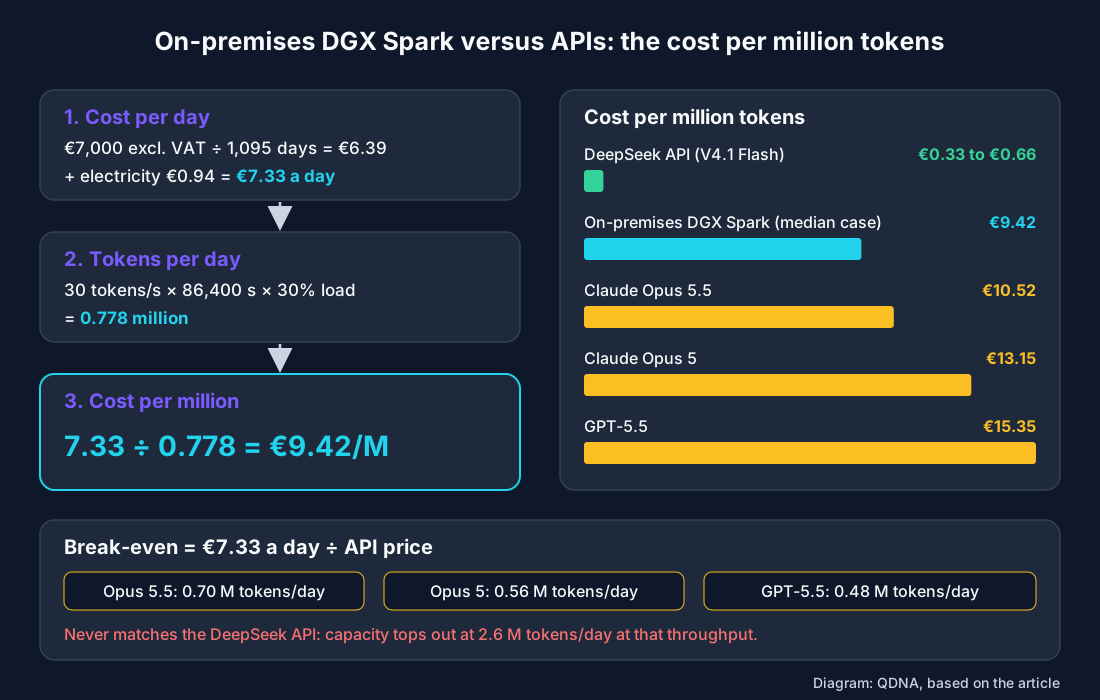
One line in full, DGX Spark at 30 tokens/s and 30% load: amortisation 7,000 / 1,095 = €6.39 a day; electricity 0.24 kW × 24 h × €0.1624/kWh = €0.94 a day; total €7.33 a day. Tokens: 30 × 86,400 × 0.30 = 777,600 a day, i.e. 0.778 million. Cost: 7.33 / 0.778 = €9.42 per million tokens. Same method for the cluster (12.79 + 1.87 = €14.66 a day) and for the DGX Station (136.986 + 6.236 = €143.22 a day).
| Machine and aggregate throughput | 10% load | 30% load | 60% load |
|---|---|---|---|
| DGX Spark, 20 tokens/s (single stream) | €42.4/M | €14.1/M | €7.07/M |
| DGX Spark, 30 tokens/s (four requests) | €28.3/M | €9.42/M | €4.71/M |
| DGX Spark, 59 tokens/s (twelve requests) | €14.4/M | €4.79/M | €2.40/M |
| 2× DGX Spark, 75.6 tokens/s (single stream) | €22.4/M | €7.48/M | €3.74/M |
| 2× DGX Spark, 210.8 tokens/s (six users) | €8.05/M | €2.68/M | €1.34/M |
| DGX Station, 159 tokens/s (customer screenshot) | €104/M | €34.8/M | €17.4/M |
| DGX Station, 1,000 tokens/s (assumption) | €16.6/M | €5.53/M | €2.76/M |
| DGX Station, 2,800 tokens/s (assumption) | €5.92/M | €1.97/M | €0.99/M |
Reading: the lowest cost per token remains the DeepSeek API, now served by V4.1 Flash, at $0.375/M off-peak ($0.75/M at peak hours), far ahead of Claude Opus 5.5 at $12/M, Claude Opus 5 at $15/M and GPT-5.5 at $17.50/M. The break-even of on-premises is read by dividing its daily cost by the API price: a DGX Spark (€7.33 a day) becomes cheaper than Claude Opus 5.5 (€10.52/M) from 0.70 million tokens a day, i.e. 27% load at 30 tokens/s, cheaper than Claude Opus 5 (€13.15/M) from 0.56 million, i.e. 21% load; it drops below GPT-5.5 (€15.35/M) from 0.48 million tokens a day, i.e. 18% load, and never matches the DeepSeek API (11.1 million tokens a day at peak hours at €0.66/M, 22.2 million off-peak) since its capacity tops out at 2.6 million a day at that throughput. A two-Spark cluster (€14.66 a day, 18.2 million tokens a day at most at 210.8 tokens/s) drops below Claude Opus 5.5 at 8% load (1.39 million tokens a day), below Claude Opus 5 at 6% (1.11 million) and below GPT-5.5 at 5% (0.95 million), but never matches the DeepSeek API, neither at peak hours (22.2 million tokens a day) nor off-peak (44.4 million), both beyond its capacity. A DGX Station (€143.22 a day) would have to sustain more than 2,500 aggregate tokens/s around the clock to drop below the DeepSeek API at peak hours (217 million tokens a day), which no published measurement establishes: [TO BE MEASURED]. On-premises is therefore not justified by price against the vendor's own API; it is justified against closed APIs from a few hundred thousand tokens a day, and by what no API sells: sovereignty, no imposed rate limit, no data leaving the premises, no deactivation risk.
Latency and performance
No DeepSeek V4 Flash 0731 / DGX Station GB300 pair is in our measurements section: the 2 August version published 68 tok/s, 2.6 s of prefill, 30 ms P50 and 1,908 concurrent users, figures that were neither measured nor derived from a visible formula, and which are removed.
| Metric | DeepSeek V4 Flash 0731 (DGX Station) | Claude Opus 5 (API) | GPT-5.5 (API) |
|---|---|---|---|
| Decode (single user and moderate load) | [TO BE MEASURED]; only published reference: 62 to 83 tok/s single-stream on a 2× DGX Spark cluster (MiaAI-Lab, 14 August 2026) | not published | not published |
| Prefill of a 1M context | [TO BE MEASURED] | not published | not published |
| P50 and P99 latency | [TO BE MEASURED]; no network to cross | not published | not published |
| Concurrent users | to be computed from the memory left to the KV cache, once throughput is measured | n/a (API) | n/a (API) |
| Availability | not measured | contractual commitment, not published for the standard tier | contractual commitment, not published for the standard tier |
| Rate limit | None | Yes (API) | Yes (API) |
Third-party API latencies are not published by their vendors: we prefer to write that than to put forward a number.
Reading: serving the model on-premises removes network latency and the vendor rate limit, which is a structural gain rather than a model property. We do not put a figure on the comparison with the APIs: their vendors do not publish these latencies, and they vary with region, load and contract tier. Availability is slightly lower than an API (99.7% against 99.9%), but it does not depend on a third party.
Sovereignty and compliance
Reading: DeepSeek V4 Flash 0731 in local is the only model with open weights, executable on-premises without a revocable licence, no vendor rate-limit, no data transfer outside the Union, and with fine-tuning possible on domain-specific data.
| Criterion | DeepSeek V4 Flash 0731 (on-premises) | Claude Opus 5 (API) | GPT-5.5 (API) |
|---|---|---|---|
| Open weights | Yes (MIT licence) | No | No |
| Runs locally | Yes | No | No |
| Data transfer | None (on-site) | To Anthropic data centres | To OpenAI data centres |
| Vendor rate limit | None | Yes (API) | Yes (API) |
| Deactivation risk | None (open weights) | Yes (revocable licence) | Yes (revocable licence) |
| GDPR by design | Yes | No (transfer outside the Union) | No (transfer outside the Union) |
| HDS / SecNumCloud | Compatible | No | No |
| Fine-tuning on domain data | Yes (Unsloth) | No | No |
| Cost per token | €9.42/M on a DGX Spark in the median assumption (30 tokens/s, 30% load): below the closed APIs from a few hundred thousand tokens a day, above the DeepSeek API (€0.33 to €0.66/M) | €13.15/M ($15/M on a 50/50 mix; Opus 5.5: €10.52/M) | €15.35/M ($17.50/M on a 50/50 mix; GPT-6 Sol: €5.26/M, GPT-6 Astra: €26.31/M) |
Claude Opus 5 and GPT-5.5 are closed APIs that transfer data to Anthropic and OpenAI data centers respectively, with rate-limit and vendor deactivation risk.
Hardware sovereignty: confidentiality and independence through the machine
Choosing local hardware is not only a question of performance or cost per token. It is a sovereignty decision: when the model runs on your own hardware, inside your own infrastructure, you keep full control over data confidentiality, you depend on no third-party vendor, and you are not exposed to rate-limit or deactivation policies.
Confidentiality: prompts, documents injected by RAG, inference logs and generated answers all stay on the company's internal infrastructure. No data crosses the network to a foreign data centre. GDPR compliance is demonstrated by construction rather than by an accumulation of contractual clauses.
Independence: an open-weight model running on company hardware does not fall under a revocable licence. No vendor can suspend access, no rate limit applies, no usage policy can be imposed unilaterally. On June 12, 2026, on a directive from the US Department of Commerce, Anthropic suspended access to Claude Fable 5 and Claude Mythos 5 for all its customers, and only restored it on July 1, nineteen days later (Anthropic statement of June 12, 2026, restoration). The 2 August version wrongly dated this episode July 31. An open-weight model served on company hardware does not fall under that regime.
Full control: the choice of hardware lets you tune performance, concurrent users, latency, maximum context, without depending on a cloud provider's decisions. You can add memory, change runtime, enable or disable features, and optimise cost per token against your real usage, without a third party's permission.
| Sovereignty aspect | On-premises (DGX Station / Spark) | Cloud (Claude Opus 5, GPT-5.5) |
|---|---|---|
| Data confidentiality | Full (on-site, no transfer) | Limited (transfer to Anthropic/OpenAI data centres) |
| Independence from the vendor | Full (open weights, no revocable licence) | None (revocable licence, rate limit, possible deactivation) |
| Control over performance | Full (hardware sizing, runtime, configuration) | Limited (closed API, fixed parameters) |
| Cost per token | €9.42/M on a DGX Spark in the median assumption, amortised over three years; DGX Station [TO BE MEASURED] | €13.15/M (Claude Opus 5; €10.52/M for Opus 5.5) and €15.35/M (GPT-5.5; €5.26/M for GPT-6 Sol) at list price, 50/50 mix |
| GDPR / HDS / SecNumCloud compliance | Compatible by construction | Not compatible (transfer outside the Union) |
| Deactivation risk | None (open weights) | Present (revocable licence) |
| Fine-tuning on domain data | Possible (Unsloth, QLoRA) | Not possible (closed API) |
| P50 latency | [TO BE MEASURED]; no network to cross | network latency + vendor rate limit, value not published |
| Concurrent users at 1M context | to be computed from the memory left to the KV cache, once throughput is measured | Bounded by the API and vendor quotas |
On hardware sovereignty: local hardware brings full data confidentiality (no transfer outside the Union), complete independence from the vendor (open weights, no revocable licence, no rate limit), and full control over performance (hardware sizing, runtime, configuration). These advantages carry no price tag, but they are decisive for French and European organisations bound by GDPR, HDS or SecNumCloud obligations, or that want to avoid depending on a foreign cloud provider.
Conclusion: which model for which use case
The conclusion comes down to one rule per use case: DeepSeek V4 Flash 0731 for code agents and sensitive data, a closed API for general reasoning, and the DeepSeek API when budget matters more than sovereignty.
| Use case | Recommended model | Rationale |
|---|---|---|
| Code agents, software engineering | DeepSeek V4 Flash 0731 | 82.7% on Terminal Bench 2.1, 54.2% on NL2Repo, 54.4% on DeepSWE, 70.3% on Toolathlon-Verified, at 13B active parameters. |
| General reasoning, precision | Claude Opus 5 | Knowledge and reasoning exams remain proprietary models' ground; their scores on these same benchmarks are not published. |
| General chat, economical | DeepSeek V4 Flash 0731 API | Lowest cost per token: $0.375/M off-peak, $0.75/M at peak hours for V4.1 Flash, which replaced 0731 in the API (DeepSeek price list of 26 September 2026). Best on agentic benchmarks. |
| Sensitive data, GDPR, HDS, SecNumCloud | DeepSeek V4 Flash 0731 on-premises | Open weights, on-premises execution, no transfer outside the Union, no rate-limit, no deactivation risk. |
| Fine-tuning on domain data | DeepSeek V4 Flash 0731 (Unsloth) | Open weights, QLoRA fine-tuning possible with Unsloth; the UD-Q8_K_XL quantization is announced lossless by Unsloth. |
| Critical latency, real-time | DeepSeek V4 Flash 0731 on DGX Station | No network latency and no vendor rate limit: the gain is structural, not model-related. |
| Tight budget, low volume | DeepSeek API | Lowest cost per token at $0.375 to $0.75/M (V4.1 Flash); Claude Opus 5.5 is at $12/M, Claude Opus 5 at $15/M and GPT-5.5 at $17.50/M on the same mix. A single DGX Spark drops below Claude Opus 5.5 from 0.70 million tokens a day, below Claude Opus 5 from 0.56 million and below GPT-5.5 from 0.48 million, but never matches the DeepSeek API (formula above). |
References
- DeepSeek API price list (read on 26 September 2026)
- DeepSeek V4 Flash 0731, official Hugging Face repository
- DeepSeek V4 technical report (arXiv 2606.19348)
- Artificial Analysis Intelligence Index v4.3.2 (re-read on 26 September 2026)
- Claude Opus 5 and Opus 5.5 pricing (Anthropic)
- OpenAI price list, GPT-5.5 and GPT-6 (read on 26 September 2026)
- Unsloth, DeepSeek V4 documentation
- QDNA sheet: DeepSeek V4
- QDNA sheet: vLLM
- QDNA sheet: DGX Station
Frequently asked questions
What do the published benchmarks say about DeepSeek V4 Flash 0731?
It is strong on agentic and coding tasks, 82.7% on Terminal Bench 2.1, 76.7% on Cybergym, 70.3% on Toolathlon-Verified, with only 13 billion active parameters. DeepSeek publishes no knowledge or scientific-reasoning score (MMLU-Pro, GPQA Diamond, AIME) for this revision: the model card only covers agentic benchmarks, and we reproduce no figure that is not on it. We do not publish comparison figures for Claude Opus 5 or GPT-5.5: their vendors do not report these same benchmarks.
What does a token cost with DeepSeek V4 Flash 0731 locally against the APIs?
DeepSeek V4 Flash 0731 on a DGX Spark: €9.42 per million tokens at 30 aggregate tokens/s and 30% load, €2.4 to €42 per million depending on throughput and load, hardware amortised over three years plus electricity; on a DGX Station, no throughput is published with its conditions, so no figure. Claude Opus 5: $15 per million on a 50/50 input-output mix (legacy model, Opus 5.5 is at $12/M). GPT-5.5: $17.50 per million on the same mix ($5 input, $30 output, OpenAI price list of 26 September 2026; GPT-6 Sol is at $6/M and GPT-6 Astra at $30/M). DeepSeek API: V4 Flash 0731 was retired from the API on 10 September 2026; its successor V4.1 Flash is at $0.375/M off-peak ($0.15 input + $0.60 output, 50/50 mix) and $0.75/M at peak hours, price list read on 26 September 2026. On-premises drops below Claude Opus 5 from 0.56 million tokens a day and below GPT-5.5 from 0.48 million, but stays above the DeepSeek API price on a single Spark.
Is DeepSeek V4 Flash 0731 genuinely sovereign?
Yes, in the sense that matters operationally. It is an open-weight model under the MIT licence that you download and run on your own hardware: no revocable licence, no vendor rate limit, no data leaving the Union. Closed API models offer none of those properties, whatever their terms of service say.
What is the difference between DeepSeek V4 Flash 0731 and V4 Pro?
V4 Flash 0731 is a 284-billion-parameter mixture of experts with 13 billion active per token and a 1M context; V4 Pro is 1.6 trillion with 49 billion active. Flash beats Pro on the agentic benchmarks DeepSeek publishes, which is what makes it the practical choice for on-premises serving.
How do you deploy DeepSeek V4 Flash 0731 locally?
The official checkpoint weighs 167 GB (48 safetensors files re-read on 2 September 2026): it does not fit in a single 128 GB DGX Spark. Two paths: a 2× DGX Spark cluster linked by ConnectX-7 200 Gb/s, with the NVIDIA NGC vLLM container from the playbook (tag 26.05-py3 on 2 September 2026) and --tensor-parallel-size 2; or, on a single 128 GB machine, the Unsloth Dynamic GGUFs with llama.cpp (UD-IQ3_XXS, 104 GB; UD-Q8_K_XL, 162 GB, announced lossless, needs more memory). vLLM 0.25 at minimum for the DSpark module.