Sovereign AI inference in the enterprise: 8 × RTX PRO 6000 Blackwell vs 8 × H200 SXM
To process confidential enterprise document streams in September 2026, an organisation deploys an on-premises redundant inference cluster across eight accelerator cards, eliminating third-party data transfers through a calculated trade-off between professional PCIe workstation cards and datacenter modules.
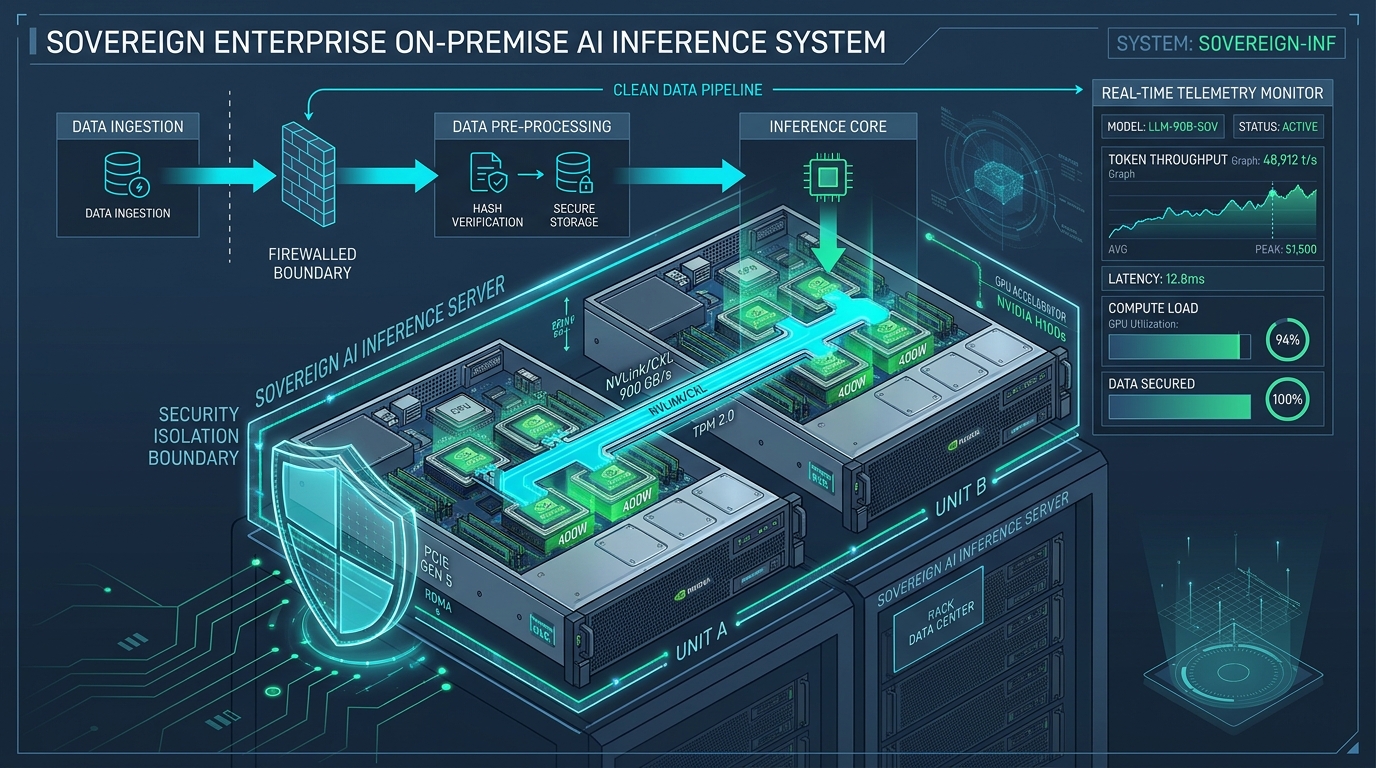
Why size two separate servers for on-premises inference?
Deploying two identical physical servers guarantees service continuity through active load distribution and hardware fault tolerance. Should any compute node experience an unplanned outage, the secondary machine immediately absorbs the entire inference workload without interrupting ongoing operations.
In an enterprise production environment, a single point of failure exposes mission-critical software to severe outages. Distributing four accelerators per chassis across twin server chassis allows engineering teams to perform kernel upgrades and runtime maintenance without downtime.
Dual-node topologies also distribute electrical load and thermal dissipation across independent rack circuits. Each machine operates on a dedicated electrical feed absorbing approximately 3,200 W without requiring the complex facility plumbing or high-density liquid loops demanded by monolithic multi-rack installations.
What are the architectural differences between RTX PRO 6000 and H200 SXM?
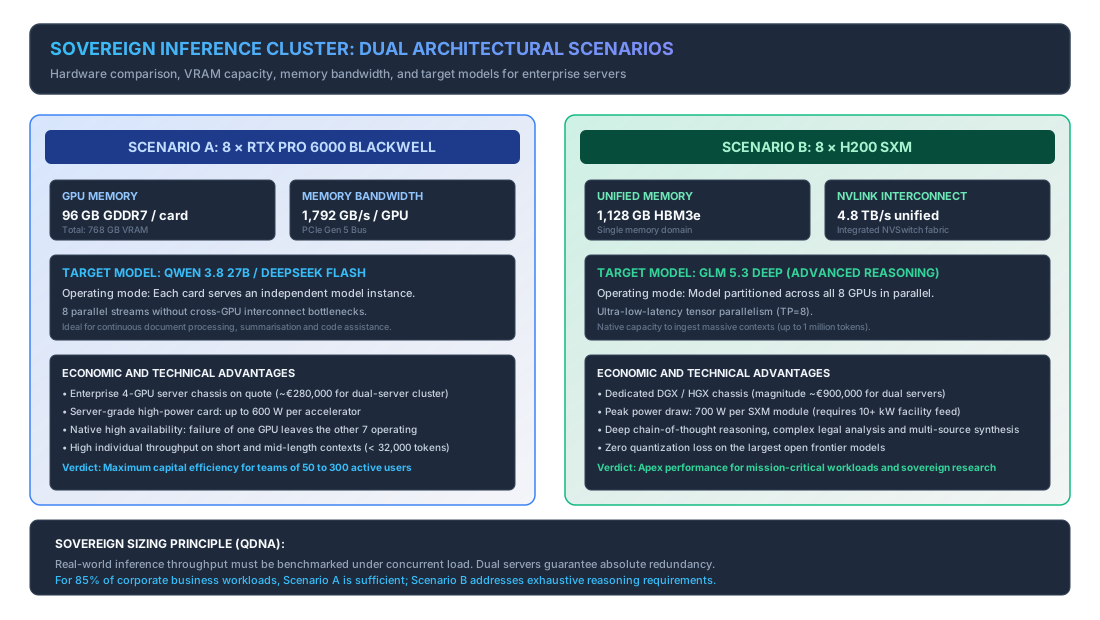
The RTX PRO 6000 Blackwell card operates over a standard PCIe bus with ninety-six gigabytes of fast memory, whereas the H200 SXM module integrates one hundred and forty-one gigabytes of high-bandwidth memory connected through dedicated NVLink interconnects.
The H200 SXM datacenter module is designed for raw compute throughput across distributed model weights. Equipped with HBM3e delivering 4.8 TB/s per GPU and bidirectional NVLink fabrics running at 900 GB/s, it synchronises model activations across accelerators at speeds unmatched by PCIe buses.
Conversely, the server-grade RTX PRO 6000 Blackwell accelerator is rated for an operating thermal design envelope reaching up to 600 W per card under maximum compute loads. Delivering 1,792 GB/s over GDDR7 memory within reinforced PCIe Gen 5 chassis slots, it operates on high-velocity forced-air cooling without requiring dedicated liquid cooling loops.
| Technical specification | 8 × RTX PRO 6000 Blackwell cluster | 8 × H200 SXM5 cluster |
|---|---|---|
| Total graphics memory | 768 GB GDDR7 (96 GB per GPU) | 1,128 GB HBM3e (141 GB per GPU) |
| Per-device memory bandwidth | 1,792 GB/s per GPU (14.3 TB/s aggregate) | 4.8 TB/s per module (38.4 TB/s aggregate) |
| Inter-GPU interconnect | PCIe Gen 5 bus (64 GB/s bidirectional) | NVLink 4 (900 GB/s bidirectional per GPU) |
| Estimated power draw | Up to 600 W per card (~3,200 W per server) | ~700 W per module (~3,800 W per server) |
| Electrical provisioning | Dedicated 16 A or 32 A lines per chassis | Dedicated 32 A three-phase power feed |
| Chassis cooling | Standard forced-air rack chassis | Direct liquid cooling or rear-door heat exchanger |
| Recommended open-weight models | Qwen 3.8 27B, DeepSeek V4 Flash | GLM 5.3 Deep, DeepSeek V4 671B |
Which open-weight models run on each cluster?
A cluster powered by RTX PRO 6000 accelerators serves fast and compact open-weight models such as Qwen 3.8 27B or DeepSeek V4 Flash, while the H200 architecture comfortably runs massive frontier networks like GLM 5.3 Deep without quantization compromises.
With 768 GB of total VRAM across both servers, an RTX PRO 6000 deployment hosts multiple specialised model instances simultaneously. An engineering team can concurrently run a thirty-billion-parameter reasoning model, dense vector embedding models and structured extraction microservices.
The H200 SXM modules, aggregating 1,128 GB of ultra-fast HBM3e memory, become essential when serving colossal dense models in native half-precision floating point. However, this expenditure must align with actual enterprise reasoning complexity requirements.
What inference throughput can you expect with vLLM?
The vLLM engine optimises inference throughput by combining continuous batching of incoming requests with key-value cache reuse in graphics memory. Across the eight RTX PRO 6000 cards, aggregated memory bandwidth maintains smooth response rates under heavy concurrent workloads.
Language model generation decomposes into two phases: prompt prefill and token decoding. Prefill saturation stresses tensor compute cores, while sequential decoding performance is strictly governed by memory bandwidth.
In enterprise document analysis featuring long shared prompts, vLLM prefix caching retains precomputed attention layers directly in GPU memory. This mechanism reduces redundant computations across recurring documents, stabilising request latency during peak business hours.
What is the total cost of ownership over three years?
Total cost of ownership includes initial hardware capital expenditure amortised over thirty-six months, continuous power consumption and secure datacenter hosting. The RTX PRO 6000 cluster delivers an upfront acquisition cost three times lower than an equivalent H200 SXM deployment.
Examining financial commitments over a 36-month operational horizon reveals a stark economic distinction. Two dual-socket enterprise servers equipped with four RTX PRO 6000 cards each represent approximately €280,000 in capital expense, compared to nearly €906,000 for an equivalent H200 SXM setup with InfiniBand networking.
Factoring electricity costs at €0.1624/kWh for continuous 6.4 kW aggregate draw and private datacenter colocation, the RTX PRO 6000 cluster totals approximately €9,337 per month. This produces an effective cost per million generated tokens around €0.35, while preserving strict internal data ownership.
| Expense item | 8 × RTX PRO 6000 Blackwell cluster | 8 × H200 SXM5 cluster |
|---|---|---|
| Initial hardware investment (2 enterprise servers) | ~€280,000 | ~€906,000 |
| Monthly hardware amortisation (36 months) | €7,778 / month | €25,167 / month |
| Continuous power consumption (€0.1624/kWh) | ~€759 / month (6.4 kW average) | ~€903 / month (7.6 kW average) |
| Colocation space and facility maintenance | ~€800 / month | ~€1,800 / month |
| Total monthly operating cost (TCO) | ~€9,337 / month | ~27,870 / month |
| Cumulative 3-year total cost | ~€336,132 | ~€1,003,320 |
| Estimated cost per million generated tokens | ~€0.35 | ~€0.62 |
How to secure the LiteLLM gateway and the private network?
The LiteLLM gateway secures internal access using isolated virtual keys and departmental quotas without requiring any external internet connectivity. All inference requests remain confined within the enterprise local network, preventing any confidential data leakage.
Placing an orchestration gateway in front of distributed vLLM nodes streamlines enterprise administration. LiteLLM assigns virtual API keys to internal teams, enforces rate limits and logs every transaction to local immutable audit trails for compliance reporting.
Complete network isolation guarantees trade secret protection and alignment with European cybersecurity standards. No operational data, legal briefs or internal records ever leave the perimeter of the corporate datacenter.
Sovereign inference infrastructure rests on a pragmatic balance: hardware tailored to actual production model profiles, strictly air-gapped access gateways, and predictable long-term operating costs.
Official sources
Sources: official vLLM distributed inference documentation, accelerated computing specifications from NVIDIA enterprise compute, and cybersecurity guidance from ANSSI.
Frequently asked questions
Why are two four-card servers preferable to a single eight-card server?
Splitting GPUs across two distinct servers eliminates the single point of failure. It enables system maintenance and updates without halting production workloads while distributing power requirements across independent electrical feeds.
What is the recommended amortisation period for an inference cluster?
A thirty-six-month straight-line amortisation period is the enterprise standard. It aligns monthly accounting expenses with the typical hardware innovation cycle of AI accelerators.
Can an organisation mix RTX PRO 6000 cards and H200 modules in the same cluster?
Yes, through orchestration logic. The LiteLLM gateway can route standard high-volume requests to the RTX PRO 6000 cards while dispatching heavy complex reasoning queries to the H200 nodes.
Does GDDR7 memory bottleneck token generation compared to HBM3e?
During sequential decoding, HBM3e delivers superior throughput for massive frontier models. However, for mid-sized models operating with modern low-precision formats, the latency gap remains imperceptible to human users.
Architect your sovereign inference cluster
Schedule a no-commitment strategy call with our infrastructure architects to dimension your hardware and design your on-premises platform.
Book a call