DeepSeek V4 Flash Vision Exp: DeepSeek's first multimodal model
Updated on 18 October 2026: Image reading has joined the model's main line, since DeepSeek V4.1 Flash 1017, released on 17 October 2026, natively reads both text and images, and its API name now absorbs requests addressed to this experimental variant, withdrawn from service on 10 September 2026.
Updated on 26 September 2026: DeepSeek V4.1 Flash, natively multimodal, replaced V4 Flash 0731 and Vision Exp in the DeepSeek API on 10 September 2026; the Vision Exp weights remain published.

An analysis of the repository published on 31 August 2026, of what the visual encoder adds to the V4 Flash architecture, and of what the experimental suffix commits you to if you consider deploying it.
Method
Every figure on this page was read on 31 August 2026 from the repository itself: the
config.json file for the architecture, the Hugging Face API for file sizes
and tensor types, the model card for the scores.
The comparison with DeepSeek V4 Flash 0731 comes from a term-by-term difference between the two configuration files, which isolates exactly what the vision release changes.
The scores below are the ones DeepSeek declares in its own model card. No third party had reproduced them when this article was published, the repository being then a few hours old. We therefore report them as publisher declarations rather than independent measurements, and the distinction is preserved everywhere they appear.
What does the repository actually publish?
The release consists of three distinct things, which are better not conflated: the weights first, distributed across 48 safetensors files totalling 168 gigabytes, then a prompt encoding chain, which turns OpenAI-format messages into a model prompt.
Finally a minimal PyTorch inference implementation, which the documentation describes as covering the vision encoder, the aligner, DFlash attention, the mixture of experts, Hyper- Connections and the DSpark forward path.
That reference implementation is the only execution path the publisher provides at this stage. The repository announces neither a recipe for an established serving engine nor a port to the runtimes production usually relies on. This is a meaningful difference from DeepSeek V4 Flash 0731, whose tooling ecosystem has been building since late July.
Two prompt notations coexist and, according to the documentation, produce identical
token identifiers: OpenAI-style JSON content blocks, and a compact textual notation of the
form <image>path</image>. The repository ships an example of
each.
What the visual encoder adds
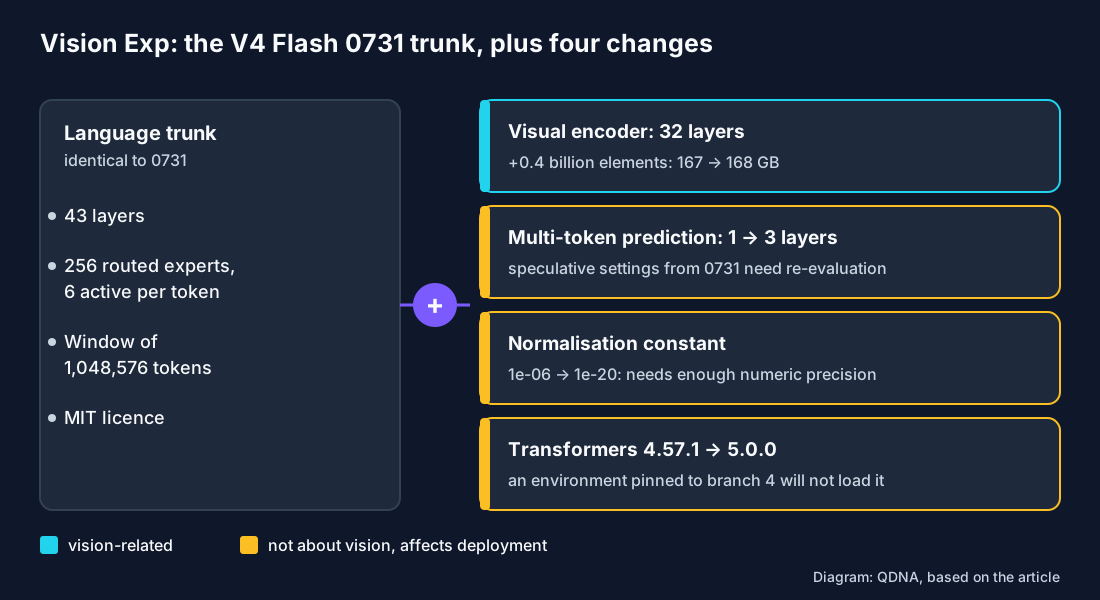
The difference between the two configuration files states the addition plainly, since the language trunk does not move, with 43 layers, 256 routed experts of which 6 are active per token, a hidden dimension of 4096, a 1,048,576-token window, so everything new concerns vision.
| Parameter | Value | What it governs |
|---|---|---|
| vision_n_layers | 32 | Depth of the visual tower. |
| vision_dim | 1024 | Dimension of visual representations. |
| vision_n_heads | 16 | Attention heads in the encoder. |
| vision_inter_dim | 2816 | Inner dimension of the projection layers. |
| vision_patch_size | 14 | Side in pixels of an elementary patch. |
| vision_downsample_ratio | 3 | Reduction factor before the trunk. |
| vision_max_n_token | 384 | Ceiling of visual tokens per image. |
| vision_min_pixels | 147,456 | Minimum accepted area, that is 384 by 384. |
| vision_max_wh_ratio | 8 | Maximum admissible width to height ratio. |
| vision_rope_theta | 10,000 | Base of the visual rotary positional encoding. |
The cost of that addition is legible in the composition of the published tensors. BF16 elements go from 1.5 to 1.9 billion between 0731 and the vision release, while the bulk of the model stays unchanged, with 296.4 billion elements in INT8 and 6.3 billion in FP8. The visual tower therefore accounts for roughly 0.4 billion additional elements, which explains why the on-disk weight moves only from 167 to 168 gigabytes. Adding vision to this model costs less than one percent of its footprint.
Two changes that are not about vision
Comparing the configurations reveals two changes a hurried reader would wrongly attribute to multimodality, and which nevertheless bear on deployment.
The first concerns multi-token prediction, whose depth goes from one layer to three. That mechanism serves speculative decoding, where the model proposes several tokens ahead which a verification step then accepts or rejects. Tripling this depth changes the trade-off between the cost of the proposal and the throughput gain, so any setting carried over from 0731 needs to be reassessed.
The second is quieter: the normalisation stabilisation constant drops from 1e-06 to 1e-20. That value guards a division against a null denominator. Reducing it by fourteen orders of magnitude assumes the computation happens in a precision that supports it, and a careless conversion to a narrower format exposes you to non-numeric values.
Finally, the repository declares that it requires version 5.0.0 of the Transformers library, where 0731 was content with 4.57.1, which is not housekeeping trivia, since an environment pinned to the version 4 branch will not load this model.
The scores the publisher declares
DeepSeek publishes two sets of results, obtained according to its own note with the minimal mode of its agent harness, a maximum reasoning effort level, a temperature of 1.0 and a top_p of 0.95. These remain publisher declarations about its own models.
| Text benchmark | Vision Exp | Flash 0731 | Opus 4.8 |
|---|---|---|---|
| Terminal Bench 2.1 | 83.9 | 82.7 | 85.0 |
| NL2Repo | 57.7 | 54.2 | 69.7 |
| Cybergym | 75.3 | 76.7 | 78.3 |
| DeepSWE | 59.3 | 54.4 | 58.0 |
| Toolathlon Verified | 75.9 | 70.3 | 76.2 |
| DSBench-Hard | 63.6 | 59.6 | 71.7 |
| AutomationBench | 25.7 | 25.1 | 27.2 |
The notable result lies in what these figures do not show. Adding a visual modality frequently degrades textual capability, since the additional training moves the model, whereas here the card announces comparable performance, and the recorded values go further: six benchmarks out of seven improve, Toolathlon gaining 5.6 points and DeepSWE 4.9. Only Cybergym falls back, by 1.4 points.
| Multimodal benchmark | Vision Exp | Flash 0731 | Opus 4.8 |
|---|---|---|---|
| ApexBench (Pass@1) | 36.5 | 26.2 | 39.4 |
| Agents' Last Exam | 27.3 | 25.2 | 25.7 |
| Chartography | 64.3 | not evaluated | 65.0 |
| ZeroBench (Pass@5) | 35.0 | not evaluated | 34.0 |
The trap in the second table
The first two rows of the multimodal table carry, in the model card, a footnote marker whose reading changes everything. DeepSeek states that on ApexBench and on Agents' Last Exam, the 0731 release simply ignores the visual elements of the input. The reference column therefore does not measure weaker vision, it measures the absence of vision.
The 10.3-point gap on ApexBench does not compare two visual encoders: it compares a model that sees with a model that answers without looking. That is useful information about what vision brings to a given task, but it is not a comparison of visual quality. The next two rows, Chartography and ZeroBench, carry no value at all for 0731, which is both more honest and easier to read.
Memory footprint and hardware
The 168 gigabytes of weights are the floor, never the real requirement, because on top comes the key and value cache, which grows with the length of the context served and with the number of concurrent sessions.
On a model announcing a 1,048,576-token window, that cache quickly becomes the dominant item, and sizing must start from the window actually served rather than from the maximum window.
This calculation, and not this measurement, places the model among machines with abundant unified memory or servers with several accelerators. We publish no throughput figure for this model: we have not measured it, and copying a value obtained on 0731 would be all the more misleading given that the multi-token prediction depth has changed.
What the experimental label commits you to
The Exp suffix is not a turn of phrase. It signals a release for which the publisher announces neither interface stability, nor a maintenance commitment, nor availability on established serving engines. An experimental model may see its configuration change, its prompt format evolve, or its release replaced by a differently named version.
For a production platform, that places this model on the evaluation side rather than the serving side. The reasonable use is to try it on a representative set of tasks, to measure what it brings on your own documents, and to keep DeepSeek V4 Flash 0731 as the foundation, or evaluate DeepSeek V4.1 Flash (10 September 2026, 552 billion parameters, natively multimodal, MIT licence), which replaced Flash 0731 and Vision Exp in the DeepSeek API on its release day.
When to consider it
Considering Vision Exp makes sense in three situations, which share a real visual corpus and an existing V4 Flash deployment against which to measure the gap.
- Your agents process screenshots, charts or scanned documents, and you want to stay on open weights under the MIT license.
- You already run a DeepSeek V4 Flash deployment and want to measure what vision would change, with an identical trunk architecture.
- You are assessing, on your own corpus, the gap between a model that reads images and a model that ignores them.
When not to consider it
It is better not to consider it when serving stability comes first, when the environment is pinned to Transformers 4, or when the need remains purely textual.
- You need a stable serving model: the repository ships only a reference implementation and declares itself experimental.
- Your environment is pinned to Transformers 4: the repository requires version 5.
- Your need is purely textual: the trunk being that of 0731, the vision release adds a dependency without changing the nature of the model.
- You would carry speculative decoding settings over from 0731 without reassessing them.
Official sources
- DeepSeek V4 Flash Vision Exp: official Hugging Face repository
- DeepSeek V4 Flash 0731: official Hugging Face repository
- DeepSeek: V4 family announcement
- NVIDIA Developer: building with DeepSeek V4 on Blackwell
Frequently asked questions
Is DeepSeek V4 Flash Vision Exp open weight?
Yes. The repository publishes 168 gigabytes of weights across 48 safetensors files under the MIT license, together with the tokenizer, the prompt encoding chain and a minimal PyTorch inference implementation.
How does it differ from DeepSeek V4 Flash 0731?
The language trunk is identical, with 43 layers, 256 routed experts of which 6 are active and a 1,048,576-token window. Added to it are a 32-layer visual encoder, a multi-token prediction depth raised from one layer to three, a normalisation constant lowered from 1e-06 to 1e-20, and a requirement for Transformers 5.0.0.
Does vision degrade text performance?
According to the scores DeepSeek declares, no. Six of the seven text benchmarks improve on 0731, Toolathlon gaining 5.6 points and DeepSWE 4.9. Only Cybergym falls back, by 1.4 points. No third party has reproduced these measurements to date.
Can it be put into production?
The publisher calls it experimental and ships only a PyTorch reference implementation, with no recipe for an established serving engine and no stability commitment. It therefore belongs to evaluation. DeepSeek V4 Flash 0731 remains the serving choice until a stable vision release is published.
How many tokens does an image cost?
The configuration caps visual tokens at 384 per image, imposes a minimum area of 147,456 pixels, that is 384 by 384, and refuses a width to height ratio above eight.