Open weight models for local deployment 2026: complete comparison
The 2026 comparison of open-weight models for local deployment on DGX Spark, 2× Spark cluster and DGX Station GB300: DeepSeek V4 Flash 0731 and V4 Pro, Kimi K3, GLM 5.3, Kimi K2.7 Code, MiniMax M3, Qwen3.8-2.4T-A95B, Qwen3.8-27B, Llama 3.1 70B. Total and active parameters, context, published weights, licence and hardware, every value re-read in the model's Hugging Face repository.
Updated on 8 October 2026: reference prices raised to €7,000 excl. VAT for the DGX Spark and €150,000 excl. VAT for the DGX Station GB300 after the observed increase; 3-year costs and cost per million tokens recomputed, the LDLC.pro and pi3g readings remain cited.
Updated on 26 September 2026: GLM 5.3 (756 GB FP8 weights, GLM-5.3 licence, official 464 GB NVFP4 conversion since 14 September) replaces GLM 5.2 in the tables; DGX Spark price from LDLC.pro (€5,083 before VAT), pi3g page of 14 September, DeepSeek V4 Pro 0813 revision noted, Claude Opus 5.5 as the closed reference.
Updated on September 2, 2026: 3-year cost table recomputed with a visible formula (hardware at a dated retailer price plus electricity at the regulated tariff); the August 2 amounts "~€12,000 / ~€25,000 / ~€200,000", which mixed acquisition and services without detail, are removed; the DGX Station is costed at €95,000 excl. VAT (pi3g reading of August 27, 2026) since NVIDIA publishes no price; monthly-revenue condition added to the Qwen3.8-Max licence; every value in the model table re-read in the Hugging Face repositories.
Updated on September 1, 2026: model table corrected against the Hugging Face repositories. The August 2 version compared a model that does not exist ("Qwen 3.7") and gave wrong active parameters, context windows and licences for Kimi K3, GLM 5.2, Kimi K2.7 Code, MiniMax M3 and Llama 3.1 70B. The score and API-price columns, which had no dated source, are removed.
Methodology
This comparison evaluates open-weight models for local deployment on enterprise hardware (DGX Spark 128 GB, 2× Spark cluster 256 GB, DGX Station GB300 748 GB).
The criteria are: total and active parameters (as stated by the vendor on the model card), native context (the max_position_embeddings value in config.json), published weights (the sum of the repository's safetensors files, in the format the vendor ships), licence (the repository's LICENSE file) and hardware (does the model fit in memory, with published weights as-is or requantised to 4 bits).
Every value was re-read on September 1, 2026 in the config.json, README and licence of each model's Hugging Face repository, and checked against the site's fact base (connaissance/faits.yaml). Third-party indices such as the Artificial Analysis Intelligence Index are not shown as a column: on the consultation date (v4.1.1, September 1, 2026) the index did not cover every model in the table, and vendor-published scores cannot be compared across vendors. API prices are not shown either: they change without notice and are read on each vendor's price list.
Open weight models comparison for local deployment
Reading: "total parameters" and "active" are the figures the vendor states on the model card; the Hugging Face counter, which counts tensor elements, differs by a few percent (753 billion for GLM 5.3, 291 for DeepSeek V4 Flash).
| Model | Total parameters | Active per token | Native context (tokens) | Published weights | Licence | Source |
|---|---|---|---|---|---|---|
| DeepSeek V4 Flash 0731 | 284 billion | 13 billion | 1,048,576 | 167 GB (FP4 + FP8) | MIT | deepseek-ai/DeepSeek-V4-Flash-0731 |
| DeepSeek V4 Pro | 1,600 billion | 49 billion | 1,048,576 | 865 GB (FP4 + FP8) | MIT | deepseek-ai/DeepSeek-V4-Pro |
| Kimi K3 | 2,800 billion | 104 billion | 1,048,576 | 1,561 GB (MXFP4) | Kimi K3 License | moonshotai/Kimi-K3 |
| GLM 5.3 | 744 billion | 40 billion | 1,048,576 | 756 GB (FP8) | GLM-5.3 | zai-org/GLM-5.3 |
| Kimi K2.7 Code | 1,000 billion | 32 billion | 262,144 | 595 GB (compressed-tensors) | Modified MIT | moonshotai/Kimi-K2.7-Code |
| MiniMax M3 | 428 billion ("about", per the vendor) | 23 billion ("about") | 1,048,576 | 854 GB (BF16) | MiniMax Community | MiniMaxAI/MiniMax-M3 |
| Qwen3.8-2.4T-A95B | 2,400 billion | 95 billion | 262,144 (extensible to 1,010,000 per the model card) | 4,892 GB (BF16) | Qwen3.8-Max | Qwen/Qwen3.8-2.4T-A95B |
| Qwen3.8-27B | 27 billion (dense) | 27 billion | 262,144 | 56 GB (BF16) | Apache 2.0 | Qwen/Qwen3.8-27B |
| Llama 3.1 70B Instruct | 70 billion (dense) | 70 billion | 131,072 ("128k" on Meta's model card) | 141 GB (BF16) | Llama 3.1 Community | meta-llama/Llama-3.1-70B-Instruct |
Native context is the max_position_embeddings value in config.json; DeepSeek, Kimi K2.7 Code and Qwen add a YaRN extension that the model card announces separately. Published weights are the sum of the repository's safetensors files: a model shipped in BF16 (MiniMax M3, Qwen, Llama) weighs two bytes per parameter, a model shipped in FP8 (GLM 5.3) one byte, a model shipped in FP4 or MXFP4 (DeepSeek, Kimi K3) about half a byte, which is why Kimi K3 (2,800 billion) weighs barely more than twice GLM 5.3 (744 billion). On dense models (Qwen3.8-27B, Llama 3.1 70B), every parameter is active on every token.
Open weight models comparison by hardware
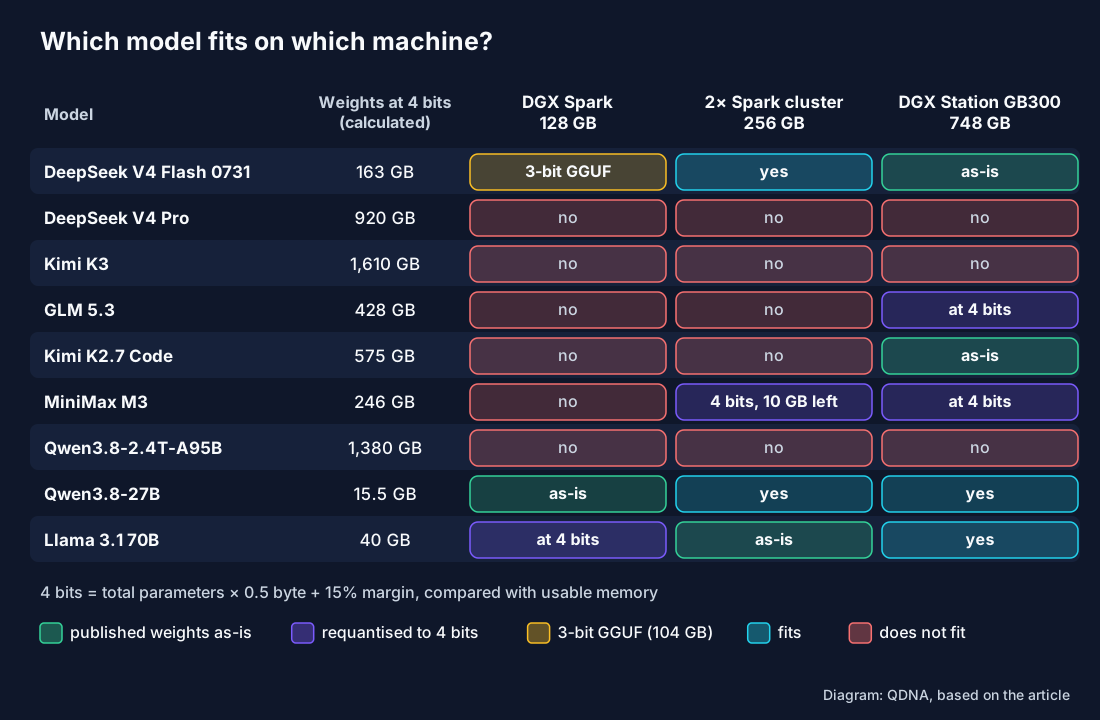
A model fits on a machine if its weights fit in memory with room left for the KV cache. The "at 4 bits" column applies the formula used by the site's sizing pages: total parameters × 0.5 byte, plus a 15% execution margin.
It is compared with the usable memory of each machine: 128 GB (DGX Spark), 256 GB (2× Spark cluster), 748 GB (DGX Station GB300). A "No" means the model exceeds memory even requantised to 4 bits; it says nothing about more aggressive quantisations.
| Model | Weights at 4 bits (calculated) | DGX Spark 128 GB | 2× Spark cluster 256 GB | DGX Station GB300 748 GB |
|---|---|---|---|---|
| DeepSeek V4 Flash 0731 | 163 GB | No at 4 bits; yes as a 3-bit Unsloth GGUF (104 GB), see the DGX guide | Yes | Yes, published weights as-is (167 GB) |
| DeepSeek V4 Pro | 920 GB | No | No | No (920 GB > 748 GB) |
| Kimi K3 | 1,610 GB | No | No | No (1,561 GB published > 748 GB) |
| GLM 5.3 | 428 GB | No | No | Yes at 4 bits |
| Kimi K2.7 Code | 575 GB | No | No | Yes, published weights as-is (595 GB) |
| MiniMax M3 | 246 GB | No | Yes at 4 bits, only 10 GB of headroom | Yes at 4 bits |
| Qwen3.8-2.4T-A95B | 1,380 GB | No | No | No (1,380 GB > 748 GB) |
| Qwen3.8-27B | 15.5 GB | Yes, published weights as-is (56 GB) | Yes | Yes |
| Llama 3.1 70B Instruct | 40 GB | Yes at 4 bits | Yes, published weights as-is (141 GB) | Yes |
Reading: three frontier-class models fit on a DGX Station GB300: DeepSeek V4 Flash 0731 without requantising, GLM 5.3 and Kimi K2.7 Code at 4 bits. On a cluster of two DGX Spark, DeepSeek V4 Flash 0731 remains the only model of that class that fits with reasonable headroom for the KV cache; the detail per quantisation (concurrent users by context length) is in our DeepSeek V4 Flash guide for DGX Station and 2× Spark cluster. Kimi K3, DeepSeek V4 Pro and Qwen3.8-2.4T-A95B need a multi-GPU machine with more than 900 GB of memory, which puts them outside a single-node deployment.
Open weight models comparison by use case
Reading: for local deployment on a DGX Station GB300, the default choice is DeepSeek V4 Flash 0731 (167 GB published, 1,048,576-token context, cost per million tokens [TO BE MEASURED] on that machine for lack of a published throughput; €9.4/M in the median assumption on a DGX Spark according to our calculation).
| Use case | Recommended model | Justification |
|---|---|---|
| Coding agents, software engineering | DeepSeek V4 Flash 0731 | Scores published by DeepSeek on the model card: Terminal Bench 2.1 82.7%, NL2Repo 54.2%, DeepSWE 54.4%, Toolathlon-Verified 70.3%. Context 1,048,576, 167 GB published. |
| General-purpose chat on-premises | DeepSeek V4 Flash 0731 or GLM 5.3 | Both fit on a DGX Station GB300 with a one-million-token context; GLM 5.3 needs a 4-bit conversion (756 GB published in FP8; official nvidia/GLM-5.3-NVFP4 conversion, 464 GB, since 14 September 2026). |
| Specialised coding assistant | Kimi K2.7 Code | 1,000 billion parameters, 32 active, 262,144-token context, 595 GB published that fit as-is on a DGX Station. |
| General reasoning, precision | Claude Opus 5.5 (closed API) | Knowledge and reasoning exams remain the ground of proprietary models; their vendors do not publish scores on the same benchmarks as open models, so we do not compare them. |
| Compact model (small business, workstation) | Qwen3.8-27B | 27 billion dense parameters, 56 GB in BF16, 15.5 GB at 4 bits, 262,144-token context, Apache 2.0. See Qwen3.8-27B on-premises. |
| Fine-tuning on domain data | DeepSeek V4 Flash 0731 | Open weights under MIT; fine-tuning recipe documented by Unsloth. |
| Sensitive data, GDPR, HDS, SecNumCloud | DeepSeek V4 Flash 0731 on-premises | Open weights, on-site execution, no data transfer, no vendor rate limit or withdrawal. |
| Tight budget, low volume | DeepSeek API V4 Flash 0731 | No hardware investment; price to be read on the DeepSeek price list, which distinguishes peak and off-peak hours. |
| Largest open model | Kimi K3 | 2,800 billion parameters, 104 active, 1,048,576-token context, native vision; 1,561 GB published, out of reach of a single-node machine. See the Kimi K3 page. |
For a DGX Spark 128 GB, DeepSeek V4 Flash 0731 as a 3-bit GGUF (104 GB) or Qwen3.8-27B without requantising. For API use without hardware, DeepSeek API V4 Flash 0731.
How do open weight models compare by 3-year total cost of ownership (TCO)?
The amounts below are limited to what can be computed from public sources: hardware at the reference price, for the PNY DGX Spark €7,000 excl. VAT, the price used from October 2026 after the observed increase (LDLC.pro reading of 26 September 2026: €5,083 excl. VAT).
Electricity is counted over three years at the rated power of the NVIDIA sheet, an upper-bound assumption (240 W × 8,760 h × 3 = 6,307 kWh; ServeTheHome measures 60 to 200 W under load) at EDF's regulated Tarif Bleu for professionals, Base option, grid of August 1, 2026 (€0.1624/kWh excl. VAT, CRE deliberation 2026-147), hence 7,000 + 1,024 ≈ €8,000 excl. VAT for one Spark and twice that, €16,000 excl. VAT, for two.
For the DGX Station, €150,000 excl. VAT, the price used from October 2026 after the observed increase (Exxact Valence configuration at pi3g, page dated September 14, 2026: €95,000 excl. VAT; €88,000 to €110,500 excl. VAT depending on the OEM), plus 1,600 W × 8,760 h × 3 = 42,048 kWh, i.e. ≈ €156,800 excl. VAT. Integration, operations and training are quoted separately and are not included. These amounts depend on the machine, not on the model.
A "Does not fit" cell refers to the hardware table above. The cost per million tokens is only calculated for DeepSeek V4 Flash 0731, the only model with a third-party throughput published with its conditions on a DGX Spark; on a DGX Station no throughput is published: [TO BE MEASURED]. For the others it is not calculated.
| Model | DGX Spark 128 GB (hardware + electricity, 3 years, excl. VAT) | 2× Spark cluster 256 GB (hardware + electricity, 3 years, excl. VAT) | DGX Station GB300 748 GB (3 years) | Cost per million tokens |
|---|---|---|---|---|
| DeepSeek V4 Flash 0731 | ≈ €8,000 excl. VAT (3-bit GGUF) | ≈ €16,000 excl. VAT | ≈ €156,800 excl. VAT | €9.4/M on a DGX Spark in the median assumption (30 tokens/s, 30% load), €2.4 to €42/M depending on throughput and load; [TO BE MEASURED] on a DGX Station (calculation and sources) |
| DeepSeek V4 Pro | Does not fit | Does not fit | Does not fit | Not calculated |
| Kimi K3 | Does not fit | Does not fit | Does not fit | Not calculated |
| GLM 5.3 | Does not fit | Does not fit | ≈ €156,800 excl. VAT (4 bits) | Not calculated |
| Kimi K2.7 Code | Does not fit | Does not fit | ≈ €156,800 excl. VAT | Not calculated |
| MiniMax M3 | Does not fit | ≈ €16,000 excl. VAT (4 bits, little headroom) | ≈ €156,800 excl. VAT (4 bits) | Not calculated |
| Qwen3.8-2.4T-A95B | Does not fit | Does not fit | Does not fit | Not calculated |
| Qwen3.8-27B | ≈ €8,000 excl. VAT | ≈ €16,000 excl. VAT | ≈ €156,800 excl. VAT | Not calculated |
| Llama 3.1 70B Instruct | ≈ €8,000 excl. VAT (4 bits) | ≈ €16,000 excl. VAT | ≈ €156,800 excl. VAT | Not calculated |
Reading: the cheapest machine that serves a frontier-class model is the cluster of two DGX Spark with DeepSeek V4 Flash 0731. The DGX Station GB300 adds GLM 5.3 and Kimi K2.7 Code. A single DGX Spark is limited to DeepSeek V4 Flash 0731 requantised to 3 bits, to Qwen3.8-27B and to Llama 3.1 70B at 4 bits.
Open weight models comparison by licence and sovereignty
The conditions below were read in each repository's LICENSE file on September 1, 2026. A licence with conditions does not rule out an enterprise deployment; it imposes an attribution, a threshold or a prior agreement that you need to know before signing.
| Model | Licence | Specific conditions | Local execution (DGX Station 748 GB) |
|---|---|---|---|
| DeepSeek V4 Flash 0731 | MIT | None | Yes |
| DeepSeek V4 Pro | MIT | None | No (920 GB at 4 bits) |
| Kimi K3 | Kimi K3 License | Separate agreement with Moonshot AI for a model-as-a-service operator whose revenue exceeds $20M over twelve months; "Kimi K3" attribution above 100 million monthly active users or $20M monthly revenue. | No (1,561 GB published) |
| GLM 5.3 | GLM-5.3 | Z.ai's own licence, to be re-read in the repository; GLM 5.2, same base, remains published under MIT | Yes at 4 bits |
| Kimi K2.7 Code | Modified MIT | "Kimi K2.7 Code" attribution above 100 million monthly active users or $20M monthly revenue. | Yes |
| MiniMax M3 | MiniMax Community | Non-commercial use free; commercial use requires the "Built with MiniMax M3" attribution, a notice to MiniMax, and written authorisation above $20M yearly revenue. | Yes at 4 bits |
| Qwen3.8-2.4T-A95B | Qwen3.8-Max | Attribution above 100 million monthly active users or $20M in monthly revenue; separate agreement for a model-as-a-service or AI-assistant operator whose revenue exceeds $50M over twelve months. | No (1,380 GB at 4 bits) |
| Qwen3.8-27B | Apache 2.0 | None | Yes |
| Llama 3.1 70B Instruct | Llama 3.1 Community | "Built with Llama" attribution and a copy of the licence on redistribution; specific licence to request from Meta above 700 million monthly active users. | Yes |
Reading: for sovereignty and GDPR, HDS or SecNumCloud compliance, the permissively licensed, unconditional models that fit on a DGX Station are DeepSeek V4 Flash 0731 (MIT) and Qwen3.8-27B (Apache 2.0); GLM 5.3 fits at 4 bits under Z.ai's GLM-5.3 licence, and GLM 5.2, the same base published under MIT, remains available. The Kimi, MiniMax and Llama licences remain compatible with an internal enterprise deployment, whose 100 or 700 million user thresholds are not reached, but they must be re-read before any commercial use.
Conclusion: which open weight model for which use case
The conclusion matches each use case with the open weight model that fits the target hardware: DeepSeek V4 Flash 0731 for code and sensitive data, GLM 5.3 for long context, Kimi K2.7 Code for the specialised assistant.
| Use case | Recommended model | Justification |
|---|---|---|
| Coding agents, software engineering | DeepSeek V4 Flash 0731 | Terminal Bench 2.1 82.7%, NL2Repo 54.2%, DeepSWE 54.4% (scores published by DeepSeek), 1,048,576-token context, fits on DGX Station and 2× Spark cluster. |
| General reasoning, precision | Claude Opus 5.5 (closed API) | Ground of proprietary models; no scores published on the same benchmarks, so no numeric comparison. |
| Sensitive data, GDPR, HDS, SecNumCloud | DeepSeek V4 Flash 0731 on-premises | Unconditional MIT, on-site execution, no data transfer. |
| General-purpose chat with a one-million-token context | GLM 5.3 or DeepSeek V4 Flash 0731 | Both fit on a DGX Station GB300; GLM 5.3 at 4 bits, DeepSeek as-is. |
| Specialised coding assistant | Kimi K2.7 Code | 595 GB published that fit as-is on a DGX Station, 262,144-token context, modified MIT. |
| Tight budget, low volume | DeepSeek API V4 Flash 0731 | No investment or maintenance; price on the vendor's list. |
| Largest open model | Kimi K3 | 2,800 billion, 104 active, 1,048,576 tokens, native vision; 1,561 GB published, multi-GPU required. |
| Compact model (small business, workstation) | Qwen3.8-27B | 27 billion dense, 56 GB in BF16, 15.5 GB at 4 bits, Apache 2.0, fits on a DGX Spark or a single card. |
References
- DeepSeek V4 Flash 0731, official Hugging Face repository
- DeepSeek V4 Pro, official Hugging Face repository
- Kimi K3, official Hugging Face repository (model card, config.json, licence)
- GLM 5.3, official Hugging Face repository and Z.ai GLM-5 README (744B-A40B)
- Kimi K2.7 Code, official Hugging Face repository
- MiniMax M3, official Hugging Face repository
- Qwen3.8-2.4T-A95B, official Hugging Face repository
- Qwen3.8-27B, official Hugging Face repository
- Llama 3.1 70B Instruct, official Hugging Face repository and Llama 3.1 model card (Meta, GitHub)
- Artificial Analysis, open-weight models (Intelligence Index v4.1.1, consulted September 1, 2026)
- DeepSeek API price list
- Unsloth, DeepSeek V4 documentation
- QDNA page: DeepSeek V4
- QDNA page: Kimi K3
- QDNA page: vLLM
- QDNA page: DGX Station
- QDNA page: DGX Spark
Frequently asked questions
What is the best open weight model for local deployment in 2026?
For a single-node deployment, DeepSeek V4 Flash 0731: 284 billion parameters of which 13 active, a 1,048,576-token context, 167 GB of weights published in FP4 and FP8, MIT licence. It is the only frontier-class model whose published weights fit as-is on a DGX Station GB300 and, quantised, on a cluster of two DGX Spark. On the agentic benchmarks DeepSeek publishes (Terminal Bench 2.1 82.7%, NL2Repo 54.2%), it leads the same vendor's Pro version.
What is the difference between DeepSeek V4 Flash 0731 and V4 Pro?
V4 Flash 0731 totals 284 billion parameters of which 13 active per token; V4 Pro totals 1,600 of which 49 active. Both have a native context of 1,048,576 tokens and an MIT licence. Published weights are 167 GB for Flash and 865 GB for Pro: Flash fits on a DGX Station GB300, Pro does not. On the agentic benchmarks published by DeepSeek (Terminal Bench 2.1, NL2Repo, DeepSWE, Toolathlon), Flash 0731 leads the April Pro preview; the Pro 0813 revision of 13 August 2026 has since published 87.9 on Terminal Bench 2.1 (Z.ai harness).
Which open weight model fits on a DGX Spark 128 GB?
Without requantising, Qwen3.8-27B (56 GB in BF16). At 4 bits, Llama 3.1 70B (about 40 GB, calculated as 70 billion × 0.5 byte plus a 15% margin). DeepSeek V4 Flash 0731 only fits as a 3-bit GGUF (104 GB, Unsloth build), leaving 24 GB for the KV cache. GLM 5.3, Kimi K2.7 Code, MiniMax M3, Kimi K3, DeepSeek V4 Pro and Qwen3.8-2.4T-A95B exceed 128 GB even at 4 bits.
Which open weight model fits on a DGX Station GB300?
With 748 GB of usable memory: DeepSeek V4 Flash 0731 (167 GB published) and Kimi K2.7 Code (595 GB published) as-is; GLM 5.3 (428 GB at 4 bits) and MiniMax M3 (246 GB at 4 bits) after requantising; Qwen3.8-27B and Llama 3.1 70B easily. Kimi K3 (1,561 GB published), DeepSeek V4 Pro (920 GB at 4 bits) and Qwen3.8-2.4T-A95B (1,380 GB at 4 bits) do not fit.
Why does the table give neither scores nor API prices?
Vendor-published scores are measured under conditions that differ from one vendor to the next and cannot be compared; the independent Artificial Analysis index did not cover every model in the table on the consultation date (September 1, 2026). API prices change without notice and are read on each vendor's price list. We prefer a missing column to an unverifiable value.