GLM-5.3-Flash on a Mac Studio M5 Ultra: 320 billion parameters within 512 GB
A model of 320 billion parameters fits on a desktop machine, at 8-bit and with no quantisation compromise, because thirty-four of its forty-five layers accumulate no cache. Here is the sizing, the context actually served and the calculated throughput.
An architecture built for long context
The card published by Z.ai states 320 billion parameters in total for 18 billion active per token, under an MIT licence, which remains rare at this scale and permits commercial use as well as redistribution.
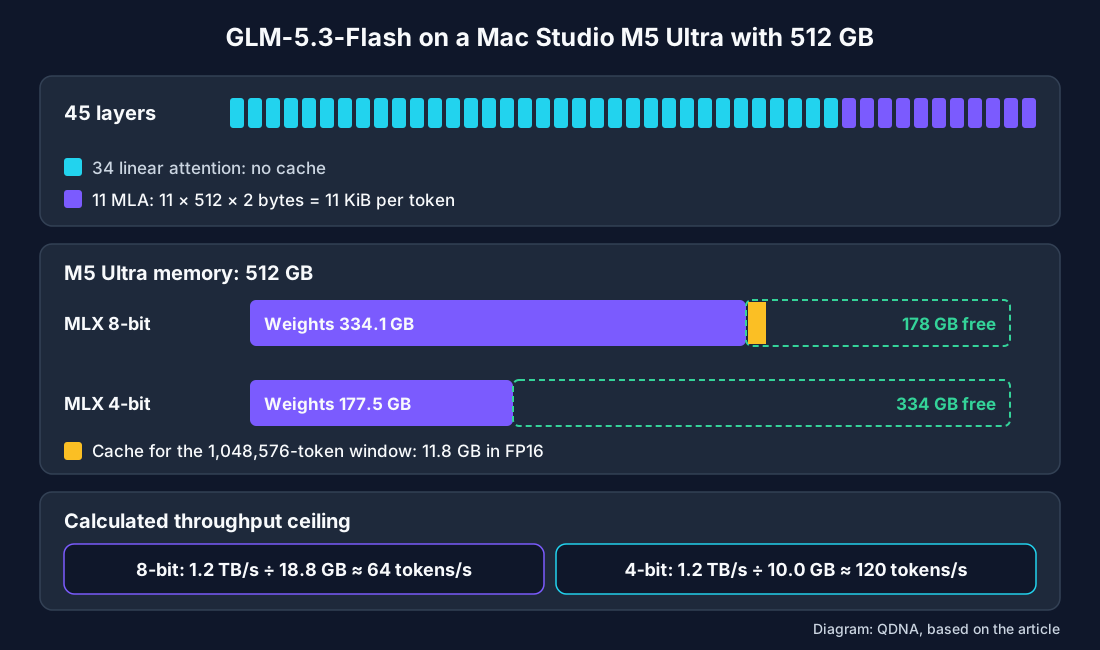
The config.json supplies the rest, namely forty-five layers of which thirty-four use linear attention and eleven use MLA sparse attention, with routing to eight experts out of two hundred and eighty-eight plus one shared expert.
The decisive point for sizing lies in the kv_lora_rank value, set to 512. Latent attention does not store separate keys and values but a single compressed vector per layer and per token, which cuts the cache by an order of magnitude compared with classic attention. The window declared in the configuration reaches 1,048,576 tokens.
What it weighs under MLX
As with other models of this size, no conversion comes from the mlx-community organisation, and the available versions are published by individual contributors. The sizes below are read from the published files rather than derived from the parameter count.
| Conversion | Weights on disk | Free on 512 GB |
|---|---|---|
| MLX 8-bit | 334.1 GB | 178 GB |
| MLX 4-bit | 177.5 GB | 334 GB |
The 8-bit version faithfully reproduces the native FP8 format of the original weights, which makes it the quality reference, and it still leaves 178 GB for cache and system. The 4-bit version halves the footprint and doubles theoretical throughput, at the cost of a degradation that must be measured on your own tasks rather than assumed.
How much context actually fits
Only eleven layers carry a cache, and each of them stores no more than a latent of 512 values per token, which gives 11 × 512 × 2 bytes = 11,264 bytes, i.e. 11 KiB per token in FP16.
FP8 halves that to 5.5 KiB, excluding the DSA indexer keys (128 bytes per layer, 1.4 KiB more).
Set against the declared window of more than a million tokens, the result is surprising.
Updated on 26 September 2026: Mac Studio M5 Ultra availability re-read on 26 September 2026: shipping since 22 September in 96 and 256 GB, 512 GB option still announced for late October, no reproducible independent measurement published.
Updated on 2 September 2026: values re-read against the config.json of the zai-org/GLM-5.3-Flash repository (45 layers, 34 linear and 11 DSA, kv_lora_rank 512, 288 routed experts plus one shared, 1,048,576 window) and against the safetensors of the cited conversions (334.1 and 177.5 GB); no value changed, the cache formula is now written out.
| Context | FP16 cache | FP8 cache |
|---|---|---|
| 262,144 tokens | 3.0 GB | 1.5 GB |
| 1,048,576 tokens (declared window) | 11.8 GB | 5.9 GB |
Even at 8-bit, where the weights already consume 334 GB, the remaining 178 GB would cover close to sixteen million tokens of FP16 cache. The model window is therefore reached long before the machine limit, which overturns the intuition inherited from full-attention architectures, where long context was paid for in tens of gigabytes.
The throughput you can expect
The calculation follows the same rule as for any mixture-of-experts model, since only the active parameters are reread on every token. The measured sizes give 1.044 byte per parameter at 8-bit and 0.555 at 4-bit, which leads directly to the two ceilings set out below.
| Conversion | Read per token | Arithmetic ceiling |
|---|---|---|
| MLX 8-bit | 18.8 GB | ~64 tokens/s |
| MLX 4-bit | 10.0 GB | ~120 tokens/s |
These values divide the 1.2 TB/s bandwidth of the M5 Ultra by the volume reread, and they are therefore calculations rather than readings. Observed throughput generally lands between sixty and eighty per cent of such a ceiling, and the gap between the two quantisations shows above all that the choice is between output quality and speed, not between fitting and not fitting.
Against Qwen3.8-Flash-Next
Both models target the same machine and adopt the same hybrid architecture idea, but they do not make the same trade. Qwen activates six billion parameters and tops out around 320 tokens per second, whereas GLM activates eighteen and tops out at 120 at 4-bit, the speed gap being paid for in reasoning capacity.
Our dedicated article covers the first case, on Qwen3.8-Flash-Next served under MLX.
The caveats
The 512 GB configuration of the Mac Studio M5 Ultra is still announced for the end of October 2026 (Apple France page re-read on 26 September); the 96 and 256 GB models have shipped since 22 September, with no reproducible independent measurement published to date, which explains why this article confines itself to calculations.
The official model card is otherwise sparse in detail, since it publishes neither the layer count, nor the file sizes, nor the context window, all values we read from the repository configuration.
Frequently asked questions
Does GLM-5.3-Flash fit on a Mac Studio M5 Ultra?
Yes, in the 512 GB configuration. The 8-bit MLX conversion weighs a measured 334.1 GB and leaves 178 GB for cache and system, while the 4-bit version drops to 177.5 GB. Neither fits on the 96 GB entry machine.
What context length can be served?
The configuration declares a window of 1,048,576 tokens, and the corresponding cache costs only 11.8 GB in FP16, because just eleven of forty-five layers carry a cache and they store no more than a compressed latent of 512 values. Machine memory is therefore never the limiting factor.
Should the 4-bit or the 8-bit conversion be preferred?
The 8-bit version reproduces the native FP8 format of the original weights and serves as the quality reference, at a ceiling of 64 tokens per second. The 4-bit version doubles theoretical throughput and frees 156 GB of memory, but the quality loss must be measured on your own tasks before any commitment.
Under which licence is the model published?
The weights are under an MIT licence, which permits fine-tuning, commercial deployment and redistribution. That is a markedly more permissive licence than those chosen by several competing models of comparable size.