Orchestrating multiple code agents in parallel: the supervisor agent
AI-assisted development is changing shape: we no longer talk to one agent but run a fleet, and soon we will talk to a single agent whose job is to run that fleet for us.

The bottleneck has moved
Not long ago, writing code was the slow step, but line-by-line completion has given way to agents capable of taking on an entire task and coming back with a complete result. The limiting factor is therefore no longer typing: it has moved to coordinating several lines of work at once and reviewing everything that comes out of them.
| Yesterday | Today |
|---|---|
| Code is written line by line | Intent is described, the agent produces |
| One agent, one task, you wait | Several agents progress in parallel |
| Context is kept in your head | Twenty sessions exceed human memory |
| The bottleneck is production | The bottleneck is coordination and review |
The multiplexer that understands agents
The first step is a session manager that knows what an agent is, where classic terminal multiplexers know about windows, tabs and panes, but not agents. A tool built for agentic work shows the state of each session, the one still working and the one waiting for a reply, so that only sessions needing a decision ever get reopened.
The session lives server-side rather than inside a graphical window, so you reconnect from any device, including a phone, and find the same context and the same agents in progress. The workstation then stops being a machine and becomes a persistent state, reachable from anywhere.
How does a supervisor agent delegate to others?
Running twenty sessions solves the slowness but creates another problem, since someone has to remember what each one of them is doing. The next step is therefore to talk to a single agent, the supervisor, and let it manage all the others.
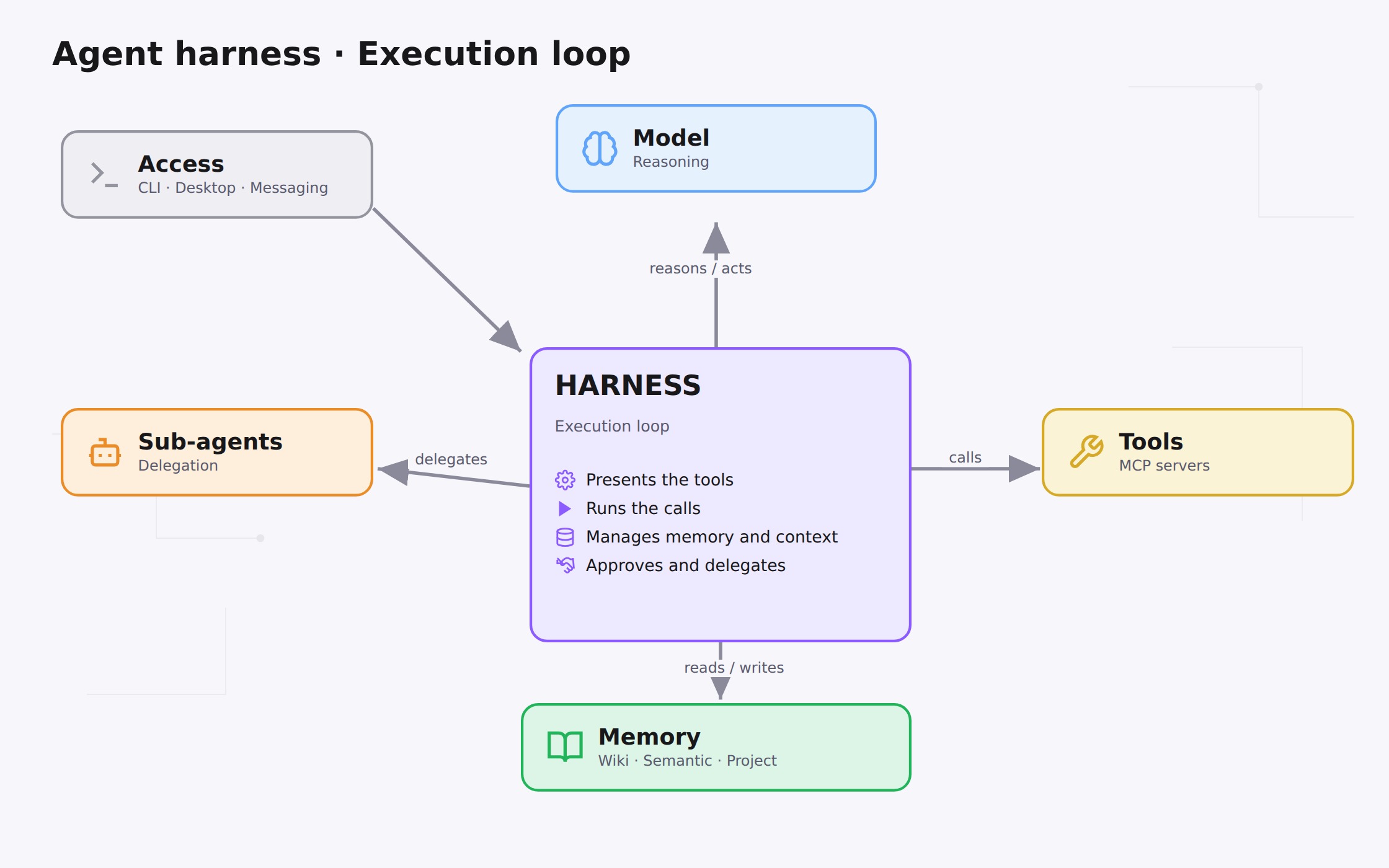
The rule that makes the system work is simple: the supervisor never carries out the task itself, and when asked to check a pending review or track a project's status, it hands the action off to a dedicated sub-agent before immediately becoming available again. If it executed the task itself it would be blocked and unreachable, whereas by delegating it stays a point of contact that listens while the fleet works.
| Role | Function |
|---|---|
| Supervisor agent | Receives intentions, distributes work, tracks progress, never executes itself |
| Sub-agent | Handles an isolated task with its own context, returns a result |
| Session manager | Makes each agent's state visible and lets you drop into a session when needed |
| Shared memory | Keeps project context so the supervisor knows what is being discussed |
A single point of contact, the fleet in the background
The comfort comes down to one point: you stay in idea mode, since dropping a thought, a question or an intention is enough for the supervisor to chain the necessary steps without you having to spell them out.
A project among twenty public repositories no longer even needs to be opened by hand, the supervisor knowing which repository matches which name and routing the request to the right place.
You can always drop down into a specific session, like a manager speaking directly to a team member instead of going through the project lead, opening a task's view to understand why it is stalling. But that remains the exception rather than the daily routine.
How do you trust autonomous agents?
Delegating this much cannot be decreed, because at first the supervisor routes tasks poorly, or two sub-agents work on the same thing and step on each other. Trust comes from observing, correcting the process and tightening the delegation rules, and it is earned gradually, up to the point where routing becomes reliable and you stop watching every step.
The right question is no longer "which agent do I launch", but "who do I talk to so everything else coordinates itself".
Why does review become the new bottleneck once production is no longer the constraint?
Once production is no longer the constraint, review becomes it, because validating thousands of lines written by agents, without shipping sloppy code, requires a review as serious as a human's.
An automated review layer that understands the whole repository, pulls context from tickets and documentation, and runs analyzers and security scanners filters out most of the noise, but human oversight of sensitive changes remains mandatory, which Article 14 of Regulation (EU) 2024/1689 requires for high-risk AI systems and prudence extends to the rest.
This architecture is not confined to software development, since the same pattern, a supervisor orchestrator delegating to specialized sub-agents on top of shared memory, structures an enterprise agentic platform. It rests on the harness, the execution loop that gives the model its tools and guardrails.
Sources: OpenCode for the harness and inter-agent delegation, and the LiteLLM documentation for the gateway enforcing per-agent quotas. On routing between models, see RouteLLM.
Frequently asked questions
Why run several code agents in parallel?
An agent takes time to finish. Several sessions make progress on several fronts at once, and the developer moves from doing the work to coordinating it.
What is a supervisor agent?
A single agent you talk to, which delegates every task to a dedicated sub-agent. It never executes the task itself, so it always stays available.
Should everything be handed to the supervisor from day one?
No. Trust is built through observation and by adjusting the delegation rules, until routing becomes reliable.
What is the new bottleneck?
Reviewing the code that gets produced. A review layer that understands the repository and runs the analyzers filters out the noise, but human validation of sensitive changes remains mandatory.
Go further
To go further, three articles extend this one: the move from a chatbot to an agentic platform, the anatomy of the agent harness, and coding with AI on a local model through LiteLLM.