Qwen3.8-Max-Preview: 2.4 trillion parameters, and open questions
In July Alibaba teased a giant multimodal model, days after the release of Kimi K3, with neither a technical report nor an independent benchmark. Since August 8, 2026, the base model weights are public on Hugging Face. Here is what we knew, what has been published since, and what it changes for local deployment.
Updated on 26 September 2026: the full version has shipped: Qwen3.8-Max generally available on the Alibaba API since 3 August 2026 ($2 and $6 per million tokens), Max-0902 revision on 2 September, Artificial Analysis index v4.3.2.
Updated on 1 September 2026: the base model Qwen/Qwen3.8-2.4T-A95B has been public on Hugging Face since 8 August 2026 (2.4 trillion parameters, 95 billion active, Qwen3.8-Max licence). The passages stating that the weights were not published are corrected; the multimodal Max version remains API-only.

What is this about?
On 19 July 2026, Alibaba's Qwen team presented Qwen3.8-Max-Preview, the next iteration of its "Max" range. The model reportedly handles text, images, video and documents, and Alibaba claims a size of 2.4 trillion parameters and a position just behind the best models on the market on its own evaluations.
The preview was open to developers at 10% of the standard rate through the Token Plan; the full version has been generally available since 3 August 2026 on the Alibaba Cloud Model Studio API ($2 per million input tokens, $6 output, $0.25 cached input), with a Qwen3.8-Max-0902 revision published on 2 September 2026.
Every figure calls for caution: this is a commercial announcement rather than a scientific publication, and no technical report accompanies the preview, and no independent team has been able to measure the model.
A mixture of experts at very large scale
Like the previous "Max" models, the architecture relies on a sparse mixture of experts: the network contains a large number of experts, and a router activates only a small fraction of them for each token. You get the capacity of a giant model at a lower compute cost per request.
The open models we recommend, such as DeepSeek V4, Kimi K3 or MiniMax M3, follow the same principle at a documented scale.
The number of active parameters of Qwen3.8-Max had not been communicated in July; the Hugging Face model card published in August gives it: 95 billion active out of 2.4 trillion, with 512 experts of which 10 routed and 1 shared are active on each token. That is the figure that determines the real inference cost, the latency and the memory sizing. Our guide on inference hardware explains why this number drives everything else.
Performance figures to handle with caution
No benchmark table accompanied the July preview. The Hugging Face card of the base model, re-read on 2 September 2026, publishes one for Qwen3.8-Max, produced by Alibaba and not reproduced by a third party; here are six of its rows, the Terminal Bench 2.1 score being measured with Claude Code (average of ten runs, five-hour timeout).
| Benchmark | Qwen3.8-Max score (vendor card) |
|---|---|
| Terminal Bench 2.1 | 86.6 |
| SWE-bench Pro | 67.7 |
| Toolathlon Verified (Pass@1) | 72.5 |
| GPQA Diamond | 92.6 |
| Humanity's Last Exam (no tools) | 43.6 |
| IFBench | 82.8 |
Source: Qwen/Qwen3.8-2.4T-A95B card, "Qwen3.8-Max" column. These scores are the vendor's, obtained on its own harness; they compare with each other, not with figures published elsewhere under other settings.
An announcement in a tight race
The preview lands days after Moonshot's open-weight launch of Kimi K3. The timing is no accident, since Chinese labs multiply frontier-model announcements to occupy the field and attract developers, and teasing a 2.4-trillion-parameter model before any documentation is as much communication as product release.
What we know, what we do not
The table separates what Alibaba announced on 19 July from what the base model's Hugging Face card, re-read on 1 September 2026, has published since.
| Item | Announced in July 2026 | Published since (Hugging Face model card) |
|---|---|---|
| Name | Qwen3.8-Max-Preview, preview live since 19 July 2026 | Base model Qwen3.8-2.4T-A95B, repository created on 8 August 2026; Qwen3.8-Max is its "official version" served by the API |
| Parameters | 2.4 trillion, active count not communicated | 2.4 trillion of which 95 billion active; 512 experts, 10 routed + 1 shared per token; 92 layers |
| Modalities | Text, image, video, document | Base model is text only; image input is reserved for the Max version on the API |
| Context | Not communicated | 262,144 tokens natively, extensible to 1,010,000 per the model card; 1 million by default on the API |
| Weights and licence | Not published, no licence announced | 4,892 GB of safetensors in BF16; "Qwen3.8-Max" licence: attribution required above 100 million monthly active users, separate agreement for a model-as-a-service operator above $50M revenue over twelve months |
| Technical report | None | Still none; the model card points to Alibaba's blog post |
| Independent benchmarks | None | The model is listed on the Artificial Analysis index v4.3.2 (consulted 26 September 2026, Qwen3.8 Max at 45 points); the scores on the model card remain Alibaba's own |
What does Qwen3.8-Max-Preview change for local deployment?
Publishing the weights changes the model's status, not its scale. A 2.4-trillion-parameter model weighs 4,892 GB as published in BF16, and about 1,380 GB requantised to 4 bits (calculated as 2.4 trillion × 0.5 byte plus a 15% margin).
No single-node machine in the catalogue can hold it: the DGX Station GB300 tops out at 748 GB. It takes a multi-GPU cluster with several terabytes of memory, which remains out of reach of nearly every organisation. For the vast majority of uses, access therefore still goes through Alibaba's API, with the data-location and control questions that raises. Our comparison on-premises or API covers this trade-off.
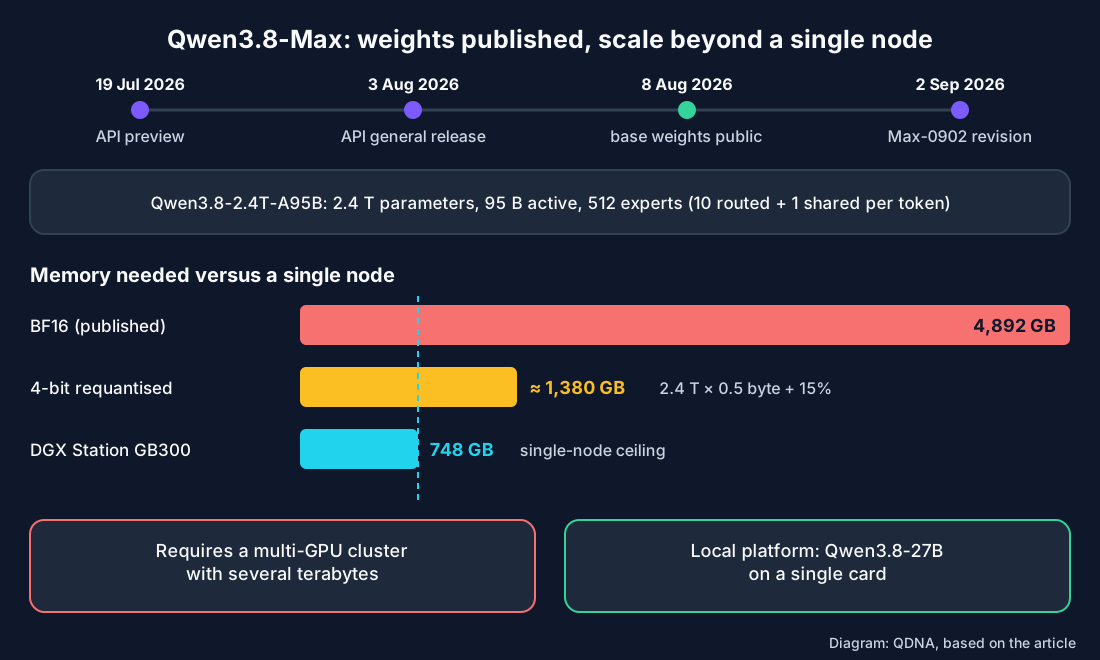
What really changes is legibility: the active parameters, the native context and the licence are now published and verifiable in the repository, which allows honest sizing instead of guessing. A local platform is built on models whose specification is published, whose weights can be downloaded, and which fit on the target machine: the version is pinned, the hardware is sized to the actual need and the behaviour stays stable over time. Our open-source LLM comparison lists these models; in the Qwen range, Qwen3.8-27B (27 billion parameters, Apache 2.0, 262,144 tokens) fits on a single card, and Qwen3.8-Flash-Next on a Mac Studio.
Frequently asked questions
What is Qwen3.8-Max-Preview?
A preview of Alibaba's flagship model, presented on 19 July 2026: a multimodal mixture-of-experts model with 2.4 trillion parameters, accessible through Alibaba's API. Since 8 August 2026, the base model Qwen3.8-2.4T-A95B (text only, 95 billion active parameters) is published on Hugging Face; Qwen3.8-Max is the version served by the API, with image input and a one-million-token context by default.
Can Qwen3.8-Max be deployed locally?
The base model Qwen3.8-2.4T-A95B, yes on paper: its weights are public under the Qwen3.8-Max licence, which allows commercial use under conditions. In practice, 2.4 trillion parameters weigh 4,892 GB in BF16 and about 1,380 GB at 4 bits, which exceeds any single-node machine (748 GB for a DGX Station GB300) and requires a multi-GPU cluster with several terabytes. The multimodal Max version only exists on Alibaba's API.
Are the figures announced by Alibaba verified?
The size now is: the Hugging Face model card publishes 2.4 trillion parameters of which 95 billion active, and the repository counter measures 2,446 billion tensor elements. The positioning against competing models still rests on scores published by Alibaba, with no technical report; the independent Artificial Analysis index has listed the model since August 2026.
Which Qwen models can be deployed on-premises?
The open-weight Qwen models that fit on the target machine: Qwen3.8-27B (27 billion parameters, Apache 2.0, 262,144-token context) on a single GPU card or a workstation, Qwen3.8-Flash-Next on a Mac Studio. Their specification is published, which allows precise hardware sizing and a platform that stays stable over time.