
ASRock AI BOX-A395 + Qwen3.8-27B: 256K context on Strix Halo 128 GB
The ASRock AI BOX-A395 (Ryzen AI Max+ 395, Radeon 8060S, 128 GB of shared LPDDR5X-8000) runs Qwen3.8-27B multimodal locally, and here are the measured throughputs, the KV cache sizing, the native 262k context windows extensible to 1M, the operating-system comparison and the pricing.
Updated on 8 October 2026: AI BOX-A395 price read at MITXPC at $4,299.95 ex-VAT, about €3,771 ex-VAT at the ECB rate of 25 September 2026; DGX Spark raised to €7,000 excl. VAT (€8,400 incl. VAT), the price used from October 2026 after the observed increase, instead of €5,083 excl. VAT; the AI BOX-A395 now sits roughly 46% below it.
Updated on 26 September 2026: the dollar-to-euro conversion now uses the ECB rate of 25 September 2026 (€1 = $1.1403, which puts the AI BOX-A395 at €3,507 before VAT), and the DGX Spark price is taken from LDLC.pro (€5,083 before VAT) instead of the idealo comparator, the ASRock staying roughly 30% below it; independent Sleeping Robots measurement (15 August 2026, 9.6 then 18.0 tok/s with MTP) added to the table.
Updated on September 2, 2026: KV cache recomputed on the 16 full-attention layers of config.json (64 KiB per token, not 256), i.e. 30% of memory at 262k instead of 48%; KyaniteLabs profile re-read (UD-Q4_K_XL, ROCm, 11 to 24 tok/s on real traffic); 0.9 GB vision encoder (mmproj file) instead of 5; Framework, Minisforum and Mac Studio prices read on 2 September 2026, HP price not published; ASRock sheet re-read through LinuxGizmos.
The context
The Strix Halo (Ryzen AI Max+ 395) is a special case in the local LLM landscape: an APU with an Radeon 8060S iGPU (RDNA 3.5, 40 CU) and up to 128 GB of unified LPDDR5X shared between CPU, GPU, and NPU. The same memory serves as VRAM for the iGPU via the GTT (Graphics Translation Table) mechanism.
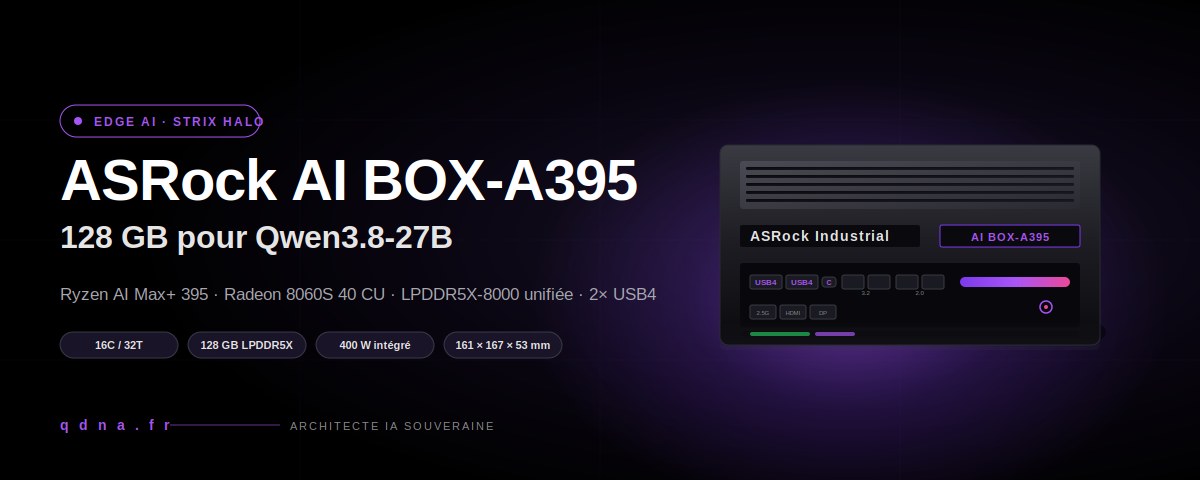
ASRock Industrial has industrialized this chip in the AI BOX-A395, a compact edge AI enclosure, which we evaluated on Qwen3.8-27B, the multimodal vision-language model published by Alibaba/Qwen on August 14, 2026 under the Apache-2.0 licence.
AI BOX-A395 specifications
Sources: ASRock Industrial spec sheet (JavaScript-rendered page, re-read on 2 September 2026 through LinuxGizmos), AMD Ryzen AI Max+ 395 spec sheet (40 CUs, LPDDR5x-8000, 256 GB/s).
| Component | Detail |
|---|---|
| APU | AMD Ryzen AI Max+ 395 (Strix Halo), 16 cores / 32 threads, Zen 5 + Zen 5c, up to 5.1 GHz |
| iGPU | Radeon 8060S, RDNA 3.5, 40 CU, gfx1151 |
| NPU | XDNA 2, ~50 TOPS INT8 |
| Memory | 128 GB LPDDR5X-8000 unified CPU/GPU/NPU (128 GB version) |
| Storage | 2 × M.2 2242/2280 NVMe PCIe Gen4 x4, RAID 0/1 |
| Network | 1 × 10 GbE (Marvell AQC113) + 1 × 2.5 GbE, Wi-Fi 7, Bluetooth 5.4 |
| USB ports | 2 × USB4, 1 × USB-C 3.2 Gen2, 2 × USB-A 3.2 Gen2, 2 × USB-A 2.0 |
| Power supply | AC 100-240 V, 400 W (built-in) |
| Supported OS | Windows 11, Linux (Ubuntu 24.04 LTS, Fedora 41+) |
Qwen3.8-27B: multimodal Apache-2.0
Qwen3.8-27B was published on August 14, 2026 by Alibaba/Qwen, under the Apache-2.0 license. It is a multimodal vision-language model (image + video + text), based on a hybrid Gated DeltaNet (linear attention) + Gated Attention architecture.
| Parameter | Value (config.json) |
|---|---|
| Total parameters | 27 B (dense) |
| Hidden dimension | 5120 |
| Layers | 64 |
| Attention heads (Q) | 24 |
| KV heads (GQA) | 4 |
| Attention head dim | 256 |
| Linear head dim (DeltaNet) | 128 (V:48 heads, QK:16 heads) |
| FFN intermediate | 17,408 |
| Vocab size | 248,320 |
| Native context | 262,144 tokens (extensible to 1,000,000 with YaRN, factor 4, per the Qwen model card; MTP serves speculative decoding, not context) |
| Layer layout | 16 × (3 × (DeltaNet → FFN) → 1 × (Attention → FFN)) |
| Multi-Token Prediction (MTP) | Yes, trained multi-step |
Source: huggingface.co/Qwen/Qwen3.8-27B : config.json verbatim.
ROCm / Vulkan prerequisites
On Strix Halo, two approaches coexist for llama.cpp, and the choice between Vulkan and ROCm decides both how simple the installation is and which serving engine you will be able to run:
- Vulkan (recommended in 2026): native gfx1151 support, no HSA_OVERRIDE_GFX_VERSION needed, generally higher performance than HIP/ROCm. Ollama-vulkan, LM Studio, and llama.cpp Vulkan share the same backend.
- ROCm / HIP: required for vLLM batch serving. ROCm 7.13 officially supports RDNA 3.5 APUs. Always use
HSA_OVERRIDE_GFX_VERSION=11.5.1unless ROCm 7.14+ detects gfx1151 natively.
On Fedora 41+ or Ubuntu 24.04 LTS with kernel 6.13 or newer, rocminfo | grep gfx1151 should return the device, while on Windows 11 vLLM is unavailable but Vulkan works out of the box through LM Studio or Ollama-vulkan.
Sources: ROCm 7.13 Expanding Hardware, llama.cpp Strix Halo build, NixOS Discourse.
Measured benchmarks
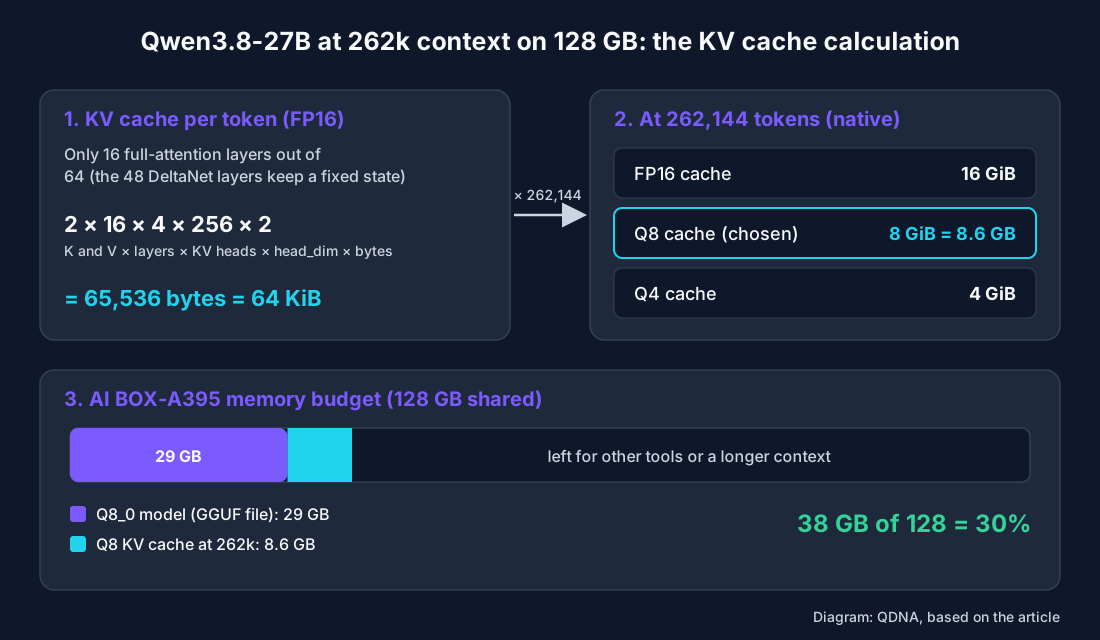
96k is not the machine's ceiling, it is where the published serving profile was measured. The KV cache table below shows the native 262,144-token context fits at 30% of memory (Q8_0 model 29 GB + Q8 KV cache 8 GiB, i.e. 8.6 GB, at 262k = 38 GB of 128).
The throughputs below therefore apply at 96k; at 256K expect a drop proportional to the cache volume re-read, without memory becoming the limiting factor.
Three community sources publish measured benchmarks of Qwen3.8-27B on Strix Halo 128 GB:
| Source | Configuration | Throughput |
|---|---|---|
| kyuz0 (r/LocalLLaMA, Q8/Q4 30k context, llama.cpp; community figure we could not re-read on 2 September 2026, page unreachable) | Qwen3.8-27B Q8 / Q4_K_M | ~208 tokens/s reported (generation, 30k ctx) |
| KyaniteLabs (published serving profile, MTP n12 + ngram speculation, re-read on 2 September 2026) | Qwen3.8-27B UD-Q4_K_XL, llama.cpp ROCm/HIP, q4_0 KV cache, 262,144 context | 59.7 tok/s cold; 148 to 163 tok/s warm on identical reruns (ngram artifact); 11 to 24 tok/s on real traffic (prose), 30 to 40 tok/s (code) |
| Sleeping Robots (post of 15 August 2026, 1 warm-up then 3 measured runs, 256 generated tokens, re-read on 26 September 2026) | Qwen3.8-27B Q6_K (22 GB), llama.cpp Vulkan RADV, Strix Halo 128 GB | 9.6 tok/s without MTP; 18.0 tok/s with MTP (2 draft tokens), 15.2 tok/s with 5; prompt processing 24 to 26 tok/s |
Q4 is faster than Q8 in tokens per second, Q8 being the format closest to the BF16 weights. KyaniteLabs states that its warm figures come from identical reruns and that real conversational traffic falls back to 11 to 24 tok/s: that last figure is the one to size against.
Sources: kyuz0 r/LocalLLaMA benchmark, KyaniteLabs/qwen38-27b-strix-halo.
KV cache and context windows
The KV cache of Qwen3.8-27B only concerns the 16 full-attention layers out of 64 (full_attention_interval = 4 in config.json); the 48 DeltaNet layers keep a fixed-size state. Each has 4 KV heads (GQA, 256 head_dim). Per token, in FP16: 2 × 16 × 4 × 256 × 2 = 65,536 bytes (64 KiB/token).
The 20 August version counted all 64 layers and overstated the cache fourfold.
| Context | FP16 | Q8 | Q4 |
|---|---|---|---|
| 32,768 (32k) | 2.0 GiB | 1.0 GiB | 0.5 GiB |
| 65,536 (64k) | 4.0 GiB | 2.0 GiB | 1.0 GiB |
| 131,072 (128k) | 8.0 GiB | 4.0 GiB | 2.0 GiB |
| 262,144 (262k native) | 16.0 GiB | 8.0 GiB | 4.0 GiB |
With 128 GB shared, the Q8_0 model takes 29.0 GB (Qwen3.8-27B-Q8_0.gguf in the unsloth repository, re-read on 2 September 2026) and the Q8 KV cache at 262k takes 8 GiB (8.6 GB), for 38 GB out of 128, or 30% utilization, which leaves plenty of headroom to run other tools in parallel or to dedicate more memory to the KV cache for longer windows.
Sources: config.json Qwen3.8-27B, kyuz0 amd-strix-halo-toolboxes.
Windows vs Linux
For Qwen3.8-27B multimodal, Vulkan is today the path of least friction, and the following matrix summarizes the available options:
| OS | Backend | vLLM | Recommended use |
|---|---|---|---|
| Windows 11 | Vulkan (LM Studio, Ollama-vulkan, llama.cpp) | ❌ | Interactive development, multimodal |
| Linux (Fedora 41+, Ubuntu 24.04 HWE) | Vulkan or ROCm | ✅ ROCm | Batch serving, multimodal agentic |
For an AI BOX-A395 workstation, Linux Fedora 41+ with kernel 6.14 or newer is the preferred target, with vLLM, llama.cpp Vulkan, ROCm-SMI for monitoring and BIOS access to iGPU allocation, while Windows 11 remains valid for interactive use through LM Studio, without vLLM.
Source: KyaniteLabs/qwen38-27b-strix-halo.
Price comparison
The AI BOX-A395 128 GB is listed at $4,299.95 USD ex-VAT at MITXPC (US integrator, reading of 8 October 2026, "Contact Sales"), up from $3,999 in August 2026, which is about €3,771 ex-VAT at the ECB rate of 25 September 2026 (€1 = $1.1403), before the margin added by the European distribution channel (Avnet, Arrow, MITXPC EU).
The NVIDIA DGX Spark (PNY edition) is at €7,000 excl. VAT, the price used from October 2026 after the observed increase (LDLC.pro reading of 26 September 2026: €5,083 excl. VAT), i.e. €8,400 incl. VAT, which places the ASRock roughly 46% below it.
| Machine | Unified RAM | 2026 indicative price | Use case |
|---|---|---|---|
| ASRock AI BOX-A395 | 128 GB shared LPDDR5X | ~€3,771 ex-VAT ($4,299.95) | Compact edge AI, multimodal local |
| Nvidia DGX Spark | 128 GB unified | €7,000 excl. VAT (€8,400 incl. VAT, price used from October 2026) | CUDA, native vLLM |
| Framework Desktop (DIY, Ryzen AI Max+ 395) | 128 GB | €3,889 incl. VAT, i.e. €3,241 ex-VAT (frame.work, 2 September 2026) | Modular DIY |
| HP Z2 Mini G1a (Ryzen AI Max PRO) | 128 GB | price not published (HP configurator showed no offer on 2 September 2026) | ECC workstation |
| Minisforum MS-S1 MAX (128 GB + 2 TB) | 128 GB | €3,999 incl. VAT, i.e. €3,333 ex-VAT (Minisforum EU store, 2 September 2026, list price €4,999) | Mini-ITX alternative |
| Mac Studio M5 Ultra | 96 GB base, 512 GB announced for late October 2026 | from €6,599 incl. VAT, i.e. €5,499 ex-VAT (apple.com/fr, 2 September 2026) | 1.2 TB/s, faster in pure MLX |
For Qwen3.8-27B multimodal, the AI BOX-A395 sits roughly 46% below the DGX Spark at the price used from October 2026 (€3,771 vs €7,000 excl. VAT), with inverted tradeoffs: the DGX Spark has CUDA and native vLLM, while the AI BOX-A395 has ROCm still being finalized and Vulkan available today. The Mac Studio M5 Ultra, from €6,599 incl. VAT or about €5,499 ex-VAT, costs appreciably more, but it reaches 512 GB of unified memory served at 1.2 TB/s, with weaker vision compatibility.
Sources: MITXPC ($4,299.95 ex-VAT, 8 October 2026), LDLC.pro, PNY DGX Spark (26 September 2026), Framework Desktop (configurator, 2 September 2026), Minisforum MS-S1 MAX (EU store, 2 September 2026), Apple, Mac Studio M5 Ultra (2 September 2026), HP Z2 Mini G1a, LinuxGizmos coverage. Ex-VAT conversions at the 20% VAT rate.
Limits of this article
The tokens/s at 262k context (Qwen3.8-27B native limit) and 1M tokens (YaRN extension) remain to be measured on the AI BOX-A395 specifically. The community publishes regularly on r/StrixHalo and r/LocalLLaMA: as deeper benchmarks arrive (ETA Prime, Phoronix), we update this article.
The AI BOX-A395 is sold through industrial B2B channels, so the catalog price is not public and a quote is required, the market estimates above being provided for indicative purposes only.
Official sources
- ASRock Industrial : AI BOX-A395 (product sheet)
- Qwen/Qwen3.8-27B : Hugging Face (model card)
- unsloth/Qwen3.8-27B-GGUF (quants)
- AMD Ryzen AI Max+ 395
- AMD ROCm 7.13 : Expanding Hardware and Reach
- ROCm system-optimization RDNA 3.5
- llama.cpp : Strix Halo gfx1151 build
- KyaniteLabs/qwen38-27b-strix-halo : tuned serving profile
- Phoronix : ROCm 7.9 Strix Halo early tests
- r/LocalLLaMA : Qwen3.5/3.8 benchmarks Strix Halo
- kyuz0 amd-strix-halo-toolboxes dashboard
Frequently asked questions
Is the ASRock AI BOX-A395 the right choice for Qwen3.8-27B?
Qwen3.8-27B or Qwen3.5-27B-Instruct?
ROCm or Vulkan for llama.cpp?
Which quantization should I choose?
How much does the AI BOX-A395 cost?
Is the ASRock AI BOX-A395 the right choice to run Qwen3.8-27B locally?
Yes, under three conditions. First, Qwen3.8-27B is multimodal (vision + text), not a text-only LLM: Qwen3.5-27B-Instruct remains the choice for text-only workloads. Second, the 128 GB shared LPDDR5X-8000 lets you load the Q8 model (~30 GB) plus a comfortable KV cache for 96k context (3 GiB in Q8 KV, 16 full-attention layers). Third, the Vulkan backend of llama.cpp is today more performant and stable than ROCm/HIP on gfx1151 : start with Vulkan, switch to ROCm if a specific workload demands it.
Why Qwen3.8-27B over another 27B model?
Qwen3.8-27B was published by Alibaba/Qwen on August 14, 2026 under Apache-2.0. It is a multimodal model with a hybrid Gated DeltaNet (linear attention) + Gated Attention mechanism, native context of 262,144 tokens extensible to 1,000,000 with YaRN per the Qwen model card. For local VL, it combines image/video understanding and agentic reasoning that do not exist in text-only Qwen3.5-27B. For text-only, Qwen3.5-27B-Instruct is faster and lighter.
How many tokens per second can be expected on the AI BOX-A395?
Depends on quantization and context. Per kyuz0 (r/LocalLLaMA, Qwen3.5/Qwen3.8 30k context, llama.cpp), Qwen3.8-27B Q8 would reach about 208 tokens per second in generation, a figure we could not re-read on 2 September 2026. Per KyaniteLabs (published serving profile, UD-Q4_K_XL, llama.cpp ROCm, 262,144 context), cold start is 59.7 tokens/s, warm reaches 148 to 163 tokens/s on identical reruns, and real conversational traffic falls to 11 to 24 tokens/s. At 262k context, expect a throughput drop proportional to the cache re-read, not measured on this machine.
Is the ROCm backend required or does Vulkan suffice?
On Strix Halo (gfx1151), Vulkan is today the recommended backend for llama.cpp: no HSA_OVERRIDE_GFX_VERSION override needed, native support, generally higher performance than HIP/ROCm. ROCm 7.13 officially supports RDNA 3.5 APUs, but for llama.cpp or ollama-vulkan, Vulkan remains the path of least friction. For vLLM batch serving, ROCm is mandatory and Linux is required (no Windows vLLM).
What are the prerequisites to install Qwen3.8-27B on the AI BOX-A395?
Three prerequisites. OS: Fedora 41+ or Ubuntu 24.04 LTS with kernel 6.13+ (amdgpu upstream stable for gfx1151), or Windows 11 + Vulkan if you do not need vLLM. Backend: llama.cpp compiled with -DGGML_VULKAN=1 (recommended), vLLM ROCm for batch serving. Model: download Unsloth GGUFs (Q4_K_M for VRAM savings, Q8_0 for quality) from huggingface.co/unsloth/Qwen3.8-27B-GGUF.
How much does the ASRock AI BOX-A395 cost?
The AI BOX-A395 128 GB is listed at $4,299.95 USD ex-VAT at MITXPC (8 October 2026), about €3,771 ex-VAT at the ECB rate of 25 September 2026 (€1 = $1.1403), before European channel margin. The NVIDIA DGX Spark is taken at €7,000 excl. VAT (€8,400 incl. VAT) from October 2026, which places the ASRock roughly 46% below it. Distribution is through industrial B2B channels (Avnet, Arrow, MITXPC EU): no public MSRP, quote required.