Mac Studio M5 Ultra: 512GB at 1.2TB/s, what it changes for a local LLM
Apple announced the Mac Studio M5 Ultra on August 25, 2026. The machine moves to 1.2TB/s of unified memory bandwidth, keeps a 512GB ceiling and starts at $5,499. Here is what those numbers actually buy : and what nobody can claim yet, for lack of any measurement.
Updated on 26 September 2026: measurement status re-read on September 26, 2026, four days after the first deliveries: still no reproducible independent measurement, the circulating figures extrapolate the M3 Ultra.
Updated on 2 September 2026: Qwen3.8-Flash-Next has 180 billion published parameters (125 compute, 51 n-gram embeddings, 4 multi-token prediction, 360 GB in BF16), not 125: it does not fit in 96 GB (111.6 GB measured in 4-bit MLX) and its ceiling becomes 320 tokens/s; GLM 5.3 Flash ceilings are recomputed on the bytes per parameter actually measured on the cited conversions; the 36-core chassis price, which our tools cannot read on the Apple Store, is removed; the gap between Thunderbolt 5 and memory is a factor of 80, not three orders of magnitude; Apple specifications re-read (25 August 2026 press releases, French tech specs).

What Apple announced, official figures
Apple offers two chips with distinct positions: the M5 Max targets the creative workstation, whereas the M5 Ultra is the one that matters for an inference platform, since it remains the only variant that goes beyond 128GB of unified memory.
| M5 Max | M5 Ultra | |
|---|---|---|
| CPU (base) | 18 cores (6 super + 12 performance) | 30 cores (10 super + 20 performance) |
| CPU (configurable) | 18 cores | 36 cores |
| GPU | 32 cores, or 40 as an option | 64 cores, or 80 as an option |
| Neural Engine | 16 cores | 32 cores |
| Memory bandwidth | 460GB/s, or 614GB/s with the 40-core GPU | 1.2TB/s on both variants |
| Unified memory | 36GB, configurable to 48 / 64 / 128GB | 96GB, configurable to 256 or 512GB |
| Storage | 512GB, up to 8TB | 1TB, up to 16TB |
| US price (from) | $2,499 | $5,499 |
| Maximum continuous power | 480W | |
| Availability | September 22, 2026 · 512GB option late October | |
Sources: Apple Mac Studio technical specifications and the Apple Newsroom announcement of August 25, 2026. European pricing starts at €2,999 and €6,599 incl. VAT respectively, recorded on the French Apple Store on August 28, 2026.
Two details in the configuration grid matter more than all the rest, and both are easy to miss when reading a product sheet.
The 256GB and 512GB options are not available on the entry-level configuration. Apple reserves them for the variant fitted with the 36-core CPU and the 80-core GPU, so that a machine billed at $5,499 cannot be taken to 512GB at all: you first have to move up to the higher chassis before paying anything for memory.
Bandwidth does not depend on how much memory you order. The figure of 1.2TB/s is quoted for both M5 Ultra variants, including the 96GB one. That is the opposite of the M5 Max, whose bandwidth only rises from 460 to 614GB/s with the 40-core GPU. For LLM work it means a 96GB M5 Ultra delivers the same generation throughput as a 512GB one : on the models that fit in 96GB.
1.2TB/s: the only figure that decides output throughput
Serving a language model means two distinct regimes, and they do not depend on the same component. We covered this in prefill, decode and KV cache: which hardware for an LLM; the M5 illustrates the split almost caricaturally.
Apple writes it plainly in its own research publication: "generating the first token is compute-bound", while "generating subsequent tokens is bounded by memory bandwidth, rather than by compute ability". The Neural Accelerators built into the M5 GPU therefore massively speed up the prefill phase, and much less the generation phase.
Apple's published measurements, M5 against M4, give the order of magnitude:
| Model | Format | First token (TTFT) | Generation | Memory |
|---|---|---|---|---|
| Qwen3-1.7B | BF16 | × 3.57 | × 1.27 | 4.40 GB |
| Qwen3-8B | BF16 | × 3.62 | × 1.24 | 17.46 GB |
| Qwen3-8B | 4-bit | × 3.97 | × 1.24 | 5.61 GB |
| Qwen3-14B | 4-bit | × 4.06 | × 1.19 | 9.16 GB |
| Qwen3-30B-A3B | 4-bit | × 3.52 | × 1.25 | 17.31 GB |
| gpt-oss-20b | MXFP4-Q4 | × 3.33 | × 1.24 | 12.08 GB |
Source: Apple Machine Learning Research, "Exploring LLMs with MLX and the Neural Accelerators in the M5 GPU". Method: 4,096-token prompt, 128 tokens generated, MLX. These measurements compare an M5 to an M4 on MacBook Pro, not an M5 Ultra to an M3 Ultra. They describe the behaviour of the architecture, not the performance of the machine this article is about.
The ratio is spectacular in one column and modest in the other: up to four times faster on the first token, a fifth to a quarter better on everything after. And the gap is explained entirely by bandwidth: between M4 and M5 it rises from 120 to 153GB/s, or +28% : precisely the order of magnitude of the observed generation gain.
That is precisely what makes the figure announced for the M5 Ultra interesting, since going from 819GB/s to 1.2TB/s represents 47% more of the quantity that bounds generation. On a machine whose memory capacity does not move at all, that is where the whole of the progress sits.
The generation ceiling, calculated and not measured
Nobody has published a reproducible M5 Ultra measurement as of September 26, 2026: the machine has shipped since September 22 and the 512GB configuration does not arrive before late October. The tokens-per-second figures already circulating are therefore estimates, sometimes presented as readings, which is why we do not reproduce them here.
What can be calculated, on the other hand, is the ceiling that the hardware cannot exceed. Generating a token means reading the weights that take part in the computation: all of them for a dense model, only the active experts for a mixture-of-experts model. Dividing bandwidth by that volume yields an upper bound the hardware cannot exceed : in practice 50 to 80% of it is reached, depending on runtime, context and concurrency.
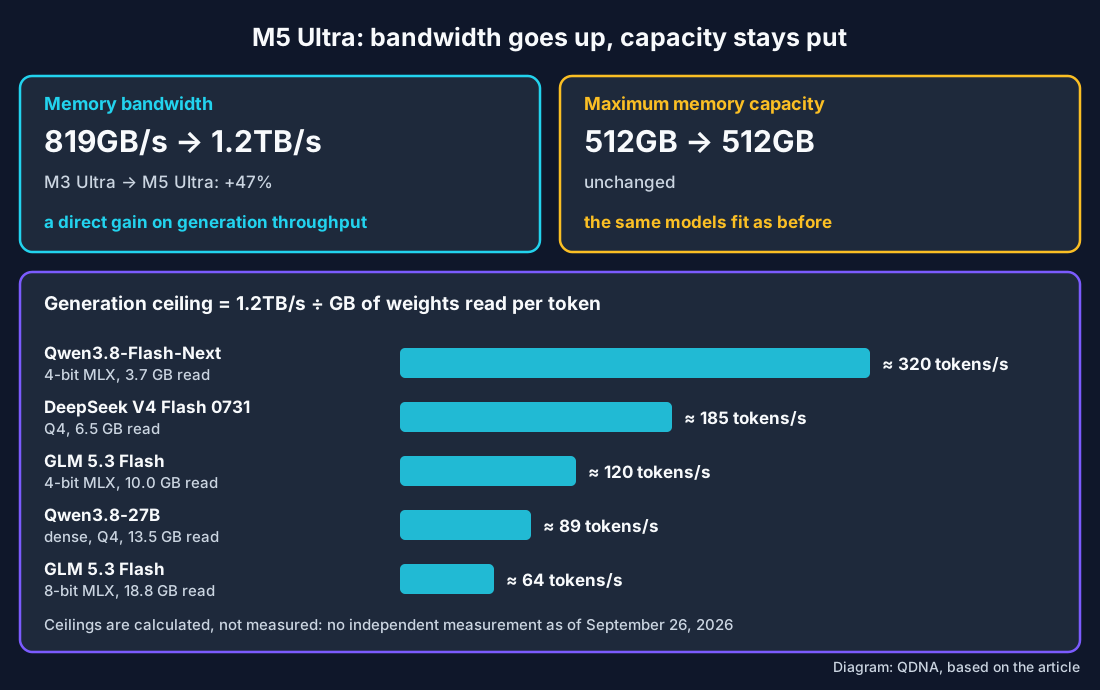
| Model | Weights read per token | Format | Volume read | Ceiling at 1.2TB/s |
|---|---|---|---|---|
| Qwen3.8-Flash-Next | 6B active of 180B published | 4-bit MLX (0.62 byte/parameter measured) | 3.7 GB | ≈ 320 tokens/s |
| DeepSeek V4 Flash 0731 | 13B active of 284B | Q4 | 6.5 GB | ≈ 185 tokens/s |
| GLM 5.3 Flash | 18B active of 320B | 4-bit MLX (0.555 byte/parameter measured) | 10.0 GB | ≈ 120 tokens/s |
| GLM 5.3 Flash | 18B active of 320B | 8-bit MLX (1.044 byte/parameter measured) | 18.8 GB | ≈ 64 tokens/s |
| Qwen3.8-27B | 27B (dense) | Q4 | 13.5 GB | ≈ 89 tokens/s |
QDNA calculation: announced bandwidth ÷ volume of weights read per token, the volume being active parameters × bytes per parameter, measured on the cited conversion when one exists (0.62 for Qwen3.8-Flash-Next in 4-bit MLX, 0.555 and 1.044 for GLM 5.3 Flash in 4- and 8-bit MLX, read from the safetensors on 2 September 2026) and nominal otherwise (0.5 byte in Q4). These are arithmetic ceilings, not measurements, they include neither attention-cache reads, nor activations, nor runtime overhead. The table only lists models that actually fit on the machine and whose active parameter count is published: Qwen3.8-Flash-Next (180B published, 6B active), DeepSeek V4 Flash 0731 (284B, 13B active), GLM 5.3 Flash (320B, 18B active) and Qwen3.8-27B (dense). Very large mixture-of-experts models such as Kimi K3 are excluded: they fit in no format, so no throughput figure means anything for them here.
On the same arithmetic, an M3 Ultra at 819GB/s would top out around 221 tokens/s for Qwen3.8-Flash-Next in 4-bit MLX, against 320 for the M5 Ultra; 126 against 185 for DeepSeek V4 Flash 0731. The ratio of 1.47 recurs line by line, since it depends on nothing but bandwidth.
Which models fit, depending on the memory ordered
Capacity, by contrast, has not moved since the M3 Ultra and 512GB remains the ceiling, so that the question of which model fits has the same answer as before and depends entirely on the memory option chosen at order time.
| Model | Total / active | 96GB | 256GB | 512GB |
|---|---|---|---|---|
| Qwen3.8-27B | 27B, dense | FP16 | FP16 | FP16 |
| Qwen3.8-Flash-Next | 180B published / 6B | does not fit (111.6 GB measured in 4-bit MLX) | 4-bit MLX (111.6 GB measured) | BF16 (360 GB published) |
| DeepSeek V4 Flash 0731 | 284B / 13B | does not fit | Q4 (163 GB) | FP8 (327 GB) |
| GLM 5.3 Flash | 320B / 18B | does not fit | Q4 (184 GB) | FP8 (368 GB) |
QDNA calculation: parameters × bytes per parameter × 1.15 runtime margin, excluding attention cache. Same rule as the site's sizing matrix. Sizes and active parameter counts taken from the official model cards: Qwen3.8-Flash-Next (125B compute of which 6B active, plus 51B n-gram embeddings and 4B multi-token prediction, i.e. 180B and 360 GB published in BF16; 262,144 native context extensible to 1,000,000; 4-bit MLX size read from Vontra/Qwen3.8-Flash-Next-MLX-4bit), DeepSeek V4 Flash 0731 (284B, 13B active) and GLM 5.3 Flash (320B, 18B active, MIT licence). Accessed August 28, 2026, re-read 2 September 2026.
The verdict has reversed with the current generation of open models, for a reason that lies in their architecture. "Flash" mixture-of-experts architectures activate few parameters per token, which makes them both compact once quantised and fast: the 96GB entry configuration only runs Qwen3.8-27B, since Qwen3.8-Flash-Next already needs 111.6 GB in 4-bit MLX because of its 51 billion n-gram embeddings. It is 256 and 512GB that unlock Qwen3.8-Flash-Next, DeepSeek V4 Flash and GLM 5.3 Flash, and they alone justify moving to the 36-core variant.
What stays out of reach are models with a very large total parameter count, whatever their active count: Kimi K3 (2,800B) needs roughly 1,610 GB of weights in Q4. That is the machine's structural limit : 512GB is a lot for a workstation, and little against a DGX Station or an RTX PRO 6000 server.
MLX: what 512GB actually buys
On Apple Silicon the choice of inference runtime directly conditions the performance observed. The comparative study published by Rajesh et al. (arXiv 2511.05502), conducted on a 192 GB M2 Ultra Mac Studio with the Qwen-2.5 family and prompts ranging from a few hundred to 100,000 tokens.
It concludes that MLX achieves the highest sustained generation throughput, while MLC-LLM delivers lower time-to-first-token on moderate prompts, and llama.cpp stays highly efficient for lightweight single-stream use. The authors also state the limit honestly: these stacks "still trail NVIDIA GPU-based systems such as vLLM in absolute performance".
That hierarchy matches what Apple measures on its own side, since the Neural Accelerators speed up the prefill phase while generation remains bounded by memory bandwidth, and MLX is the runtime that exploits both dimensions together.
The quantisation ladder, measured
This is where memory capacity stops being a spec-sheet line and becomes a quality decision. The MLX conversions of GLM 5.3 Flash published by orcarouter come with perplexity and token-agreement measurements against the FP8 reference:
| MLX variant | Size on disk | Perplexity vs FP8 | Top-1 token agreement | Minimum machine |
|---|---|---|---|---|
| 6-bit | ≈ 296 GB | + 0.24% | 97.76% | 512 GB |
| 4-bit | ≈ 204 GB | + 2.96% | 96.13% | 256 GB |
| 3-bit | ≈ 184 GB | + 9.96% | 92.06% | 256 GB |
| 2-bit | ≈ 145 GB | + 56.9% | 86.56% | 256 GB |
| 2-bit "lite" | ≈ 102 GB | + 141% | 77.19% | 128 GB |
Source: orcarouter/GLM-5.3-Flash-MLX, perplexity measured against the FP8 reference at 2.7797. The "minimum machine" column is our reading: size on disk plus headroom for the attention cache and runtime state.
The reading of this table is as blunt as it is instructive for anyone about to place an order. Between 6 and 4 bits, quality loses just under three points of perplexity while token agreement stays above 96%, which makes the gap real but arguable. Between 4 and 2 bits however, perplexity rises by 57% and agreement falls to 86.6%. The author of these conversions says it plainly for the most aggressive variant: "long code generation is not reliable at this precision", with repetition loops and missing glue code.
In other words, 512GB does not buy you the ability to run one more model, it buys you the right to run it at 6-bit rather than 4-bit. On writing or question-answering that gap will not show at all, whereas on long code generation it sits exactly where the line falls between a usable assistant and one that invents.
GLM 5.3 Flash on M5 Ultra, the concrete case
Crossing the three preceding sets of figures produces the table a buyer actually wants, since the MLX variant chosen determines at once the machine required, the throughput reachable and the quality retained. GLM 5.3 Flash activates 18 billion parameters out of 320, which makes its generation ceiling a direct function of the precision selected: fewer bits per parameter means fewer bytes re-read for every token, therefore more tokens per second, at the price of a degradation that perplexity measurements quantify precisely.
| MLX variant | Size | Minimum machine | Ceiling at 1.2TB/s | Perplexity | Top-1 agreement |
|---|---|---|---|---|---|
| 6-bit | ≈ 296 GB | 512 GB | ≈ 72 tokens/s | + 0.24% | 97.76% |
| 4-bit | ≈ 204 GB | 256 GB | ≈ 104 tokens/s | + 2.96% | 96.13% |
| 3-bit | ≈ 184 GB | 256 GB | ≈ 116 tokens/s | + 9.96% | 92.06% |
| 2-bit | ≈ 145 GB | 256 GB | ≈ 147 tokens/s | + 56.9% | 86.56% |
Sizes, perplexity and token agreement taken from orcarouter/GLM-5.3-Flash-MLX. The ceilings are a QDNA calculation, not a measurement: 1.2 TB/s divided by 18 billion active parameters × (size on disk ÷ 320 billion), i.e. 0.92 byte per parameter at 6-bit (16.6 GB read per token), 0.64 at 4-bit (11.5 GB), 0.58 at 3-bit (10.4 GB) and 0.45 at 2-bit (8.2 GB), sizes read from the repository safetensors on 2 September 2026. The "minimum machine" column adds headroom for the attention cache and runtime state to the model size.
The practical reading fits in one sentence: the 512GB configuration is the only one that allows GLM 5.3 Flash to be served at 6-bit, meaning at a quality practically indistinguishable from the FP8 reference, whereas 256GB forces a drop to 4-bit and three additional points of perplexity. The move is counter-intuitive for anyone reasoning in throughput, since dropping precision accelerates generation: 4-bit tops out at 104 tokens per second against 72 at 6-bit. In other words, 512GB does not buy speed, it buys the right to decline speed bought at the expense of quality.
One practical constraint remains, which the product sheet does not mention: at the moment the machine is delivered, serving this model requires installing mlx-vlm from its main branch, where the glm5_next architecture only landed on August 26, 2026, together with the third-party patch that restores numerical parity with the reference.
The real state of support
One point product pages do not mention and which decides short-term feasibility: the glm5_next architecture only landed in the mlx-vlm main branch on August 26, 2026, and no published release carries it yet. PipeNetwork's 4-bit conversion, at 177.6 GB against 642.7 GB for the upstream bfloat16, documents in passing two numerical bugs and two epsilon mismatches found in that branch, fixed by a patched runtime reaching 1e-6 end-to-end parity with the reference.
This is not an implementation detail, because it means that at the moment the machine ships, running the model that most interests it requires installing mlx-vlm from the main branch together with a third-party patch. The operation remains doable, but it is not what a commercial datasheet describes.
The four-machine cluster
Apple states that "a four Mac Studio cluster delivers up to 3x faster AI inference performance", relying on Thunderbolt 5 and RDMA. The M5 Ultra offers six Thunderbolt 5 ports at 120Gb/s, two of them on the front.
The figure deserves to be read for exactly what it states. Four machines for a factor of three is 75% efficiency, which is honest for pipeline parallelism over an external link : but 120Gb/s is 15GB/s, roughly 1.2% of internal memory bandwidth. The link between machines is therefore almost two orders of magnitude slower than local memory (a factor of 80): the split has to be done by layers, with very little exchange, and the gain lands on aggregate throughput, not on single-request latency.
For comparison, the UltraFusion interconnect joining the four dies of a single M5 Ultra (two dual-die M5 Max chips, according to the Apple press release of 25 August 2026) exceeds 4.4TB/s. The gap between the inside and the outside of the enclosure is what makes the cluster useful for serving several requests in parallel, and of little use for speeding up one.
Against the alternatives
The Mac Studio has never won on raw throughput, and the M5 Ultra does not change that. Its ground remains memory per euro and per watt, in a silent 3.6 kg enclosure drawing 480W at most.
- Against a DGX Spark (128GB, unified LPDDR5X): the 512GB Mac Studio plays in another capacity class, but the Spark stays inside the CUDA ecosystem, which counts the moment you want to fine-tune a model.
- Against a DGX Station (748GB, HBM3e and LPDDR5X): the Station loads models the Mac cannot, and serves more simultaneous requests. It also costs an order of magnitude more.
- Against an API: the question is not throughput but control. A Mac Studio transmits nothing to anyone, which settles data location in one move : see on-premises or API: comparing the real cost.
For an inference workstation dedicated to a single team, installed in an office rather than a server room, the M5 Ultra is today the densest memory option that requires no dedicated infrastructure. That scope remains narrow, but it corresponds to a need that organisations actually have.
What we do not know yet
Three things we do not know yet remain open, the real throughput, the price of the larger memory options and the behaviour of MLX on a four-die chip, and it is better to name them than to fill them with estimates.
- Real throughput, no reproducible independent measurement has been published as of September 26, 2026, four days after the first deliveries. The ceilings above say what the hardware cannot exceed, not what it reaches.
- The price of the 256GB and 512GB options, apple does not publish them on its specifications page, and the figures circulating in the trade press contradict each other by a factor of two. A quote is required.
- How MLX behaves on a four-die chip, apple's published measurements cover a monolithic M5. How MLX spreads the load across the 80 GPU cores of an M5 Ultra, and at what efficiency, remains to be observed.
We will complete this article with readings as soon as a machine can be measured, following the same method as the measurements section: one (model, format, hardware) triple per page, with a reproducible procedure, and no value for anything that has not been measured.
What to remember
The M5 Ultra is a bandwidth update rather than a capacity update, which determines who it is for. The additional 47% feeds generation throughput directly, since throughput depends on bandwidth linearly, while the question of which model fits in memory gets exactly the same answer as with an M3 Ultra.
An organisation whose constraint was capacity will therefore see no improvement, whereas one limited by speed at constant capacity gets the clearest step Apple has offered on this line.
The commercial trap lies in the entry configuration, since at $5,499 the machine carries only 96GB and cannot later be taken to 512GB. Sizing is therefore decided before the order is placed rather than after the machine is delivered. It is set on the model × hardware matrix.
Frequently asked questions
What is the memory bandwidth of the Mac Studio M5 Ultra?
1.2TB/s of unified memory bandwidth, on both M5 Ultra variants. Apple states this is 50% more than before, the M3 Ultra generation topping out around 819GB/s. For token generation, which is bounded by bandwidth and not by compute, this is the figure that decides speed.
How much memory can a Mac Studio M5 Ultra take?
96GB in the base configuration, 256 or 512GB as options : but only on the 36-core CPU / 80-core GPU variant, not on the entry configuration. The 512GB option is only announced for late October 2026.
Which open-weight models fit on a 512GB Mac Studio M5 Ultra?
Four current-generation open models cover most uses on this machine. At 512 GB: GLM 5.3 Flash (320B, 18B active) and DeepSeek V4 Flash 0731 (284B, 13B active) in FP8, Qwen3.8-Flash-Next (180B published, 6B active) up to BF16 (360 GB), and dense Qwen3.8-27B in every format. At 96 GB, only one fits: Qwen3.8-27B, since Qwen3.8-Flash-Next needs 111.6 GB in 4-bit MLX. Very large mixture-of-experts models such as Kimi K3 (2,800B) fit in no format.
Does the Mac Studio M5 Ultra replace an NVIDIA GPU server?
For a moderate-throughput, quiet inference workstation, it is credible. For production serving under high concurrency, a GPU server keeps the advantage on aggregate throughput and the CUDA ecosystem. Fine-tuning still assumes NVIDIA hardware.
Are there independent throughput measurements on M5 Ultra?
No, no reproducible measurement as of September 26, 2026: the machine has shipped since September 22, the 512GB configuration arrives in late October, and the throughputs in circulation are extrapolations from the M3 Ultra. The tokens per second circulating are calculated estimates, not readings.