Published benchmark results of DeepSeek V4 Flash 0731 (open weight, 2026)
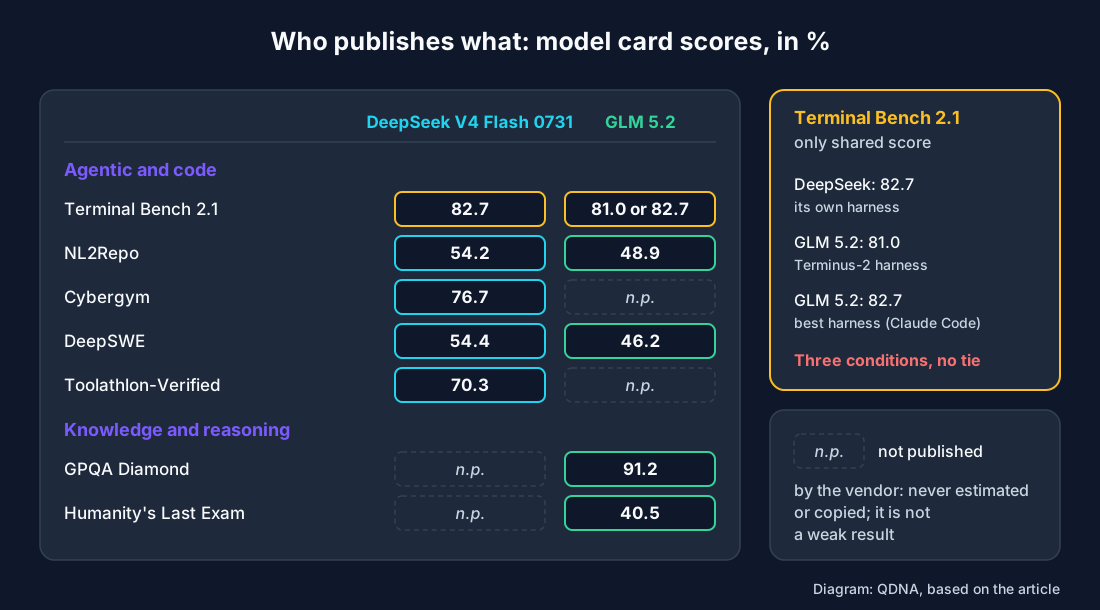
The benchmark results published by their vendors for two 2026 open weight models: DeepSeek V4 Flash 0731 (284B / 13B active, 1M context, FP4+FP8 weights) and GLM 5.2 (744B). Terminal Bench, NL2Repo, Cybergym, DeepSWE and Toolathlon on the DeepSeek side; GPQA Diamond and Humanity's Last Exam on the GLM 5.2 side. No estimates: 'not published' where the vendor does not publish the measure.

Updated on 11 October 2026: local costs of DeepSeek V4 Flash 0731 aligned with the DGX Spark reference prices adopted on 8 October 2026: €2.4 to €42/M depending on throughput and load, €9.4/M under the median assumption.
Updated on 8 October 2026: Artificial Analysis index v4.3.2 re-read on 8 October 2026 (GLM 5.3 at 44.8).
Updated on 26 September 2026: DeepSeek price list of 26 September 2026 (V4 Flash 0731 retired from the API on 10 September, successor V4.1 Flash), V4 Pro 0813 revision, pointer to GLM 5.3 which succeeds GLM 5.2; vendor-published scores unchanged.
Updated on September 2, 2026: GLM 5.2 Terminal Bench 2.1 score split by harness (81.0 on Terminus-2, 82.7 with the best reported harness) instead of a tie with DeepSeek; arXiv 2602.15763 is the GLM-5 report, cited by the GLM 5.2 card; deployment recipe corrected (the 167 GB official checkpoint does not fit in a single Spark).
Methodology
This article reports only scores published by the vendors on their model cards and official reports. DeepSeek and Zhipu AI (GLM) are, to our knowledge, the only two vendors publishing these benchmarks for the exact checkpoints covered here. Where a vendor does not publish a measure, the cell reads 'n.p.'
(not published): no value is estimated, copied from a third party, or compared against a closed model whose vendor does not publish the same benchmarks. For a consistent, independent cross-model comparison, we point readers to the Artificial Analysis and LiveBench panels.
The sources are: arXiv 2606.19348 (DeepSeek V4 technical report), DeepSeek V4 Flash 0731 Hugging Face model card, GLM 5.2 Hugging Face model card and GLM-5 technical report (arXiv 2602.15763), cited by the GLM 5.2 model card. Model cards re-read on 2 September 2026.
Published official benchmarks
n.p. = not published by the vendor. Scores from the official model cards / reports: DeepSeek (Hugging Face), GLM 5.2 (Hugging Face, arXiv report 2602.15763). For an independent cross-model comparison: Artificial Analysis and LiveBench.
| Benchmark | DeepSeek V4 Flash 0731 | GLM 5.2 |
|---|---|---|
| Terminal Bench 2.1 (agentic, code) | 82.7 % | 81.0 % (Terminus-2 harness); 82.7 % with the best reported harness (Claude Code) |
| NL2Repo (natural language to repo) | 54.2 % | 48.9 % |
| Cybergym (cybersecurity) | 76.7 % | n.p. |
| DeepSWE (software engineering) | 54.4 % | 46.2 % |
| Toolathlon-Verified (tool calling) | 70.3 % | n.p. |
| GPQA Diamond (science) | n.p. | 91.2 % |
| Humanity's Last Exam (no tools) | n.p. | 40.5 % |
Reading. DeepSeek publishes its results on agentic and coding benchmarks (Terminal Bench, NL2Repo, Cybergym, DeepSWE, Toolathlon), whereas GLM 5.2 mainly documents knowledge and scientific reasoning (GPQA Diamond, Humanity's Last Exam). On Terminal Bench 2.1, the only benchmark common to both cards, GLM 5.2 publishes 81.0 with the Terminus-2 harness and 82.7 with the best reported harness (Claude Code), while DeepSeek publishes 82.7 with its own harness: three different conditions, which rule out reading an equality into it. An 'n.p.' cell does not signal a weak result but the absence of a measure published by the vendor; filling it with an estimate would mean inventing a figure. To position these models against others, open or closed, on a single methodology, see Artificial Analysis or LiveBench.
Recommendations by use case
Reading. For a sovereign on-site deployment, DeepSeek V4 Flash 0731 is the default choice: open weights under the MIT licence, 1M context and the most complete set of published agentic benchmarks. GLM 5.2 rounds out the picture on knowledge and scientific reasoning.
| Use case | Recommended model | Why | Indicative cost |
|---|---|---|---|
| Code agents, software engineering | DeepSeek V4 Flash 0731 | The most complete set of published agentic benchmarks (Terminal Bench 2.1, NL2Repo, DeepSWE, Toolathlon, Cybergym), 1M context | €2.4 to €42/M on-premises on a DGX Spark depending on throughput and load, €9.4/M as the median assumption (calculation and sources); $0.375 to $0.75/M via the API for the successor V4.1 Flash (off-peak or peak, 26 September 2026; 0731 retired from the API on 10 September) |
| Knowledge, scientific reasoning | GLM 5.2 | Publishes GPQA Diamond 91.2 and Humanity's Last Exam 40.5 | see Artificial Analysis |
| Frontier reasoning, maximum precision | Proprietary models (Claude, GPT, Gemini) | Their vendors do not publish these open weight benchmarks; compare on a single methodology | see Artificial Analysis |
| Sovereignty, GDPR, HDS, SecNumCloud | DeepSeek V4 Flash 0731 on-premises | Open weights under the MIT licence, on-site execution, no data transfer outside the infrastructure | €2.4 to €42/M on-premises on a DGX Spark depending on throughput and load, €9.4/M as the median assumption |
| Fine-tuning on domain data | DeepSeek V4 Flash 0731 (Unsloth) | Open weights, QLoRA fine-tuning with Unsloth | €2.4 to €42/M on-premises on a DGX Spark depending on throughput and load, €9.4/M as the median assumption |
Hardware sizing (GPU, memory, throughput, concurrent users) is covered in our DeepSeek deployment guide for DGX Station and Spark clusters.
Licence and sovereignty
Both models ship under the MIT licence with open weights: fully on-site execution, no data transfer outside the infrastructure, no dependency on a third-party API and no deactivation risk. That is the basis for GDPR, HDS and SecNumCloud compliance on sensitive data.
| Model | Licence | Open weights | On-premises execution | Fine-tuning |
|---|---|---|---|---|
| DeepSeek V4 Flash 0731 | MIT | Yes | Yes | Yes (Unsloth) |
| GLM 5.2 | MIT | Yes | Yes | Yes (Unsloth) |
Conclusion
On the benchmarks their vendors publish, DeepSeek V4 Flash 0731 documents the agentic and coding side (Terminal Bench 2.1 82.7, NL2Repo 54.2, DeepSWE 54.4, Toolathlon 70.3, Cybergym 76.7), while GLM 5.2 documents the knowledge and reasoning side (GPQA Diamond 91.2, Humanity's Last Exam 40.5).
Both are open weight under the MIT licence, so deployable on-premises. We do not rank them against proprietary models: those do not publish the same measures, and any quantified comparison goes through an independent single-methodology panel such as Artificial Analysis or LiveBench.
References
- DeepSeek V4 Flash 0731, dépôt officiel Hugging Face
- Rapport technique DeepSeek V4 (arXiv 2606.19348)
- Artificial Analysis Intelligence Index v4.1
- LiveBench open weight rankings
- OpenRouter model rankings
- Unsloth, documentation DeepSeek V4
- Fiche QDNA : DeepSeek V4
- Fiche QDNA : vLLM
- Fiche QDNA : DGX Station
- Fiche QDNA : DGX Spark
Frequently asked questions
Which open-weight model is best for local deployment in 2026?
On the benchmarks published by their vendors, DeepSeek V4 Flash 0731 (284B total, 13B active per token, 1M context, FP4+FP8 weights) is the strongest open-weight choice for agentic and coding work: 82.7% on Terminal Bench 2.1, 54.2% on NL2Repo, 54.4% on DeepSWE. For general knowledge, GLM 5.2 (744B) publishes GPQA Diamond 91.2 and Humanity's Last Exam 40.5; its successor GLM 5.3 ranks second among open models on the Artificial Analysis index v4.3.2 (45 points, 26 September 2026; index v4.3.2 of 8 October 2026: 44.8). We do not rank these against closed models: their vendors do not publish the same benchmarks.
What is the difference between DeepSeek V4 Flash 0731 and V4 Pro?
V4 Flash 0731 is a 284-billion-parameter mixture of experts with 13 billion active per token and a 1M context. V4 Pro is 1.6 trillion parameters with 49 billion active. Flash outperforms Pro on the agentic benchmarks DeepSeek publishes, despite a far smaller activated parameter count : which is what makes it the interesting one for local serving.
Which open-weight model has the best quality-to-size ratio for a 128 GB DGX Spark?
DeepSeek V4 Flash 0731 in UD-IQ3_XXS (104 GB). It is the highest-quality model that fits in 128 GB while leaving roughly 18 GB of headroom for the KV cache.
Which open-weight model has the best quality-to-size ratio for a DGX Station GB300?
On a DGX Station GB300 (748 GB coherent), DeepSeek V4 Flash 0731 in native FP4+FP8 (167 GB) or lossless UD-Q8_K_XL (162 GB). It allows the native 1M context with 14 concurrent users.
How do you deploy an open-weight model locally on DGX Spark or DGX Station?
The official checkpoint weighs 167 GB (48 safetensors files re-read on 2 September 2026): it does not fit in a single 128 GB DGX Spark. On a single 128 GB machine, use the Unsloth Dynamic GGUFs with llama.cpp (UD-IQ3_XXS, 104 GB; UD-Q8_K_XL, 162 GB, announced lossless, needs more memory). On a 2× Spark cluster linked by ConnectX-7 200 Gb/s: the NVIDIA NGC vLLM container from the playbook (tag 26.05-py3 on 2 September 2026) with --tensor-parallel-size 2. On a DGX Station GB300: same command with --tensor-parallel-size 1. vLLM 0.25 at minimum for the DSpark module.