Semantic layer and ontology for AI agents: the substrate that makes them reliable
An agent that talks directly to every database guesses the joins, confuses metrics and acts on wrong assumptions. An ontology-based semantic layer moves meaning out of the agent. Here is the architecture, and how to deploy it on a sovereign serverless substrate, governed all the way down to the kernel.
Updated on September 2, 2026: the "less than 1% overhead" attributed to Tetragon does not appear in the project documentation (re-read on 2 September 2026) and is removed.

The problem: many agents, many sources
As long as an organisation aligns a few agents with a few sources, each agent must learn the schemas and rules of each source, so the number of couplings grows as M times N.
Every agent then carries knowledge of the joins, the metric definitions and the access rights, and the day a definition changes, the correction has to be repeated in each of them.
Language models make that risk worse, because they produce plausible text rather than a correct answer over a structured domain, and an agent deprived of explicit context is left to guess. An agent that guesses picks the wrong join, misreads a metric and acts on a false assumption, which Forrester sums up in a sentence: data without meaning stays unusable for an autonomous system.
How do ontology and knowledge graph form the semantic substrate?
The answer is to insert between agents and data a layer that holds the meaning, built on two complementary blocks. The knowledge graph stores the facts as entities connected by relationships, while the ontology holds the meaning: what a customer is, how it relates to an account, which constraints apply. The graph stores, the ontology explains.
The agent becomes thin, since it reasons over concepts and leaves the joins, entity resolution and business rules to the substrate. Complexity returns from M times N to M plus N: each agent talks to the substrate, each source plugs into it, and no one relearns anyone else's work, with governance and access control now living in the same place, once, for every agent.
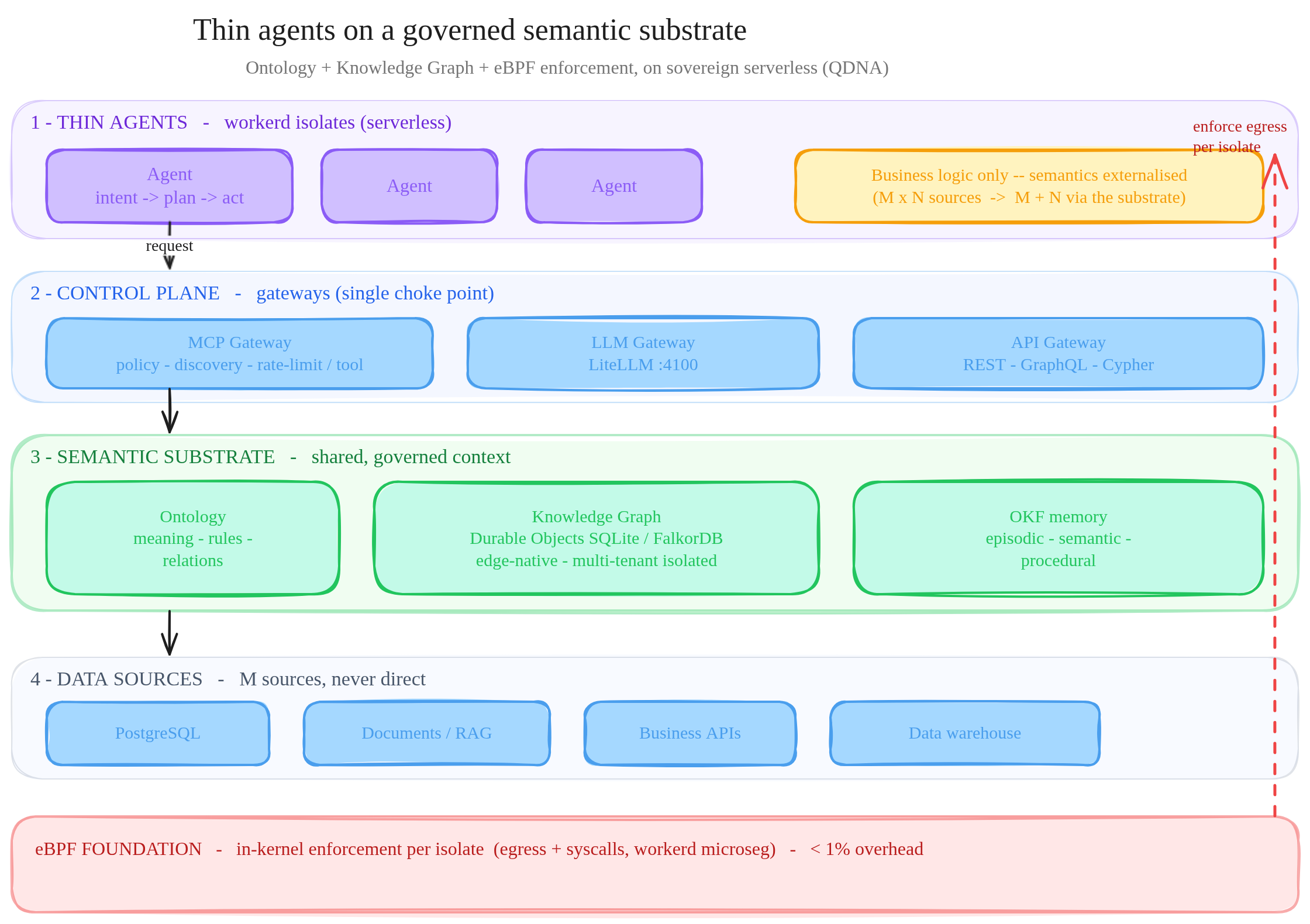
This architecture replaces neither your data warehouse nor your databases, it sits on top: the sources stay in place, but agents no longer touch them directly. The three-layer memory is modelled in the same graph, episodic for history, semantic for facts and procedural for tasks, so a single traversal call makes all three available with no external memory service. The Open Knowledge Format describes this content in a portable, versionable way.
How does a request flow through the platform?
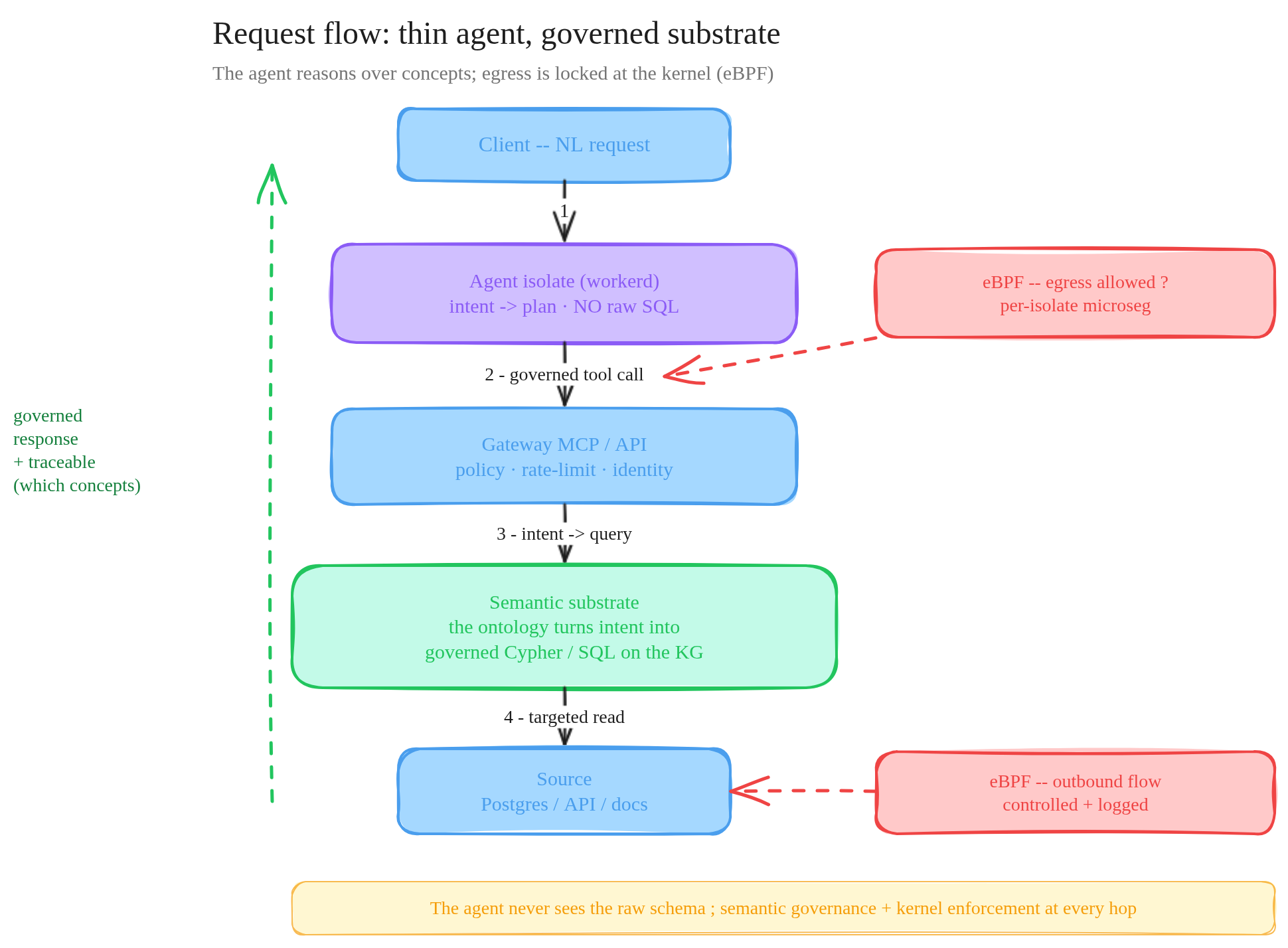
A natural-language request arrives from the client, which the agent interprets and plans without ever writing raw SQL, since it calls a governed tool through a gateway.
That gateway applies policy, quota and identity before forwarding to the substrate, where the ontology turns the intent into a governed query, in Cypher or SQL, against the knowledge graph that reads the targeted source. The response flows back governed and traceable, because you know which concepts produced which result.
Three interfaces connect the graph to the agents: the MCP protocol exposes standardised tools the agent calls, graph query languages serve structured queries, Cypher for property graphs and SPARQL for triple stores, and REST or GraphQL APIs cover the rest, with the gateway remaining the single control point. Our LiteLLM page describes the gateway on the model side, and the semantic router page covers request routing.
Governing twice: at the meaning and at the kernel
The semantic layer governs at the logical level, where it decides which concepts an agent sees and which rules apply, but that control stays in application space.
A compromised agent, or a model that goes off the rails, sometimes tries to open an outbound connection outside the intended boundary, and logical governance alone does not stop it at the right level.
The solution adds a second barrier at the kernel with eBPF, where loaded programs watch system calls and network flows per isolate, a policy blocking the action before it completes without going through a user-space agent. The Tetragon project shows the way, with filtering and blocking directly in the kernel, correlation between process and network flow, and an overhead its documentation calls low without publishing a figure. The operating rule stays cautious: observe first in audit mode, tune the false positives, then and only then turn on blocking.
The result combines two guarantees: the semantic substrate ensures the agent reasons over the right concepts, and the eBPF foundation that no outbound flow leaves the isolate without authorisation. This dual governance, logical and physical, sets a reliable agent platform apart from a mere context layer.
A serverless and sovereign substrate
The knowledge graph requires no expensive dedicated server, since a durable object hosts an isolated SQLite database, one per tenant or one per agent, so that a query on one graph never sees another's data.
Each agent runs in a lightweight isolate that scales on demand and drops to zero between tasks, which means ten thousand agents active 1% of the time mobilise only about a hundred instances at any moment, where an always-on machine model would reserve ten thousand.
This economics matters for an agent workload, intermittent and massively parallel by nature. It deploys on your hardware, in your data centres or in managed data centres, with no dependency on an external service. Moving from a chatbot to an agentic platform rests on this foundation, and our enterprise RAG guide details document access through the same layer.
BI semantic layer, or ontology for agents?
The term semantic layer comes from analytics, where a metrics engine defines the indicators once before serving them to every dashboard, on the same decoupling principle. But an agent needs far more than a metric definition: it needs the meaning, the relationships and the reasoning rules that the ontology carries.
| BI semantic layer | Ontology and knowledge graph for agents |
|---|---|
| Defines metrics and dimensions | Defines entities, relationships and rules |
| Serves consistent numbers to dashboards | Serves reasoning context to agents |
| SQL, REST, GraphQL interface | MCP, Cypher, SPARQL, API interface |
| Answers a measurement question | Guides a decision and an action |
The two complement each other, because an ontology without metric governance leaves the agent unable to calculate correctly, while a metrics layer without domain knowledge leaves it unable to reason. The substrate that connects the two is precisely the scope QDNA advises on.
Frequently asked questions
What is a semantic layer for AI agents?
It is a layer that exposes the meaning of the domain, not the raw tables. An ontology defines the entities, relationships and rules; a knowledge graph connects them; agents query this model instead of writing joins. Context, business rules and access control live in this layer, once, for every agent.
What is the difference between an ontology and a knowledge graph?
The knowledge graph holds the facts: entities connected by relationships. The ontology holds the meaning: what a customer is, how it relates to an account, which constraints apply. The graph stores, the ontology explains. A solid agent deployment needs both, plus governance that decides what is accessible.
Why add eBPF to an agent platform?
The semantic layer governs at the logical level: which concepts, which rules. eBPF governs at the kernel level: which isolate may open which outbound connection, which system calls are allowed. An agent that steps outside the boundary is blocked in-kernel, before the action, with an overhead the Tetragon documentation does not quantify. Logical governance and physical enforcement complement each other.
Can this substrate be deployed as sovereign serverless?
Yes. A knowledge graph fits inside a durable object with its own SQLite database, isolated per tenant, served as a global API. Agents run in lightweight isolates that scale on demand and drop to zero. The whole system deploys on your hardware, inside your walls, with no dependency on an external managed service.
References
- Build Meaning Before Machines, Forrester
- Ontology and Knowledge Graph in the Age of AI and Agents, Enterprise Knowledge
- Tetragon, security observability and runtime enforcement (eBPF)
- Unlimited on-demand graph databases with Durable Objects, Boris Tane
- Building a Least-Privilege AI Agent Gateway with MCP, InfoQ