Open Knowledge Format: the open memory of AI agents
On 12 June 2026, Google Cloud published the Open Knowledge Format, an open standard that represents in Markdown files the internal knowledge that AI agents need. Its promise fits in three words, a format rather than a platform, and for a sovereign infrastructure, this portability changes how agent memory is kept and shared.

The agent landscape is fragmented today
A useful AI agent does not reason about the world in general, but about the organisation's internal context: the schema of a table, the business meaning of a metric, the recovery procedure for an incident, the join path between two systems, the deprecation note for an old interface.
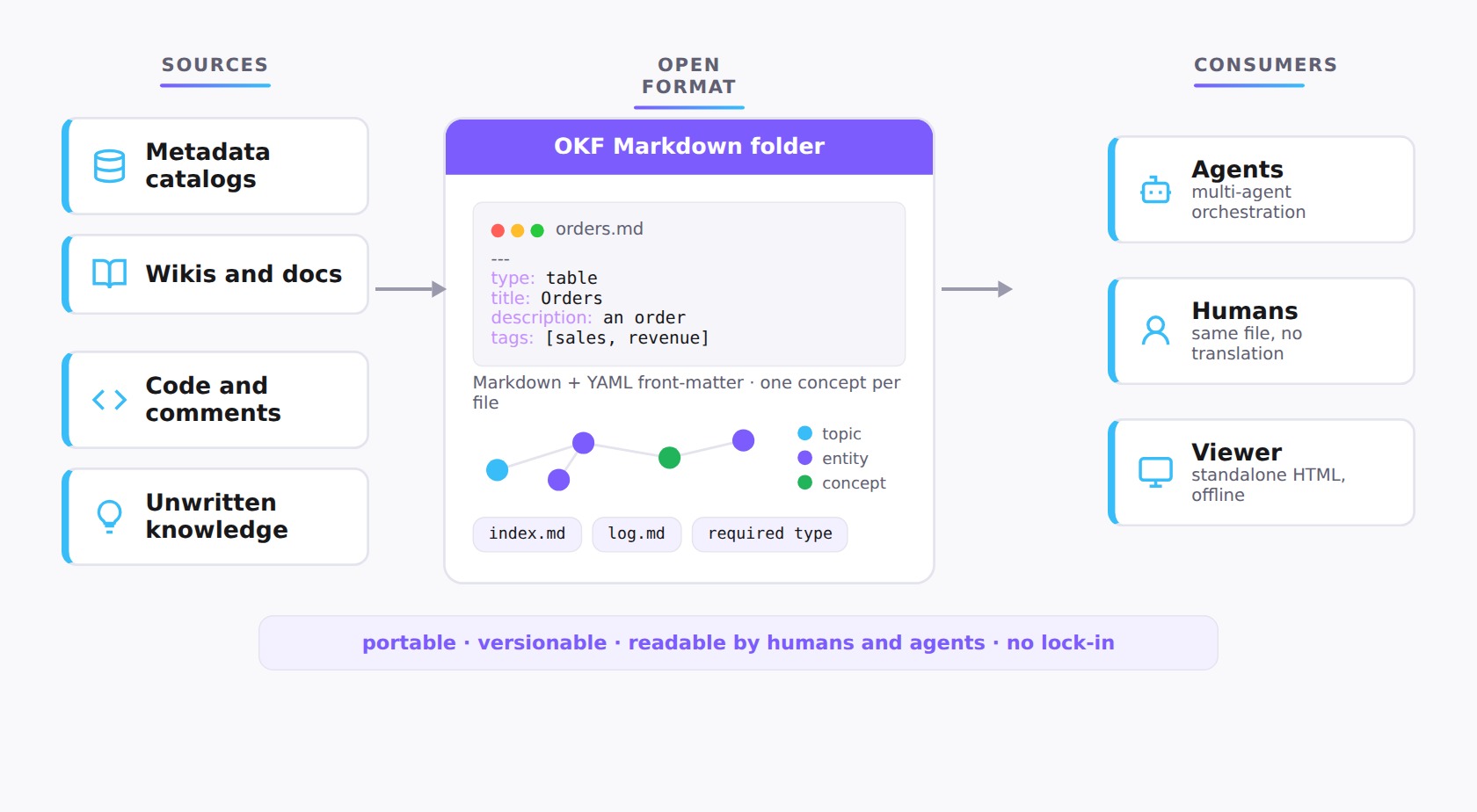
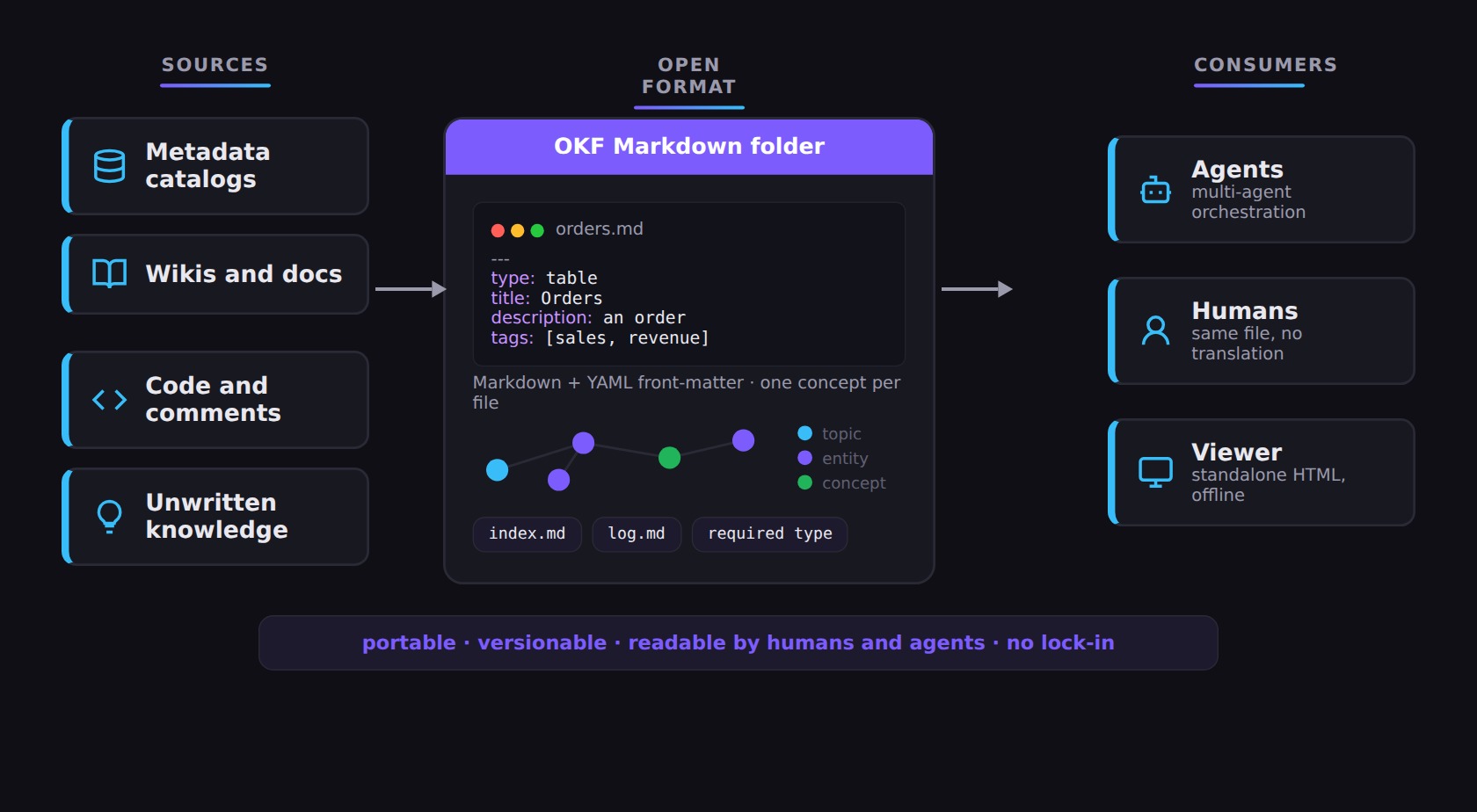
This knowledge already exists, but it is scattered: metadata catalogues with proprietary APIs, wikis, code comments, notebook cells, and unwritten knowledge in engineers' heads.
The result is systematic waste: every team building an agent reassembles context from scratch, every catalogue vendor reinvents its own data model, and knowledge stays trapped inside the tool that produced it. OKF starts from a simple observation: the answer is not a new knowledge service, but a common format.
What does the Open Knowledge Format standardise?
OKF is deliberately minimal, since knowledge takes the form of a folder of Markdown files, one concept per file, each topped with a YAML front matter block. The format requires exactly one thing from each file: a type field, for example "table", "metric" or "procedure", while the other fields, title, description, resource, tags and timestamp, are standardised but optional.
Three conventions complete the set: files link to one another through plain Markdown links, which draws a concept graph richer than a simple tree. an optional index.md file serves as a catalogue for progressive reading, and an optional log.md file keeps a chronological record of operations. The full specification, since moved to version 0.2 (re-read on 2 September 2026), fits on a single page, and the whole thing travels like an archive, lives in a Git repository, and reads in any editor.
Why does an open format serve sovereignty?
A format with no owner has properties that no service can offer, starting with the fact that knowledge becomes portable, since it survives a change of tool, vendor or organisation, and it gets versioned alongside the code it describes, with the same history and the same reviews.
The same file is read by a human and traversed by an agent, with no translation layer, and nobody needs a proprietary account or an SDK to produce it, read it or serve it.
These properties map exactly onto the requirements of a sovereign infrastructure, where knowledge stays within the certified perimeter, on the same footing as data and models, and OKF's reference viewer illustrates the principle: a self-contained HTML file turns a folder into an interactive graph, with no server and no data ever leaving the page. Portability stops being a contractual promise and becomes a property of the format itself.
What OKF does not do
Clarity requires a boundary: OKF is a representation and exchange format, not a search engine or a reasoning system. it carries no formal ontology and performs no retrieval, so finding the right fragment at the right moment remains the job of a dedicated layer: document vectorisation, result reranking, traversal of the relationship graph.
OKF sits upstream, as the structured source that this layer indexes.
This division of labour is a strength rather than a shortcoming, because the format fixes the surface of interoperability and leaves the content model to the producer, retrieval to the consumer. A producer writes its files, a consumer indexes them, and the two evolve without needing to coordinate.
Agent memory, one building block of the platform
A complete agentic platform is not limited to models and orchestration. It adds a memory layer: the knowledge base that agents read, enrich and share over time. This layer sits within the organisation's own infrastructure, alongside multi-agent orchestration and the model gateway.
An open format such as OKF strengthens this approach. The memory of a sovereign platform benefits from being expressed in a format with no owner: it stays exportable, auditable and interoperable, without depending on a single vendor. The organisation keeps control of its knowledge, moves it if it changes tools, and shares it between agents with no translation. It is the same logic that guides the rest of the platform: interchangeable open models, a single gateway, and knowledge held in an open format.
An organisation's knowledge is worth more in an open format than in a proprietary database: portable, versionable and readable by humans and agents alike, it stays under the control of whoever produces it.
Can a team adopt the format without waiting for a fixed standard?
Version 0.2, which followed June's 0.1 by adding optional provenance, trust and lifecycle fields, remains a starting point rather than a fixed standard, so nothing prevents starting small. A team exports a first scope, a few tables, a few metrics, a handful of procedures, into a folder of Markdown files with typed front matter.
It versions this alongside its code, links it with plain links and serves it to its agents, and the knowledge base grows as agents read and add to it.
The value of a format lies in how many parties speak it rather than in who owns it, so that for an organisation building a sovereign AI platform, adopting an open knowledge format means preparing tomorrow's interoperability without giving up today's control.
Source: the OKF specification published by Google Cloud, together with the announcement setting out its intent.
Frequently asked questions
What is the Open Knowledge Format?
The Open Knowledge Format is an open standard published by Google Cloud in June 2026. It represents an organisation's knowledge as a folder of Markdown files with YAML front matter, with a single required field, the type. It depends on no vendor, no SDK and no proprietary database.
How does OKF differ from a metadata catalogue?
A catalogue is a service with a proprietary API. OKF is a format: versionable Markdown files, readable without an account or an SDK, transportable like an archive. The two complement each other, but only the format guarantees the portability of knowledge across tools and organisations.
Does OKF replace vector search?
No. OKF is a representation and exchange format, not a retrieval engine. Finding the right fragment remains the job of a dedicated layer: vectorisation, reranking, graph traversal. OKF sits upstream, as the structured source that this layer indexes.
How does OKF serve a sovereign AI platform?
Knowledge stays within the certified perimeter, exportable and auditable, without depending on a single vendor. Agent memory becomes portable and interoperable, on the same footing as the open models and the single gateway that make up the platform.