What Is a Sovereign AI Platform?
Models, data, and logs on your own hardware, under your control: here is the definition, the technical choices, and the legal framework.

What does sovereignty mean for an AI platform?
Sovereignty is the ability to decide alone where your data and models sit, who accesses them, and how they are used. A sovereign AI platform brings together three guarantees: model weights run on infrastructure you control, your users' data never leaves that infrastructure, and compliance with French and European law remains demonstrable.
Concretely, sovereignty is checked on three components, and each is observed rather than declared:
- the model weights: downloaded once, they run on infrastructure you control, and nobody can withdraw them;
- data and logs: requests, answers, memory and traces stay inside your perimeter, which is observed on outbound traffic;
- compliance: GDPR, HDS certification for health data, SecNumCloud qualification when a provider is involved, and the European AI Act, all demonstrable through documentation.
Sovereign AI platform: local or hybrid?
Local mode keeps everything on-premises, since models, data, memory, and logs remain on your hardware, and no information leaves, this mode applying by default to sensitive data and healthcare.
Hybrid mode processes sensitive data locally and lets non-sensitive innovation overflow to a remote service during load peaks, while a semantic router classifies each request before the call, so that confidential content goes to a local model and public content can use an external model, which prevents sensitive data from leaving the infrastructure by mistake.
Sovereign, hybrid, EU-hosted cloud, US hyperscaler: what is the difference?
Sovereign on-premises, hybrid, EU-hosted cloud or US hyperscaler: the four options differ by where the weights run, where the data goes, and which law applies to whoever accesses it. The table sums up what this page details, without figures: costs are in our comparator.
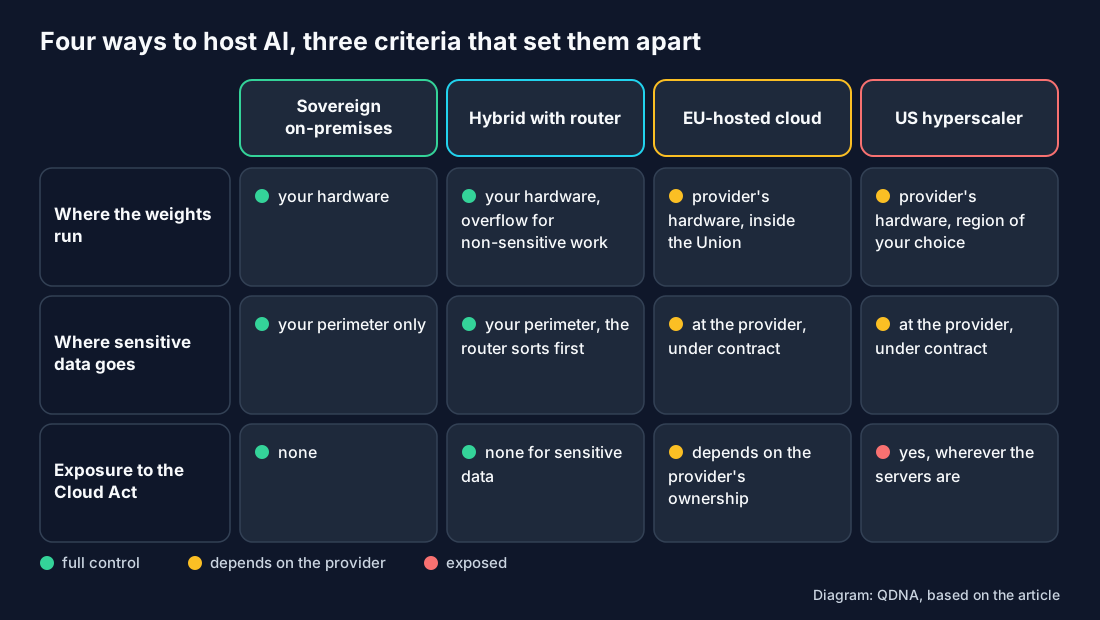
| Criterion | Sovereign on-premises | Hybrid with router | EU-hosted cloud | US hyperscaler |
|---|---|---|---|---|
| Where the weights run | your hardware | your hardware, external overflow for non-sensitive work | provider's hardware, inside the Union | provider's hardware, region of your choice |
| Where sensitive data goes | your perimeter only | your perimeter, the router sorts before the call | at the provider, under contract | at the provider, under contract |
| Exposure to the Cloud Act | none | none for sensitive data | depends on the provider's ownership | yes, wherever the servers are |
| Health data (HDS) | possible, certified-host obligation to meet | possible for sensitive data | possible if the provider is HDS-certified | possible if the provider is HDS-certified |
| SecNumCloud | not applicable, no provider | not applicable for sensitive data | if the provider is qualified | not qualified to date |
| Cost model | fixed, written down | fixed on sensitive, per token on the rest | usage or reservation | per token |
Which hardware for a sovereign AI platform?
The hardware of a sovereign platform is sized on actual need: a workstation such as the Mac Studio Ultra or the DGX Spark is enough for a small structure, while a small or medium enterprise deploys an RTX PRO 6000 server or a GB300 station.
A large enterprise moves to an H200 SXM server, B200 and B300 platforms, up to a GB300 NVL72 rack for a private AI cloud, and from the H200 onward, the same platform serves both inference and training.
Which open models for a sovereign platform?
A sovereign platform relies on open-weight models that you download once and then run in-house. The 2026 references include GLM, Kimi, DeepSeek, Nemotron, MiniMax, Mistral, and Qwen. A single gateway makes them interchangeable: switching models comes down to changing a configuration line, without rewriting application code.
How much does a sovereign AI platform cost?
An interface billed per token is paid for at every request, while an on-premises installation pays off over time. Agentic workloads are dominated by input tokens, and free reuse of the KV cache makes repeated loops nearly free locally. For hosting, two paths exist: on-premises, or managed colocation in a sovereign French data center.
This point is detailed in our analysis of the LLM cost break-even point.
Which French and European rules apply?
The rules apply according to where the model runs. On-premises execution grants full physical and legal control, outside the reach of the US Cloud Act, while for health data, using an HDS-certified host is a legal obligation (Article L. 1111-8 of the French Public Health Code), and ANSSI's SecNumCloud qualification adds extraterritorial immunity.
The framework also covers GDPR, the European AI Act, and the NIS2 directive, with safeguards masking personal data before any submission to a model.
The European AI Act applies in stages. Two obligations already bind every deployer: training users (Article 4, since 2 February 2025) and disclosing that content comes from an AI (Article 50, since 2 August 2026). The obligations for Annex III high-risk systems, recruitment and social benefits included, were postponed to 2 December 2027 by Regulation (EU) 2026/1744 of 8 July 2026, and those of Annex I to 2 August 2028. Many materials still announce 2 August 2026: they are outdated.
Data sovereignty is achievable today. Paired with open-weight models run locally, it also delivers artificial intelligence sovereignty.
Frequently asked questions
What is a sovereign AI platform?
It is an AI infrastructure that hosts models, data, and logs on your own hardware, on-premises or hybrid, under your control. It uses open-weight models and complies with GDPR, HDS, and SecNumCloud.
What is the difference between local AI and hybrid AI?
Local keeps everything on-premises, with no data leaving the site. Hybrid processes sensitive data locally and overflows to a remote service for non-sensitive workloads, using a semantic router that prevents leakage.
Is this compliant with French law?
Yes. On-premises deployment gives full control outside the reach of the Cloud Act. Healthcare requires an HDS-certified host, and SecNumCloud adds extraterritorial immunity.
Is a sovereign AI cloud the same thing as a sovereign AI platform?
No. A sovereign AI cloud is a service hosted in the Union by a provider, whose sovereignty depends on ownership and, for extraterritorial immunity, on SecNumCloud qualification. A sovereign AI platform runs the weights on your own hardware: there is no provider between your data and the model. The two can combine in hybrid mode, the semantic router keeping sensitive data on site.
What does EU-hosted AI mean?
That the servers are physically in the Union, which settles the data transfer question under GDPR but not access by a foreign authority: a provider under US law remains subject to the Cloud Act wherever its servers are. Location is necessary; it is not sufficient.
References
- Regulation (EU) 2026/1744 of 8 July 2026 amending the AI Act timeline, EUR-Lex
- ANSSI, French National Cybersecurity Agency
- Artificial intelligence, CNIL recommendations
- French Digital Health Agency, HDS certification
- Article L. 1111-8 of the French Public Health Code, health data hosting, Légifrance
- SecNumCloud, qualified and in-qualification providers, ANSSI
- Regulation (EU) 2024/1689 on artificial intelligence, official text, EUR-Lex