Kill switch and local LLMs: what French parliamentary report No. 3054 changes
On 12 June 2026, the US government ordered Anthropic to suspend foreign access to its latest AI models: the remote shutdown of a digital service, the kill switch, had just happened. A few weeks later, a commission of inquiry of the French National Assembly published a report that describes this dependency risk and proposes an answer for SMEs, an open-source tax credit.
Updated on 2 September 2026: figures and quotes re-read in the full text of report No. 3054 (45 hearings, 112 people, 264 billion, 1.5 billion of which 1 substitutable, 18 recommendations and 29 proposals, proposal No. 16, Trump v. Slaughter ruling of 29 June 2026) and in Anthropic's 12 June 2026 statement; clarification added on the actual scope of the cut-off and the number of the OSAID recommendation.

A parliamentary report documents digital dependency
The commission of inquiry into digital dependencies, chaired by Philippe Latombe with Cyrielle Chatelain as rapporteur, held forty-five hearings and heard one hundred and twelve people, and its report puts figures on the situation: American vendors account for close to 80% of software purchases by French public administrations, according to the UGAP purchasing body.
European companies buy 264 billion euros of software and cloud services from American providers every year. Of the one and a half billion euros of French public spending going to non-European vendors, the rapporteur estimates that one billion can be substituted today with existing solutions.
Building on these findings, the report makes eighteen recommendations, quick fixes that can be applied rapidly, and twenty-nine proposals, which aim at a longer-term change of model. The rest of this article focuses on the two points that directly affect a company using AI: the finding that the remote shutdown of a service has become real, and the proposal of tax support for open source aimed at SMEs.
Is the kill switch now a reality rather than just a hypothesis?
The report devotes an entire section to the threat of digital services being cut off. It materialised during the commission's work: on 12 June 2026, the US government required Anthropic to suspend access to its Mythos 5 and Fable 5 models for any foreign national, including the company's own foreign employees.
To comply, Anthropic disabled both models for all of its customers the same day, according to its 12 June 2026 statement. The commission's chairman summed it up in session: the kill switch is no longer just a hypothesis but a reality.
The report also documents individual targeting. French judge Nicolas Guillou, a magistrate at the International Criminal Court, saw his digital services and means of payment shut down one after another once he was placed on an American sanctions list, with no judicial recourse. His testimony before the commission describes a daily life that became, in his words, a laboratory of lost sovereignty.
What a shutdown interrupts inside a company
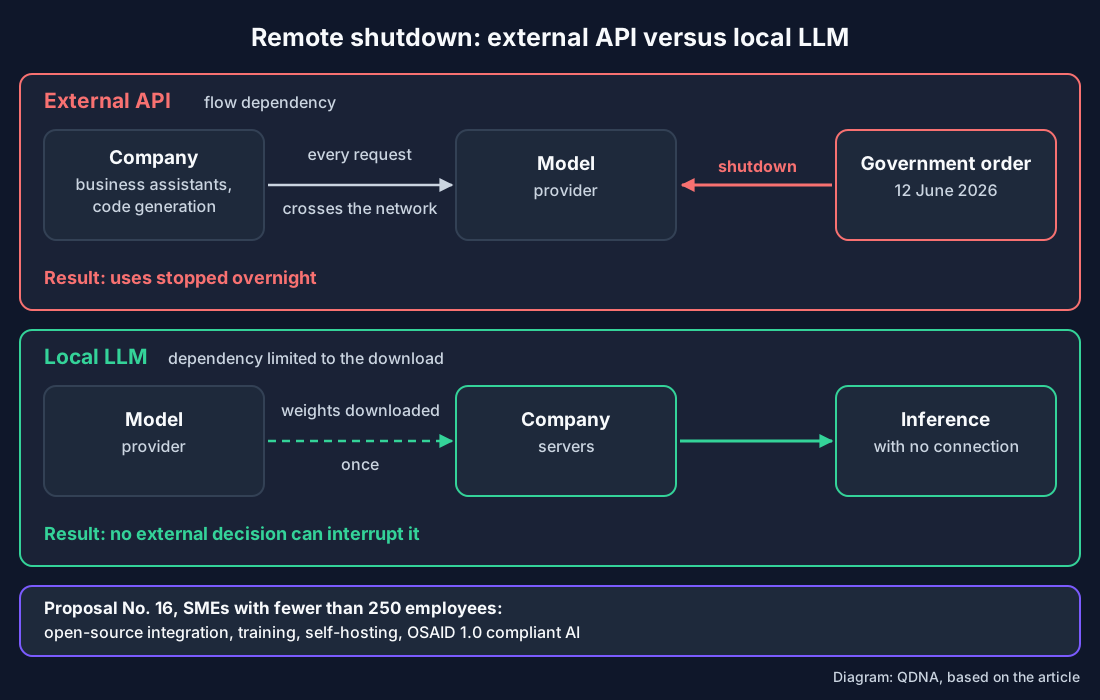
An external AI API creates a flow dependency: every request crosses the network to the provider, and the service exists only as long as the provider answers. When a company plugs its business assistants, its code generation or its agentic workflows into a remote API, a decision taken in another country can stop those uses overnight.
Neither the contract nor the location of the data protects against this risk: the shutdown comes from upstream, at the model provider level, as our page on the Anthropic APIs shows.
This risk differs from the compliance debate, since a company can have a solid data processing agreement and compliant transfer clauses, and still lose access to the service, and the report also recommends that companies assess their exposure to a general shutdown, in the same way as their security risks.
How does a local LLM insure continuity?
An open model downloaded onto the company's servers changes the nature of the dependency, because the model weights become a local asset: once installed, they run without any connection to the provider, no external decision can interrupt inference, and the dependency is limited to the moment of download.
Today's open models cover text generation, code and document analysis at a level sufficient for most internal uses, and the on-premises versus API cost comparison shows that sustained usage pays off the hardware.
Local does not rule out hybrid. An architecture with a semantic router keeps sensitive content and critical uses on the local model, and lets ordinary traffic overflow to an external API as long as it answers. Service continuity then rests on the local foundation, and the external API becomes a convenience. Practical deployment is covered in our guide to installing a local LLM in the enterprise, and hardware is chosen by load tier.
Proposal No. 16: an open-source tax credit for SMEs
The report does not stop at the diagnosis, since its proposal No. 16 creates a tax support scheme, modelled on the French innovation tax credit, for companies with fewer than 250 employees. The proposed eligible expenses cover four items:
- the integration of open-source solutions;
- user training and support;
- self-hosting of servers, or contracting with a European operator shielded from extraterritorial laws, for the first five years;
- the deployment of AI tools that comply with the OSAID 1.0 definition of open source, hosted on sovereign infrastructure.
These four items describe the scope of a local LLM project: the hardware and its integration, team training, operation inside the company's walls and genuinely open models.
A word on that OSAID reference. The Open Source AI Definition, published as version 1.0 in October 2024 by the Open Source Initiative, the organisation that has been the authority on the definition of open source since 1998, sets the conditions an AI system must meet to call itself open source: the freedom to use it for any purpose, to study it, to modify it and to share it, with sufficient access to its components, meaning the model weights, the code and a detailed description of the training data. The report recommends enforcing this definition, including through judicial means (recommendation No. 18), which would rule out so-called open models whose licences restrict commercial use or access to components.
One caveat applies: the report of a commission of inquiry has no force of law. The proposal must be taken up in legislation, for example a finance bill, before it applies. A company preparing an open-source project nevertheless has an interest in documenting its expenses now: if the scheme is voted, the file already exists.
Data transfers are wobbling at the same time
The report adds a legal signal. Following a US Supreme Court decision of 29 June 2026, which validates the political takeover of independent federal agencies, the rapporteur considers that the foundations of the Data Privacy Framework, the mechanism that legalises transfers of personal data to the United States, are now void.
The report urges companies to stop basing their contracts on this framework, so for a company processing personal data with an external AI, legal risk adds to shutdown risk, and our article on generative AI and the GDPR details how local hosting restores control.
How do you prepare for a kill switch without waiting for the law?
Four actions let you prepare for a kill switch without waiting for the law: map the company's AI uses, classify the flows between local and API by sensitivity, run a pilot on a server sized for the trial, and document the spending involved. None of them depends on a vote.
- map the company's AI uses and identify those whose sudden interruption would block a team or a process;
- classify the flows: whatever touches sensitive data or critical processes belongs on a local model, the rest can stay on an API;
- run a pilot on a server sized for the trial, with an OSAID-compliant open model, to measure quality on your real cases;
- document integration, training and hosting expenses: they form the file for the future tax credit if proposal No. 16 goes through.
A sovereign AI platform brings these choices together in one architecture: controlled hardware, open models, controlled access. The parliamentary report gives it a political framework and, perhaps tomorrow, a tax framework.
Frequently asked questions
What is a digital kill switch?
A kill switch is the remote shutdown of a digital service by its provider, on its own initiative or on a state's orders. In June 2026, the suspension of foreign access to two American AI models on orders from the US government provided a concrete case, documented by French parliamentary report No. 3054.
Can a local LLM be cut off remotely?
No. The weights of an open model downloaded onto the company's servers run without any connection to the provider. No external decision can interrupt inference. The dependency is limited to the moment of download, not to operation.
What does French parliamentary report No. 3054 propose for SMEs?
Its proposal No. 16 creates a tax scheme, modelled on the French innovation tax credit, for companies with fewer than 250 employees. The targeted expenses cover the integration of open-source solutions, user training, self-hosting of servers and the deployment of AI tools that comply with the OSAID definition.
Does the open-source tax credit for SMEs already exist?
No. The report of a parliamentary commission of inquiry has no force of law. The proposal must be taken up in legislation, for example a finance bill, before it applies. Companies can however start documenting their open-source migration expenses now.
What is the OSAID definition of open-source AI?
The Open Source AI Definition, published as version 1.0 by the Open Source Initiative, sets the criteria an AI system must meet to call itself open source: the freedom to use, study, modify and share, with sufficient access to the model's components. Report No. 3054 recommends enforcing this definition, including through judicial means (recommendation No. 18).