Generative AI and GDPR: sovereignty as a way to take back control
The GDPR does not disappear in the face of generative AI, it applies more than ever. Hosting AI locally puts data control back in the hands of the company, which makes compliance simpler.

Does the GDPR apply to generative AI?
Contrary to a common belief, the GDPR is not superseded by AI. It applies more than ever. The CNIL has published its recommendations on applying the GDPR to the development of AI systems, then made them operational.
The core principles remain applicable regardless of the system's level of complexity, and compliance becomes a matter of architecture: data traceability, rights management and documentation are built in from the design stage.
What does the CNIL ask of companies on generative AI?
Any processing of personal data by an AI system requires a legal basis, and the CNIL insists on anticipation: the legal basis is chosen before deployment, not after the fact, documentation of design choices remaining the most closely monitored point.
- A clear legal basis, chosen upfront, and a data protection impact assessment (DPIA) when the processing presents a high risk.
- Data minimisation and informing individuals, including on the fact that generated content may be inaccurate.
- Respect for rights: access, rectification, objection and erasure, exercisable in practice.
- Security under Article 32: encryption at rest and in transit, access control over models and data, logging.
The sensitive point: the third-party tool and transfer outside the Union
Compliance responsibility falls on the company using the tool, not on the model's vendor. Before deploying any remote tool, the company must obtain a data processing agreement, verify that the data will not be used to train the model, and ensure that transfers outside the Union comply with the GDPR.
A vendor subject to extraterritorial law, such as the US Cloud Act, may be compelled to hand over data, which creates tension with the European regulation.
Sovereignty as a way to take back control
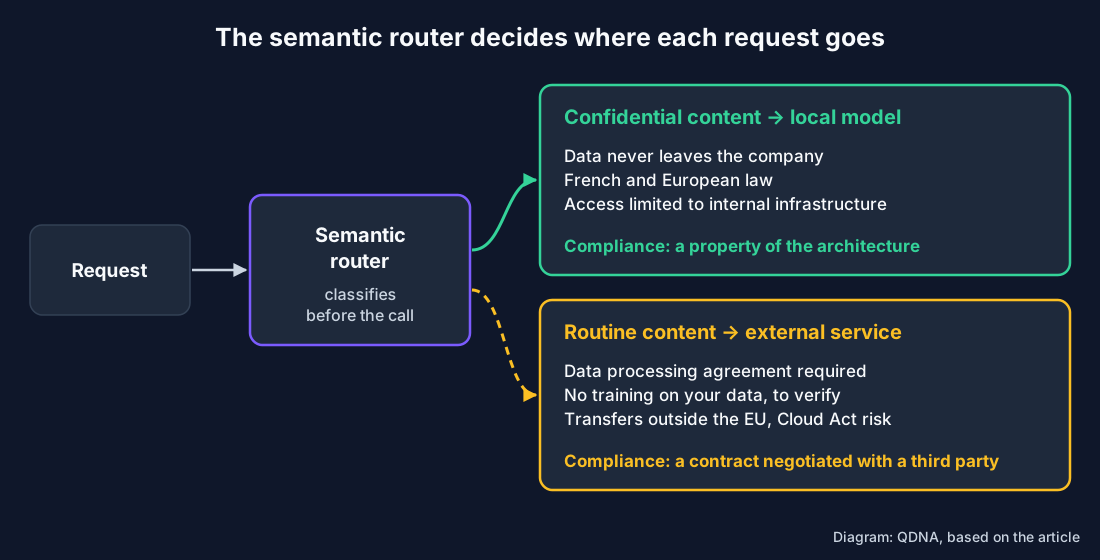
Local hosting reverses this logic. The data never leaves the company, remains under French and European law, and the access perimeter is limited to internal infrastructure. Compliance stops being a contract to negotiate with a third party and becomes a property of the architecture.
The semantic router classifies each request before the call: confidential content stays on a local model, only routine content can be routed to an external service. It is a way to take back control, not a constraint.
How do GDPR and the European AI regulation complement each other?
The two frameworks complement each other: the CNIL's recommendations cover personal data, while the European AI regulation adds product-specific obligations, applicable on a phased timeline: transparency, restrictions on prohibited practices, stricter requirements for high-risk systems, and the CNIL recommends a single compliance framework rather than two parallel efforts.
An architecture that carries compliance
Treating compliance as a property of the platform means controlling the hardware, the model and access. A sovereign AI platform brings these three areas of control together. The practical deployment steps are covered in our guide to installing a local LLM, and the choice of hardware is made by segment.
This article provides guidance and does not replace the CNIL's analysis or legal advice.
Frequently asked questions
Which AI is compliant with the GDPR?
No tool is compliant by itself: compliance depends on the use case, the legal basis and how the data is processed. AI hosted locally, where data never leaves the company, makes GDPR compliance easier.
Is ChatGPT compliant with the GDPR for enterprise use?
Professional use requires a data processing agreement, a guarantee that the data will not be used for training, and controls on transfers outside the Union. Compliance responsibility remains with the company that uses the tool.
Is local AI more compliant with the GDPR?
Local hosting keeps the data on the company's own infrastructure, under European law, and removes the risk of transfer outside the Union. It simplifies access control and the documentation required by the CNIL.
Does an AI project require a data protection impact assessment (DPIA)?
A DPIA is required when the processing presents a high risk to individuals' rights, which is common with AI. The CNIL recommends planning for it from the design stage.
Has ChatGPT already been sanctioned in Europe?
European regulators have scrutinised ChatGPT, up to a temporary suspension in Italy in 2023 followed by a fine from the Italian authority at the end of 2024. The sensitive point remains the transfer and processing of data outside the company. Running an open model locally removes that transfer and puts the processing back under your direct responsibility.
Going further, depending on your case
This article sets the general frame for going further, but three situations need separate treatment depending on your case, because the measures that answer them differ from one to the next:
- AI chatbots and GDPR : when the scope of the processing is defined by users rather than by the designer.
- Legal translation and AI : when the whole document leaves, and professional secrecy stacks on top of GDPR.
- Zero retention and sensitive data : when the burden of proof falls on you and a provider clause is no longer enough.