From Your GPU Server to an LLM Service in Production: the Seven-Phase Method
A GPU server only becomes a workable service through a method, and here are seven phases, each with a deliverable and a measurable exit criterion.
Updated on 8 October 2026: DGX Spark unit raised to €7,000 excl. VAT, the price used after the observed increase; the LDLC.pro reading of 26 September 2026 is still cited.
Updated on 26 September 2026: price ranges realigned on the 26 September 2026 readings (PNY DGX Spark at LDLC.pro, RTX PRO 6000 Max-Q at LDLC, ECB rate of 25 September for the H200 server).
Updated on September 2, 2026: inference gains are tied to their source (vLLM announcement of June 2023, PagedAttention paper, founding speculative-decoding paper) or reduced to a measurement to be made; the LoRA example is given with its arithmetic; the RTX PRO 6000 and H200 price ranges are flagged as not backed by a retailer listing.

The goal: a service, not a demo
Having a graphics server is not enough, because the target is an inference service exposed through a standard interface, usable without rewriting by your existing applications, running open-weight models on your own premises, with a team able to operate it alone. The method turns a machine into a reproducible platform.
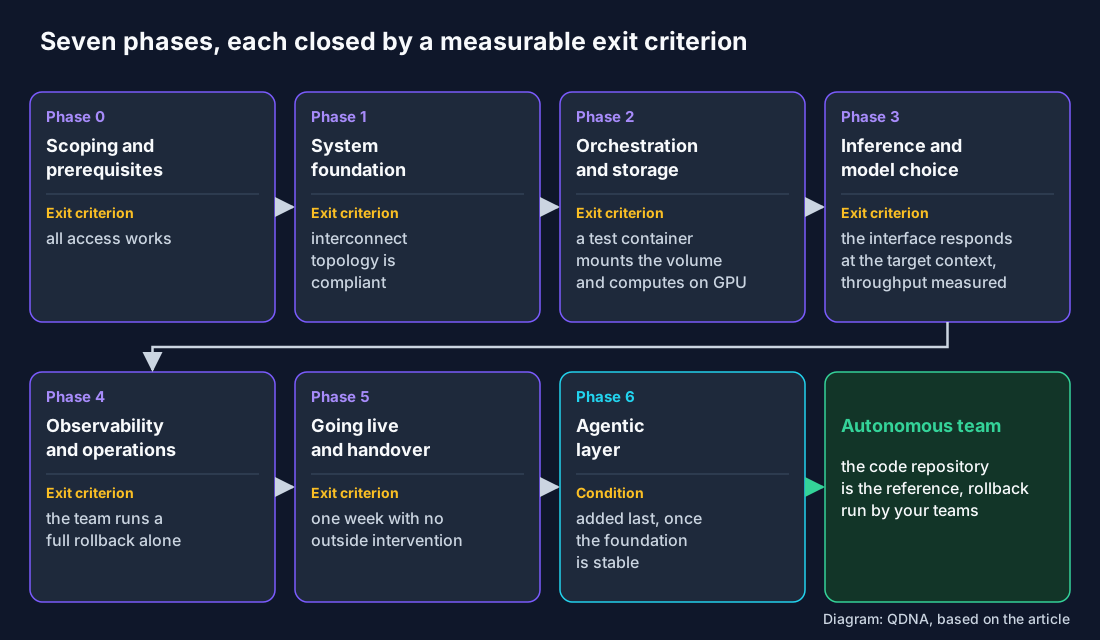
Phase 0: scoping and prerequisites
Organisational blockers are cleared before the first technical workshop: power verified under load rather than idle, network and remote access, administration accounts, the licences and tokens needed, and above all two or three priority use cases that will guide the model choice. Deliverable: a signed prerequisites file. Exit criterion: all access works.
Phase 1: system foundation
The existing setup is validated and the operating system is brought to the required state, without reinstalling if the audit allows it, the sensitive point being the interconnect between graphics cards, since a badly detected link causes a silent fallback and halves throughput for the entire life of the platform, which is why it is checked once, properly.
Deliverable: an audit report and a repeatable procedure. Exit criterion: the interconnect topology is compliant.
Phase 2: orchestration and storage
The server joins a container orchestrator as a node dedicated to inference, and model storage is the critical point there: a model of several tens of gigabytes must sit on a persistent volume, otherwise every restart would force a new download, while an internal image registry makes the platform independent of the internet on restart. Deliverable: versioned manifests.
Exit criterion: a test container mounts the volume and runs a computation on the graphics card.
Phase 3: inference and model choice
The model is served through a high-throughput inference engine exposing a standard interface, and the model choice is built in a workshop from the use cases: size, context, latency. Key settings cover how the model is split across the cards, context extension, low-precision context caching, and reuse of conversation prefixes. Deliverable: the versioned service definition.
Exit criterion: the interface responds at the target context, throughput is measured.
Inference measurements are noisy. Full generation is enabled, the run is repeated at least three times, the median is kept, and measurements are never taken cold: the first batches compile routines on the fly.
Phase 4: observability and operations
The platform is run without depending on anyone, since dashboards give a state at a glance, the code repository is the reference, and the rollback procedure is run in a workshop, not just documented. Deliverable: an operations guide. Exit criterion: the team runs a full rollback alone.
Phase 5: going live and handover
The interface is exposed to applications, a gateway handles authentication and quotas, and the first use cases go into production, while knowledge transfer happens through operations workshops and rehearsed incident scenarios. Deliverable: a first use case in production. Exit criterion: one week of operation with no outside intervention.
Phase 6: the agentic layer
An interface that produces text does not transform an organisation, because the value comes from tooled agents, with persistent memory and reusable procedures, and this layer is added last, once the foundation is stable. This move from an assisted chat to an agentic setup is covered in a dedicated article.
Which levers optimise LLM inference?
The same server serves far more users once the inference engine is tuned, and the levers stack and can be measured one by one.
- The vLLM engine multiplies throughput by up to twenty-four times over Hugging Face Transformers, on the same cards (vLLM announcement of 20 June 2023, measured by the engine's own authors).
- Paged attention cuts KV-cache memory waste from 60 to 80% down to under 4% (PagedAttention paper, 2023, same source).
- Reduced-precision quantisation halves weight memory at each step (BF16 to FP8, FP8 to FP4); the resulting throughput gain and quality loss depend on the model and hardware, and are measured on the workload.
- Speculative decoding cuts latency by a factor of two to three in the founding paper (Leviathan, Kalman and Matias, 2023), the real gain depending on the draft acceptance rate on your workload.
- A base model with several specialised adapters fit on a single card, where separate models would need three or four. Worked example: an eight-billion-parameter model in BF16 weighs sixteen gigabytes; four separate specialised variants would weigh sixty-four gigabytes, while the base and four LoRA adapters of a few hundred megabytes fit in seventeen.
These settings belong to the inference phase, where they are validated by measurement, never by assumption, and keep the workload on infrastructure hosted in Europe.
Order-of-magnitude cost by range
Budget depends on the range and the memory, and in 2026 the memory shortage is pushing prices up. Here are indicative ranges, detailed in our AI server price guide.
| Range | Who it's for | Indicative range |
|---|---|---|
| DGX Spark unit | Small business | €7,000 excl. VAT (€8,400 incl. VAT), the price used from October 2026 after the observed increase (LDLC.pro reading of 26 September 2026: €5,083 excl. VAT, PNY DGX Spark, 15-day delivery); €5,290 excl. VAT at Nelpx, in stock |
| RTX PRO 6000 server (2 to 8 GPU) | Mid-size company | on quote; single card at $16,000 excl. VAT on the NVIDIA marketplace on 1 September 2026 (thundercompute reading, secondary source); €17,709.95 incl. VAT, €14,758 excl. VAT, in the Max-Q edition at LDLC on 26 September 2026 |
| H200 server (8 GPU) | Large enterprise | about €451,000 excl. VAT (£387,785 excl. VAT at CTO Servers, read on 2 September 2026, a single vendor, converted at the ECB rate of 25 September 2026) |
| No vendor publishes a price for an eight-card RTX PRO 6000 chassis; the H200 price rests on a single reseller: both remain to be confirmed by quote (values aligned with our hardware sheets and the price guide). | ||
These prices are indicative and non-contractual, and they exclude discounts as well as integration.
Frequently asked questions
How many phases are there in total?
Seven, from scoping to the agentic layer, with a deliverable and a measurable exit criterion for each phase.
How do we avoid depending on the vendor at the end?
Validation rests on verifiable criteria, the code repository is the reference, and the rollback procedure is run by your own teams.
When should agents be introduced?
Last, once inference is served and operations are under control. Agents build on that foundation.