Costed scenario: DeepSeek V4 on DGX Station for an 80-person SME
What DeepSeek V4 Flash 0731 on a DGX Station GB300 would cost and deliver for an 80-person SME: a sizing scenario built on explicit assumptions, not a customer story, with estimated throughput, 3-year total cost of ownership and break-even against APIs.
Updated on 8 October 2026: reference prices raised to €150,000 excl. VAT for the DGX Station and €7,000 excl. VAT for the DGX Spark; the total cost of ownership, the daily cost, the cost per million tokens, the break-even thresholds and the cost of the 2× DGX Spark cluster are recomputed. Same-day correction: the gap with the cloud bill subtracted €23,300, an amount the article never derived; it now rests on the recalculated bill, 150 M tokens × €10.52/M × 12 = €18,936 per year, i.e. €56,340 more per year on-premises (€51,606 with 25% growth), and that growth gives ~€23,700/year instead of the €29,100 previously shown.
Updated on 26 September 2026: API prices realigned on the 26 September 2026 price lists (Claude Opus 5.5 at $4 and $20, GPT-6 Astra and Sol, DeepSeek V4.1 Flash, which replaced V4 Flash 0731 in the API on 10 September), ECB rate of 25 September, DGX Spark price from LDLC.pro, pi3g page of 14 September; the reference cloud bill and the break-even thresholds are recomputed.
Updated on September 2, 2026: this article, published as a "case study", is requalified as a costed scenario. There is no customer behind it: the SME, its volumes and its previous provider are working assumptions. Throughput figures that do not come from our measurements section are marked "estimated, to be measured"; the DeepSeek API price and the break-even formula are updated. Same-day re-read: the assumed cloud bill (€8,000/month) is recalculated at the Anthropic price (€1,950/month), which reverses the economic conclusion; the GPT-5.5 price is taken from the OpenAI price list; "estimated" throughputs, latencies and user counts without a formula are replaced by "to be measured"; the cost per million is given by its formula. Same-day harmonisation: the DGX Station price (€95,000 excl. VAT at pi3g, page dated 14 September 2026) and the electricity tariff (€0.1624/kWh excl. VAT, Tarif Bleu for professionals) are aligned with the site's shared assumptions, replacing the €120,000 and the 30 cents per kWh set as conservative assumptions; the TCO and the thresholds are recomputed.

Scenario assumptions
We assume an SME publishing logistics software, 80 employees in France on two sites, whose customer service processes ~500 tickets per day via an internal chat interface, and its technical documentation totals ~50,000 pages (product manuals, internal procedures, knowledge base).
We assume prior use of Claude Opus 4.5 through the Anthropic API for ~150 M tokens/month (chat + RAG), billed ~€1,580/month (~€18,900/year) at the Anthropic price of Claude Opus 5.5 on 26 September 2026, $4 input and $20 output per million mixed 50/50, i.e. €10.52/M: a working assumption, not an invoice, and the 2 August version assumed €8,000/month, an amount no price list supports. A 25% growth would bring that cost to ~€23,700/year (€18,936 × 1.25 = €23,670), not counting rate limits at peak times.
The scenario retains an open-weight model on dedicated hardware for three reasons: reduce cost per token, eliminate vendor rate-limit, and keep data on-site (GDPR by design, no transfer to a processor outside the Union).
Deployed configuration
The deployed configuration in this scenario pairs a DGX Station GB300 with a quantised DeepSeek V4 Flash 0731, served by vLLM behind the LiteLLM gateway, each choice being justified in the table.
| Component | Choice | Justification |
|---|---|---|
| Hardware | DGX Station GB300 (252 GB HBM3e + 496 GB LPDDR5X, coherent pool 748 GB via NVLink-C2C) | Allows native 1M context and 50-80 tok/s performance in UD-IQ3_XXS |
| Model | DeepSeek V4 Flash 0731 as UD-IQ3_XXS (104 GB) | Unsloth recommendation for 128 GB machines; only UD-Q8_K_XL (162 GB) is announced lossless by Unsloth, UD-IQ3_XXS has no published quality measurement; on 748 GB, the 167 GB official checkpoint would fit without quantisation |
| Runtime | vLLM 0.25+ on NGC aarch64 container | Official support for DSpark and V4 Flash 0731, no manual build required |
| Orchestration | LiteLLM as unified gateway, QDNA semantic router | Virtual keys per user, quotas per team, internal logging |
| RAG | LlamaIndex + Qdrant (vector DB) on the 50,000 documentation pages | Hybrid search (vector + lexical) for optimal coverage |
| Frontend | Internal chat interface (React) via the OpenAI-compatible vLLM API | No change of habit for users |
Estimated throughput and latency, to be measured
No DeepSeek V4 Flash 0731 / DGX Station GB300 pair appears in our measurements section: the values below are estimates derived from memory bandwidth and KV-cache sizing, to be confirmed by a reproducible measurement, and concurrent user counts are memory calculations, not observations.
| Metric | Estimated value [TO BE MEASURED] | Assumptions |
|---|---|---|
| Single-user decode (UD-IQ3_XXS) | [TO BE MEASURED] | Computed ceiling, never reached: bandwidth / bytes re-read per token = 7.1 TB/s / (13 billion active parameters × 0.37 byte in UD-IQ3_XXS, i.e. 4.8 GB) ≈ 1,500 tokens/s single-stream; the 2 August version published 68 tok/s without a formula |
| Decode under moderate load (10 users) | [TO BE MEASURED] | Only published reference: 160 to 190 aggregate tok/s on six streams on a 2× DGX Spark cluster (MiaAI-Lab, 14 August 2026), a different machine |
| 1M context prefill | [TO BE MEASURED] | The 2 August version published 2.6 s in FP8 and 10.4 s in BF16 without a formula |
| Concurrent users ctx 8K | to be computed | = memory left to the KV cache / (bytes per token × 8,192); the bytes per token of V4's compressed attention are not published by DeepSeek, and the "43 KB/token" of the 2 August version had no source |
| Concurrent users ctx 1M | 14 | UD-IQ3_XXS, 1M context per user, FP8 KV cache |
| P50 and P99 latency | [TO BE MEASURED] | The 2 August version published 30 and 150 ms without a measurement |
Total cost of ownership (TCO) over 3 years
The total cost of ownership over three years adds the station's acquisition, integration, electricity at the Tarif Bleu rate, maintenance and training, which comes to €225,828 detailed year by year.
| Item | Year 1 | Year 2 | Year 3 | 3-year total |
|---|---|---|---|---|
| DGX Station GB300 (acquisition at the price used from October 2026, excl. VAT; previous reading at pi3g on 14 September 2026: €95,000 excl. VAT, €88,000 to €110,500 excl. VAT depending on the OEM) | €150,000 | €0 | €0 | €150,000 |
| Integration (installation, configuration, testing) | €15,000 | €5,000 | €5,000 | €25,000 |
| Electricity (1,600 W, rated power on the NVIDIA sheet as an upper-bound assumption, × 24 h × 365 d = 14,016 kWh × €0.1624/kWh excl. VAT, EDF Tarif Bleu for professionals, Base option, grid of 1 August 2026) | €2,276 | €2,276 | €2,276 | €6,828 |
| Maintenance (NVIDIA support, updates, spare parts) | €8,000 | €8,000 | €8,000 | €24,000 |
| Training (internal team, documentation, workshops) | €10,000 | €5,000 | €5,000 | €20,000 |
| Total | €185,276 | €20,276 | €20,276 | €225,828 |
Calculated ROI
The scenario assumes ~150 M tokens/month (chat + RAG), or about 5 M tokens/day, which gives a recalculated cloud bill of about €1,578/month or €18,936/year, rounded to ~€18,900 (150 M × €10.52/M × 12).
The local cost amortised over 3 years comes to €75,276/year (TCO €225,828 / 3), that is €206 per day (€225,828 / 1,095 days), a figure that every break-even below divides by an API price.
Break-even, visible formula: tokens per day = daily local cost (€206) / API price per million tokens, at €1 = $1.1403 (ECB, 25 September 2026), which gives, against Claude Opus 5.5 at $12/M (€10.52/M), 19.6 M tokens/day, and against GPT-6 Astra at $30/M ($10 input, $50 output, OpenAI price list of 26 September 2026; €26.31/M): 7.8 M tokens/day; against GPT-6 Sol at $6/M ($2 and $10; €5.26/M): 39.2 M tokens/day, and against the DeepSeek API (deepseek-flash model served by V4.1 Flash since 10 September 2026, price list read on 26 September 2026, $0.15 input and $0.60 output per million off-peak, mixed 50/50, i.e. $0.375/M or €0.33/M; double at peak hours): 625 M tokens/day off-peak, 312 M at peak hours. At the assumed 5 M tokens/day, none of these thresholds is reached.
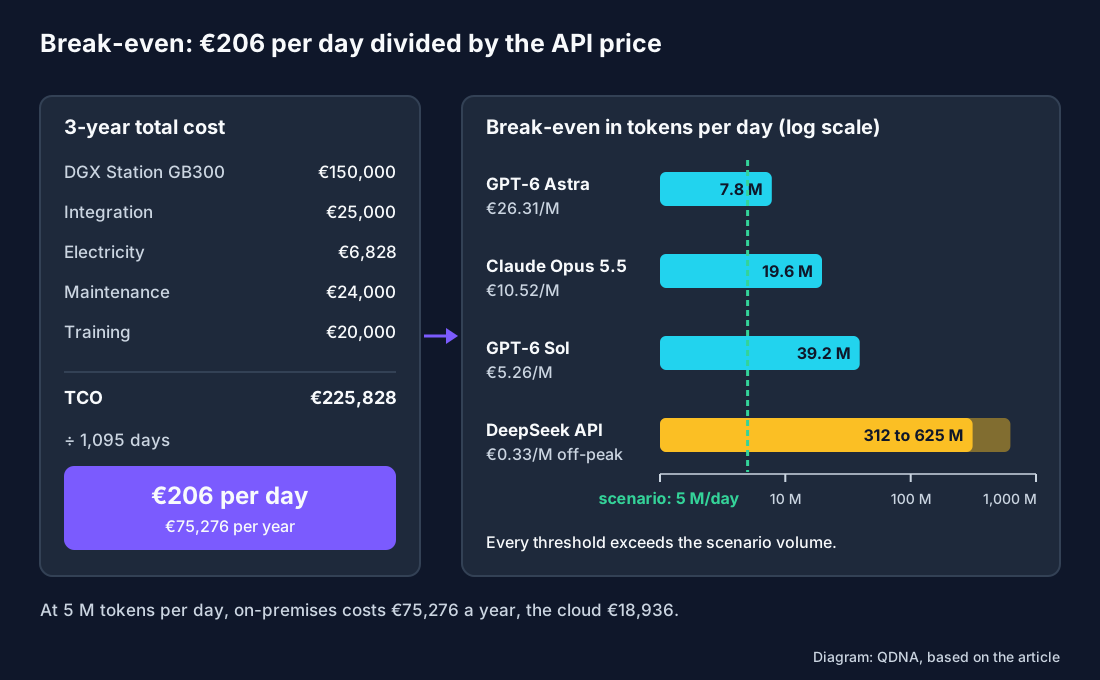
Against the recalculated cloud bill, on-premises costs €75,276 − €18,936 = €56,340 more per year, and still €75,276 − €23,670 = €51,606 with 25% growth; the 2 August version, with a €96,000 cloud bill no price list supported, concluded on a saving. The scenario is therefore not justified by cost: its arguments are data sovereignty (no transfer off-site), the absence of a vendor-imposed rate limit and the ability to fine-tune the model on internal data.
Points of attention
Four points of attention decide whether the deployment succeeds: the runtime memory margin, CPU offload for large models, FP8 calibration of the KV cache and the station's real memory.
- Underestimate runtime overhead: leave at least 3 GB of margin for vLLM runtime, CUDA buffers, and the system. On DGX Spark 128 GB, only 21 GB of KV cache remains after the UD-IQ3_XXS model (104 GB) + overhead (3 GB).
- Enable --cpu-offload-gb for large models: for models that exceed unified memory (like the 167 GB native on DGX Spark 128 GB), CPU offload is mandatory but costs latency.
- Calibrate FP8 KV cache: FP8 KV cache compression halves memory but maintains acceptable precision for most use cases. For critical cases (long reasoning, complex code), prefer BF16.
- Don't forget the B300 downgrade: the DGX Station GB300 delivers 252 GB HBM3e @ 7.1 TB/s instead of the 288 GB @ 8 TB/s announced at GTC 2025. The downgrade is due to using salvaged B300 chips with 7/8 HBM3e stacks. Source: ServeTheHome (GTC 2026).
- Plan updates: DGX OS requires planned restarts at the pace of NVIDIA security updates; plan a maintenance window.
- Train the internal team: the scenario budgets €10,000 and two weeks to train 10 people (5 dev, 3 ops, 2 data), a condition for autonomous operation.
Conclusion
In this scenario, DeepSeek V4 Flash 0731 on a DGX Station GB300 holds technically (167 GB of published weights for 748 GB of memory, one-million-token context) with throughput still to be measured.
Economically, it costs €75,276 per year amortised against a cloud bill recalculated at €18,936, i.e. €56,340 more per year, at the Anthropic price of Claude Opus 5.5 on 26 September 2026, far from the break-even thresholds against APIs at the retained volume. What justifies it is data sovereignty (no transfer off-site), the absence of a vendor rate limit and the stability of a pinned version.
The next step of such a scenario would be a 2× DGX Spark cluster (€14,000 excl. VAT of machines, 2 × €7,000 excl. VAT at the price used from October 2026) for redundancy, sized in our DeepSeek V4 Flash guide for DGX Station and 2× Spark cluster.
References
- DeepSeek V4 Flash 0731, official Hugging Face repository
- DeepSeek V4 technical report (arXiv 2606.19348)
- Unsloth, DeepSeek V4 documentation
- NVIDIA, DGX Spark performance blog
- ServeTheHome, DGX Station GTC 2026
- QDNA sheet: DGX Station
- QDNA sheet: vLLM
- QDNA sheet: DeepSeek V4
Frequently asked questions
How much does a DeepSeek V4 Flash 0731 deployment on DGX Station cost for an SME?
In this scenario, the 3-year total cost of ownership is €225,828: €150,000 excl. VAT for the DGX Station GB300 (price used from October 2026), €25,000 of integration, €6,828 of electricity (1,600 W × 24 h × 365 days × €0.1624/kWh excl. VAT, i.e. €2,276 per year), €24,000 of maintenance and €20,000 of training, i.e. €75,276 per year or €206 per day. Divided by the scenario's 5 M tokens a day, that is €41.2 per million tokens; €20/M would require 10.3 M tokens a day, a throughput not measured.
What is the real-world response time of a DeepSeek V4 Flash 0731 deployment on DGX Station?
It is not measured: no DeepSeek V4 Flash / DGX Station pair appears yet in our measurements section, and the 68 tok/s, 2.6 seconds of prefill and 14.6 ms per token of the 2 August version rested on no visible formula. The only computable ceiling, 7.1 TB/s divided by the 4.8 GB re-read per token in UD-IQ3_XXS, gives about 1,500 tokens/s single-stream, a theoretical value never reached in practice.
How can an SME justify the investment in a DGX Station GB300?
By data sovereignty, the absence of a vendor rate limit and the ability to fine-tune the model on domain data, more than by cost: with a local cost of €206 per day (TCO €225,828 over 1,095 days), break-even is 19.6 M tokens/day against Claude Opus 5.5 ($12/M, €10.52/M) and 312 to 625 M tokens/day against the DeepSeek V4.1 Flash API (price list of 26 September 2026), far above the scenario's 5 M tokens/day.
What are the pitfalls to avoid when deploying DeepSeek V4 Flash 0731 on DGX Station?
The main pitfalls are: underestimating runtime overhead (3 GB minimum), not enabling --cpu-offload-gb for models > 128 GB, neglecting FP8 KV cache calibration, and forgetting the B300 downgrade (252 GB / 7.1 TB/s instead of 288 GB / 8 TB/s announced). See the Points of attention section.
How to measure the ROI of a DeepSeek V4 Flash 0731 deployment on DGX Station?
Compute the total cost of ownership (TCO) over 3 years: purchase + electricity + integration + maintenance + training, divide it by 1,095 days, then divide that daily cost by the API price per million tokens (input and output mixed, off-peak and peak hours for DeepSeek): the quotient is the daily volume above which on-premises costs less. Add the value of sovereignty (no data transfer, no rate-limit, no deactivation risk).