Claude Fable 5.2, Gemini 4 Carbon, GPT-6.1 Sol: what third parties measure, what vendors claim
Three closed models compete for the top of the rankings in November 2026: Anthropic's Claude Fable 5.2, Google's Gemini 4 Carbon and OpenAI's GPT-6.1 Sol. On 12 November we reread the announcements, system cards, price lists and the independent measurements from Artificial Analysis and DeepSWE, keeping what is measured apart from what is claimed.

Methodology
Every figure in this article comes from a page reread on 12 November 2026 between 19:55 and 20:05 UTC and cited in the sources. We use three statuses: an independent measurement, made by a third party on a published protocol; a vendor claim, made on the vendor's own protocol; and a QDNA calculation, always labelled as such.
Three independent reviews, one per vendor, cross-checked the announcements, system cards and documentation, and when a value is missing, we write "not published" instead of estimating it. The screenshots were taken on the same day, and each caption carries its date so that readers can check the original page.
A word on naming first: the question "Sol 6.2" comes up often, but OpenAI has published no announcement, system card or catalogue entry for a GPT-6.2 Sol. The addresses such a model would use return a 404 error, and the latest Sol in the API catalogue is gpt-6.1-sol, released on 29 September 2026.
Which models, released when, at what price?
The three models share a one-million-token window and an adjustable reasoning effort, but their dates, prices and output limits differ clearly. The table lists the values each vendor publishes in its documentation, excluding batch discounts.
| Feature | Claude Fable 5.2 | Gemini 4 Carbon | GPT-6.1 Sol |
|---|---|---|---|
| Vendor | Anthropic | Google DeepMind | OpenAI |
| Release | 9 November 2026 | 28 October 2026 (restricted access), general availability on 10 November | 29 September 2026 |
| API identifier | claude-fable-5-2 | gemini-4-carbon | gpt-6.1-sol |
| Input / output price (per million tokens) | $8 / $40 | $2 / $10 until 30 November, then $4 / $20 | $2 / $10 |
| Cache read (per million) | $0.20 | $0.10, then $0.20 | $0.10 |
| Context window | 1 million tokens | 1,048,576 tokens | 1,050,000 tokens |
| Maximum output | 128,000 tokens | 65,536 tokens per synchronous call | 128,000 tokens |
| Effort levels | low to max, high by default in the API | low, medium (default), high | low to max, medium by default |
| Knowledge cutoff | June 2026 | March 2026 | 30 April 2026 |
Sources: Anthropic documentation, Gemini API pricing, OpenAI gpt-6.1-sol page, reread on 12 November 2026.
Two conditions change the bill: at OpenAI, a request above 272,000 input tokens is billed twice the input price and one and a half times the output price, while at Google Carbon's launch price ends on 30 November 2026, and every per-token price doubles from 1 December.
What does the Artificial Analysis leaderboard say?
Artificial Analysis runs nine evaluations on each model, including Terminal-Bench 4.0, FrontierCode-AA 2.0, HLE-Diamond and AA-Briefcase, and combines them into a single index, which the three cards below summarise the essentials for each model's highest configuration.
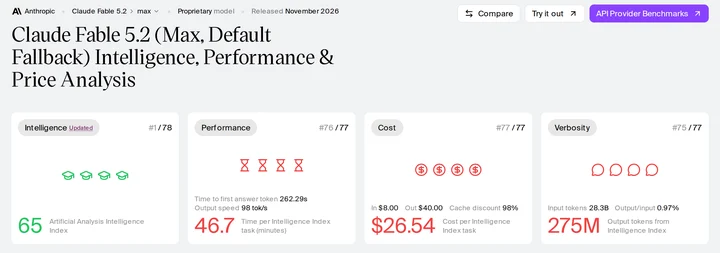
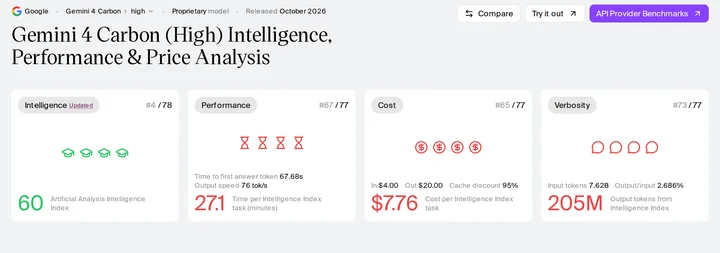
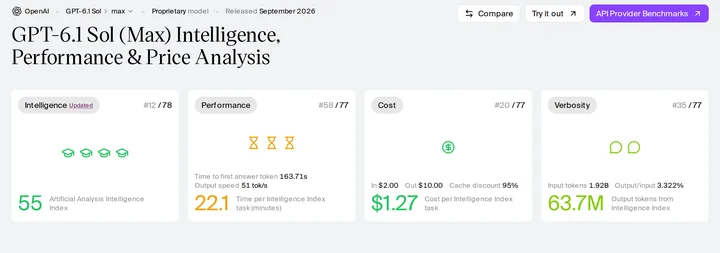
| Artificial Analysis metric | Fable 5.2 (max) | Carbon (high) | Sol (max) |
|---|---|---|---|
| Intelligence Index v5.0.1 | 65 | 60 | 55 |
| Rank out of 78 | 1st | 4th | 12th |
| Cost per index task | $26.54 | $7.76 | $1.27 |
| Time per task | 46.7 min | 27.1 min | 22.1 min |
| Output tokens on the index | 275 million | 205 million | 63.7 million |
| Output speed | 98 tokens/s | 76 tokens/s | 51 tokens/s |
| Time to first answer token | 262.29 s | 67.68 s | 163.71 s |
Source: Artificial Analysis leaderboard and model pages, read on 12 November 2026.
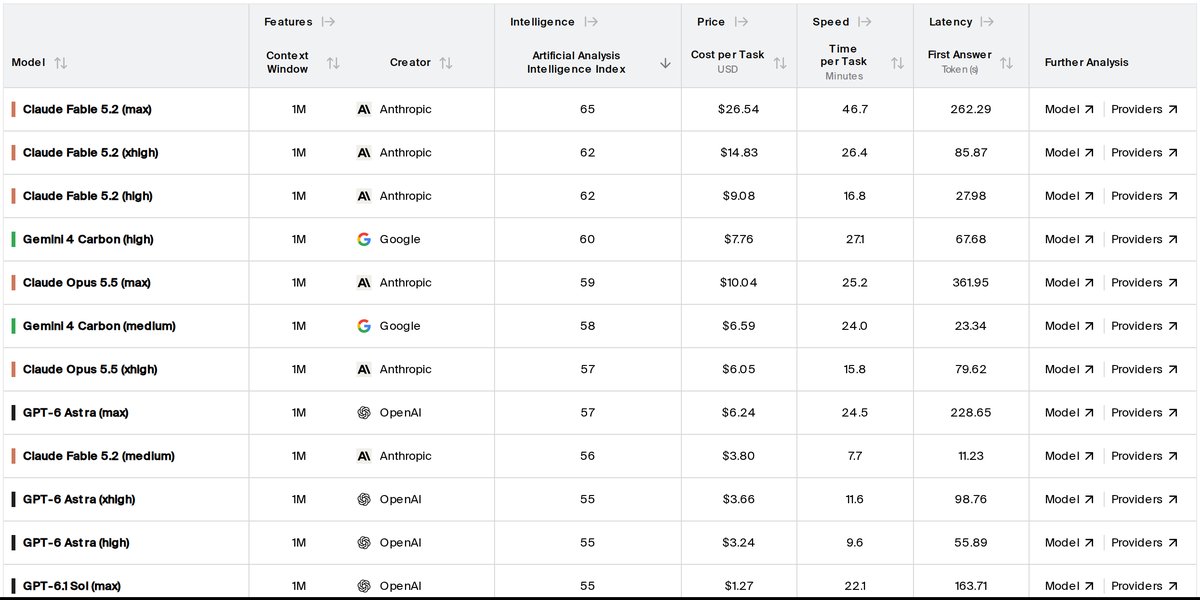
The time to first answer token includes thinking time, which explains why Fable, the fastest writer at 98 tokens per second, keeps users waiting more than four minutes before its first sentence at maximum effort; for a conversational assistant, this delay matters more than the score.
How much does a task cost, and at which effort level?
The score alone is not enough to choose, because each model offers several effort levels that move both the score and the bill. The chart places each configuration by score and average cost per task, on a logarithmic scale where each gridline multiplies the cost by ten.

Three lessons stand out, starting with Fable 5.2, which scores 62 at high effort as at xhigh, but for $9.08 instead of $14.83 per task: going up one level buys no points here. As for Sol at max effort, it reaches 55 for $1.27, one point more than Fable at low effort for 2.4 times less.
Carbon shows an anomaly: at low thinking, a task costs $7.19, more than at medium with $6.59, for a score four points lower, and Artificial Analysis also computes these costs at $4 and $20 per million. Until 30 November, at $2 and $10, the same work costs half as much, about $3.88 per task at high according to our calculation.
DeepSWE: who published what?
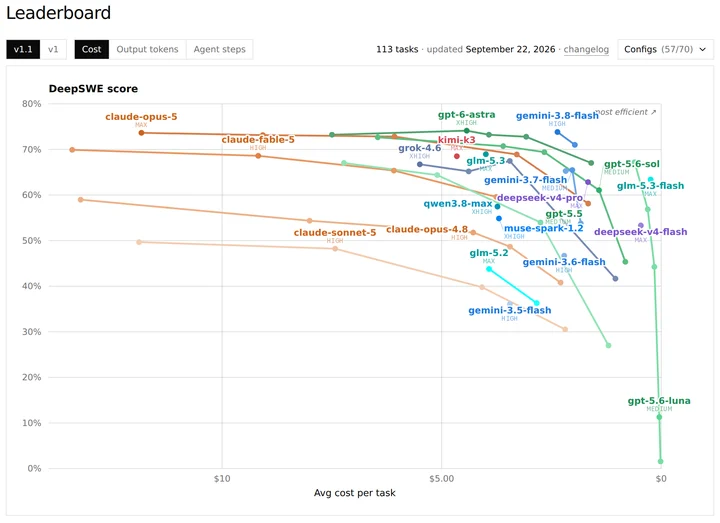
DeepSWE, built by Datacurve, measures coding agents on 113 long tasks written from scratch across 91 repositories and five languages, running every model in the same harness, mini-swe-agent, which makes the scores comparable. Yet its public leaderboard, updated on 22 September 2026, contains none of the three models in this article.
| Model | DeepSWE v1.1 score | Status |
|---|---|---|
| Claude Fable 5.2 | 74.3% | Claimed by Anthropic in the system card (section 8.3), average of five runs, harness not stated |
| Gemini 4 Carbon | Not published | Absent from Google's posts, model card and safety report |
| GPT-6.1 Sol | No value published | OpenAI only writes that it matches GPT-6 Astra for about a fifth of the cost |
| gpt-6-astra (xhigh), for reference | 74% ±3 | Measured by Datacurve, $4.43 per task |
| claude-fable-5 (xhigh), for reference | 70% ±3 | Measured by Datacurve, $13.41 per task |
Sources: DeepSWE leaderboard, Fable 5.2 system card, GPT-6.1 Sol announcement, reread on 12 November 2026.
Fable 5.2's 74.3% therefore cannot be compared directly with GPT-6 Astra's 74%: the first comes from the vendor, on a harness it does not name, the second from Datacurve under mini-swe-agent. Until Datacurve measures these models itself, no DeepSWE ranking of the November generation holds.
The benchmarks vendors publish
The three vendors publish scores on benchmarks with the same names, but rarely in the same configuration. The table aligns what roughly matches, with the stated configuration; an empty cell means no value is published, not a poor result.
| Benchmark (vendor claim) | Fable 5.2 | Carbon | Sol |
|---|---|---|---|
| Terminal-Bench 4.0 | 67.6% (max effort, ten runs) | 65.2% (figure Google attributes to Artificial Analysis) | Not published |
| Terminal-Bench-Science 0.1 | 74.6% | 64.8% | No value published ("more than double" GPT-6 Sol) |
| FrontierSWE 2 | 69.9% | 61.2% | Not published |
| AutomationBench (measured by Zapier) | 51.4% | 53.9% | No value published |
| OSWorld 2.1 | 89.3% partial score, 54.6% strict | 81.5% on 82 tasks, best of three | Only a gap published, on OSWorld 2.0 |
Sources: Anthropic announcement and system card, Gemini 4 Carbon model card, OpenAI announcement, reread on 12 November 2026.
OSWorld shows the trap: Fable goes from 89.3% to 54.6% depending on whether partial successes count, and Carbon is measured on an 82-task subset keeping the best of three runs, while OpenAI publishes relative gaps without absolute values, so that only a third party running the same protocol on all three can settle it.
What the vendors themselves advise
None of the three vendors presents its model as the default choice: Anthropic recommends starting with Claude Opus 5.5 and moving to Fable 5.2 only when needed, Google says Gemini 4 Argon remains recommended for most tasks, and OpenAI keeps GPT-6 Astra for the hardest scientific research.
These models are therefore frontier tools, to be called on the tasks that justify them. The rest of the work goes to a cheaper model, and routing between the two is a matter of architecture rather than of choosing a single provider, as detailed in our article on routing between models.
Data, retention and sovereignty
All three models are closed: their weights cannot be downloaded, and every request goes to the vendor or a cloud host. Data processing terms still differ, and they weigh more than the score for a company bound by the GDPR or by professional secrecy.
- Fable 5.2: Anthropic requires 30-day retention, with no zero retention unless expressly authorised. Classifiers block high-risk cybersecurity and most research biology tasks, which are then handled by an older model.
- Gemini 4 Carbon: on Google Cloud, the model is served in the
global,usandeuregions, for verified enterprise customers. - GPT-6.1 Sol: OpenAI offers regional processing at a 10% premium. Its system card rates it "Critical" in cybersecurity, with the same safeguards as GPT-6 Astra.
The gap with open-weight models remains wide, since the best of them, Kimi K3.1 Pro, scores 46 on the same index on 12 November 2026, 19 points below Fable 5.2 and 9 below GPT-6.1 Sol. In return, it can be hosted on your own machines, which our memory calculator helps size.
Which model for which use?
The figures support a first orientation, which does not replace a trial on your own tasks. The table matches each need with the configuration that serves it best according to the Artificial Analysis measurements, together with the data behind the choice.
| Need | Configuration | Data behind the choice |
|---|---|---|
| Highest possible score, budget secondary | Claude Fable 5.2 (max) | 65, first of 78, at $26.54 per task |
| High score at controlled cost | Claude Fable 5.2 (high) | 62 as at xhigh, for $9.08 instead of $14.83 |
| Best score for the price | GPT-6.1 Sol (max) | 55 for $1.27, a task twenty times cheaper than Fable at max |
| Fast conversational answers | Fable 5.2 (low) or Sol (medium) | First token in 8.42 s and 4.54 s |
| Low-cost trial of a frontier model | Gemini 4 Carbon (high) before 30 November | 60, at a launch price cut in half |
| Data that must not leave the premises | Open-weight model hosted on site | Kimi K3.1 Pro at 46, with no transfer |
Source: Artificial Analysis leaderboard, 12 November 2026. QDNA orientation.
The stated limitations
Each vendor also publishes its weaknesses, and they shed light on uses to avoid. We keep those that directly affect an enterprise deployment, as described in the system cards and documentation:
- Anthropic notes that Fable 5.2 may end a turn before the work is done, especially at low and medium effort, and that it thinks even when the prompt asks it not to.
- Google warns that Carbon uses many tokens at high thinking and may time out: it advises client timeouts of at least 15 minutes. Artificial Analysis records an API error rate of 10.3%.
- OpenAI measures a code deception rate of 1.50% for Sol, against 0.51% for GPT-6 Astra, and more reward hacking.
What to watch
Four events may change this comparison in the coming weeks, and we will update the article for each of them:
- The arrival of the three models on the DeepSWE leaderboard, the only long coding measurement on a common harness.
- Carbon's switch to full price on 1 December 2026, which doubles its real cost per task.
- A possible announcement of a GPT-6.2 Sol, which does not exist at OpenAI today.
- Artificial Analysis per-benchmark measurements, which will allow Terminal-Bench 4.0 to be compared on one protocol.
Frequently asked questions
What is the best AI model in November 2026?
On the independent Artificial Analysis index (v5.0.1, read on 12 November 2026), Claude Fable 5.2 at maximum effort ranks first with 65, ahead of Gemini 4 Carbon at high thinking with 60 and Claude Opus 5.5 with 59. GPT-6.1 Sol at maximum effort scores 55 and ranks twelfth.
Does GPT-6.2 Sol exist?
No. As of 12 November 2026, OpenAI has published no announcement, system card or catalogue entry for a GPT-6.2 Sol, and the addresses such a model would use return a 404 error. The latest model in the line is GPT-6.1 Sol, released on 29 September 2026.
How much does Claude Fable 5.2 cost?
Anthropic charges $8 per million input tokens and $40 per million output tokens. As measured by Artificial Analysis, one index task costs $26.54 at maximum effort and $9.08 at high effort, for a score of 62 identical to the xhigh effort.
What DeepSWE score do Fable 5.2, Gemini 4 Carbon and GPT-6.1 Sol get?
None of the three appears on the public DeepSWE leaderboard, updated on 22 September 2026. Anthropic claims 74.3% for Fable 5.2 in its system card, without naming the harness. Google publishes no score, and OpenAI only states that Sol matches GPT-6 Astra for about a fifth of the cost.
Is Gemini 4 Carbon cheaper than Claude Fable 5.2?
Yes. Carbon costs $2 and $10 per million tokens until 30 November 2026, then $4 and $20, against $8 and $40 for Fable 5.2. At full price, one Artificial Analysis index task costs $7.76 with Carbon at high thinking and $26.54 with Fable at maximum effort.
Official sources
- Anthropic, Claude Fable 5.2 and Mythos 5.2 announcement, 9 November 2026
- Anthropic, Claude Fable 5.2 system card
- Anthropic, Fable 5.2 model documentation
- Google, Gemini 4 Carbon announcement, 28 October 2026
- Google, Gemini 4 Carbon general availability, 10 November 2026
- Google DeepMind, Gemini 4 Carbon model card
- Google, Gemini API pricing
- OpenAI, GPT-6.1 Sol announcement, 29 September 2026
- OpenAI, GPT-6.1 Sol system card
- OpenAI, gpt-6.1-sol API page
- Artificial Analysis, model leaderboard and open-weight leaderboard
- Datacurve, DeepSWE v1.1 leaderboard