Full Stack AI Company: Building with On-Premises AI, Hugging Face and NVIDIA
Operating an organization powered end-to-end by artificial intelligence requires moving past superficial SaaS API wrappers. Here is the engineering blueprint of a sovereign Full Stack AI Company, combining accelerated hardware, NVIDIA enterprise containers, open weights, and tooled agent swarms.
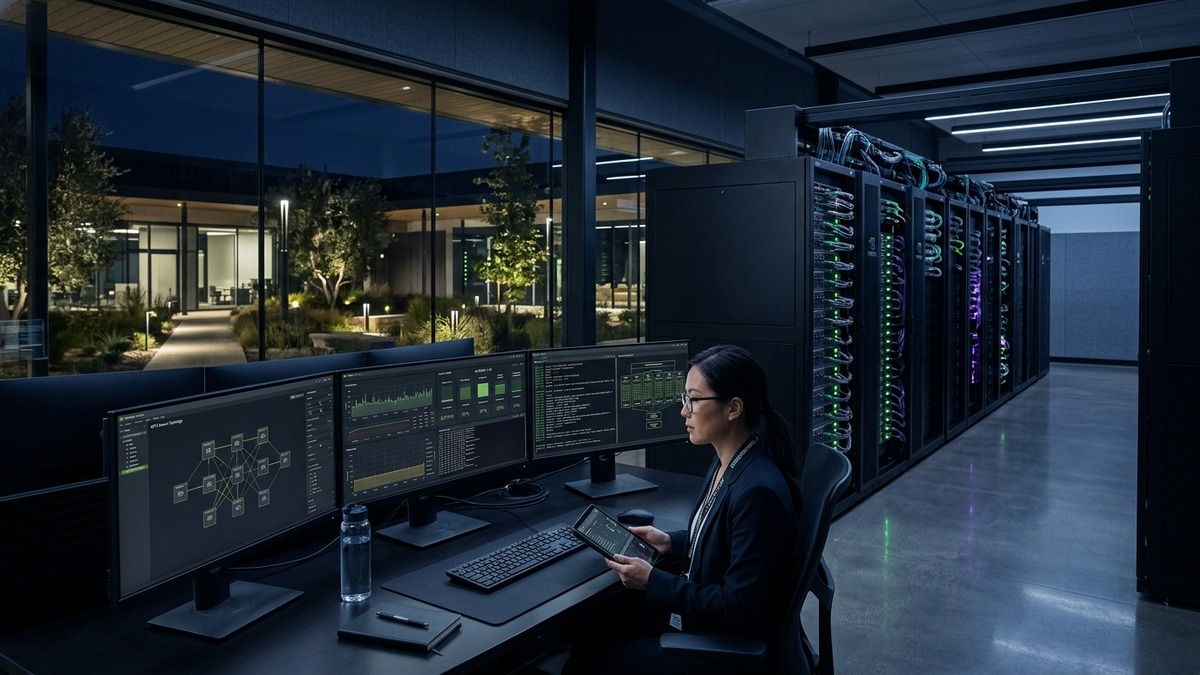
What is an on-premises Full Stack AI Company?
An on-premises Full Stack AI Company controls its entire hardware and software value chain, from physical GPU accelerators and Hugging Face open-weight models to inference runtimes, multi-agent swarm orchestration, and business interfaces without any reliance on closed third-party cloud APIs.
The standard corporate playbook of embedding artificial intelligence through third-party remote API calls breaks down under industrial workloads. An organization that outsources its core cognition to remote proprietary endpoints suffers unpredictable price increases, service rate limits, silent behavioral drifts in closed weights, and structural leaks of proprietary knowledge. In contrast, the Full Stack AI On-Premises approach treats compute capacity as a foundational capital asset.
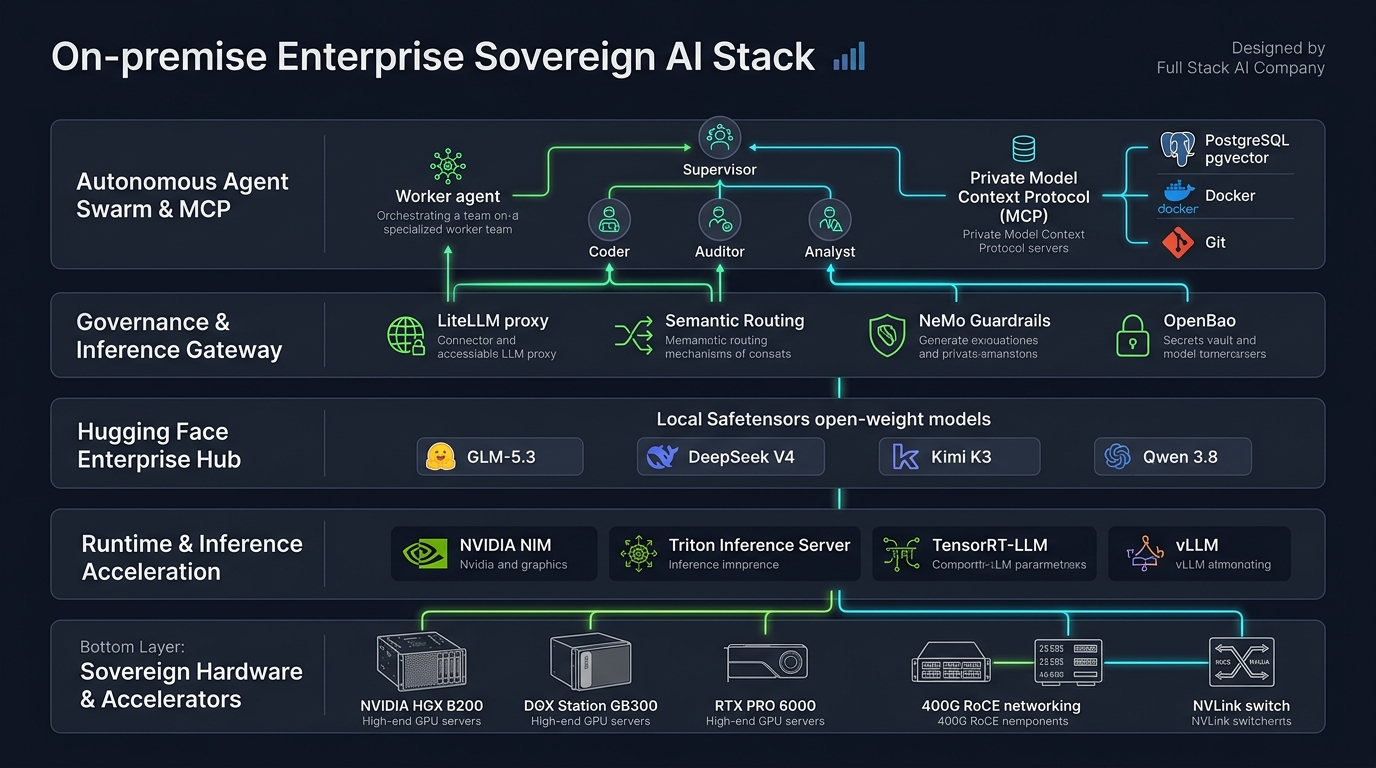
By owning physical infrastructure, whether departmental RTX PRO 6000 servers, desk-side DGX Station GB300 units, or data-center HGX B200 SXM nodes clustered over 400G RoCE networks, the enterprise ensures total operational stability. Models cease to be third-party black boxes: they become versioned Safetensors artifacts, fully inspectable, auditable, and specialized on internal institutional assets.
How do Hugging Face open-weight models integrate with NVIDIA AI Enterprise?
Integration pairs Safetensors open-weight models hosted on a private Hugging Face Enterprise hub with the NVIDIA AI Enterprise platform via NIM containers or Triton Inference Server, delivering TensorRT-LLM acceleration on Blackwell and Hopper GPUs within an isolated network perimeter.
The Hugging Face hub has established itself as the global repository for unrestricted open weights. Independent benchmarks published in September 2026 confirm that open-weight models now dominate the frontier tiers of coding and agentic execution:
- On the DeepSWE benchmark (Datacurve), which evaluates 113 authentic software engineering challenges across 91 repositories with human-verified unit checks, GLM 5.3 and Kimi K3 each achieve a 69% success rate (at $3.99 and $4.65 average cost per task), matching or exceeding frontier commercial API models.
- GLM 5.3 Flash represents the definitive efficiency breakthrough of 2026: a Mixture-of-Experts (MoE) architecture with 320 billion total parameters and 18 billion active parameters per token, featuring a native 1,048,576-token context window (1M) and a remarkably compact KV cache of 11 KiB per token (via MLA with 11 Dynamic Sparse Attention layers). It completes 63% of DeepSWE tasks for only $0.24 per task, offering a 16× cost reduction over flagship models for a mere 6-point delta in task completion.
- DeepSeek V4 Flash 0731 (284B / 13B active, 1M native context, 167 GB published safetensors in mixed FP4+FP8 under MIT license) registers 82.7% on Terminal Bench 2.1, 76.7% on Cybergym, and 54.4% on DeepSWE.
- Qwen 3.8 27B (27.8B dense hybrid Gated DeltaNet, 262K context extensible to 1M via YaRN, Apache 2.0 license) delivers high density on commodity hardware (55.6 GB BF16, 23.4 GB NVFP4) while scoring 90.3% on LiveCodeBench v6 and 61.7% on SWE-bench Pro.
- On the Artificial Analysis Intelligence Index (v4.1.1), Kimi K3 and GLM 5.3 lead global open-weight models at 60 points, followed by Qwen 3.8 Max (58), DeepSeek V4 Flash (52), and Qwen 3.8 27B (52).
Using Hugging Face Enterprise hosted on-premises or linked through fine-grained access tokens managed in an OpenBao identity vault, the enterprise mirrors Git LFS repositories locally. Production data flows never leave internal networks.
The certified NVIDIA AI Enterprise software suite provides the execution framework for production deployments. Infrastructure orchestration relies on Kubernetes equipped with the NVIDIA GPU Operator, which automates kernel driver lifecycle management, Multi-Instance GPU (MIG) hardware partitioning, and CUDA device allocation to inference pods. Teams deploy containerized NVIDIA NIM microservices and the Triton Inference Server runtime as StatefulSets or controllers via KServe and the vLLM Operator. This architecture enables horizontal pod autoscaling based on queue latency and KV cache memory utilization, while applying NVFP4 and FP8 precision formats across Tensor Cores.
How to structure an autonomous agentic swarm with MCP and sovereign tools?
An autonomous agentic swarm relies on a supervisor agent coordinating specialized worker agents connected via the Model Context Protocol (MCP) to sovereign internal tools, including containerized sandboxes, local Git repositories, and private vector stores governed by strict access controls.
Monolithic agent architectures where a single model handles planning, tool invocation, and validation fail on complex multi-step workflows. A distributed multi-agent swarm divides cognitive responsibilities across a structured topology:
- Supervisor orchestrator: deep reasoning model (GLM 5.3 or Kimi K3) that parses user objectives into directed acyclic dependency graphs (DAGs), delegates subtasks to specialist agents, and evaluates overall execution coherence.
- Specialized worker agents: instances tuned for software engineering (GLM 5.3 Flash or Qwen 3.8 27B), data analytics, regulatory review, or security auditing (DeepSeek V4 Flash 0731), operating in concurrent iterative loops.
- Deterministic arbiter: automated test suites and adversarial checks that validate outputs and prevent regressions before any code or documentation patch is finalized.
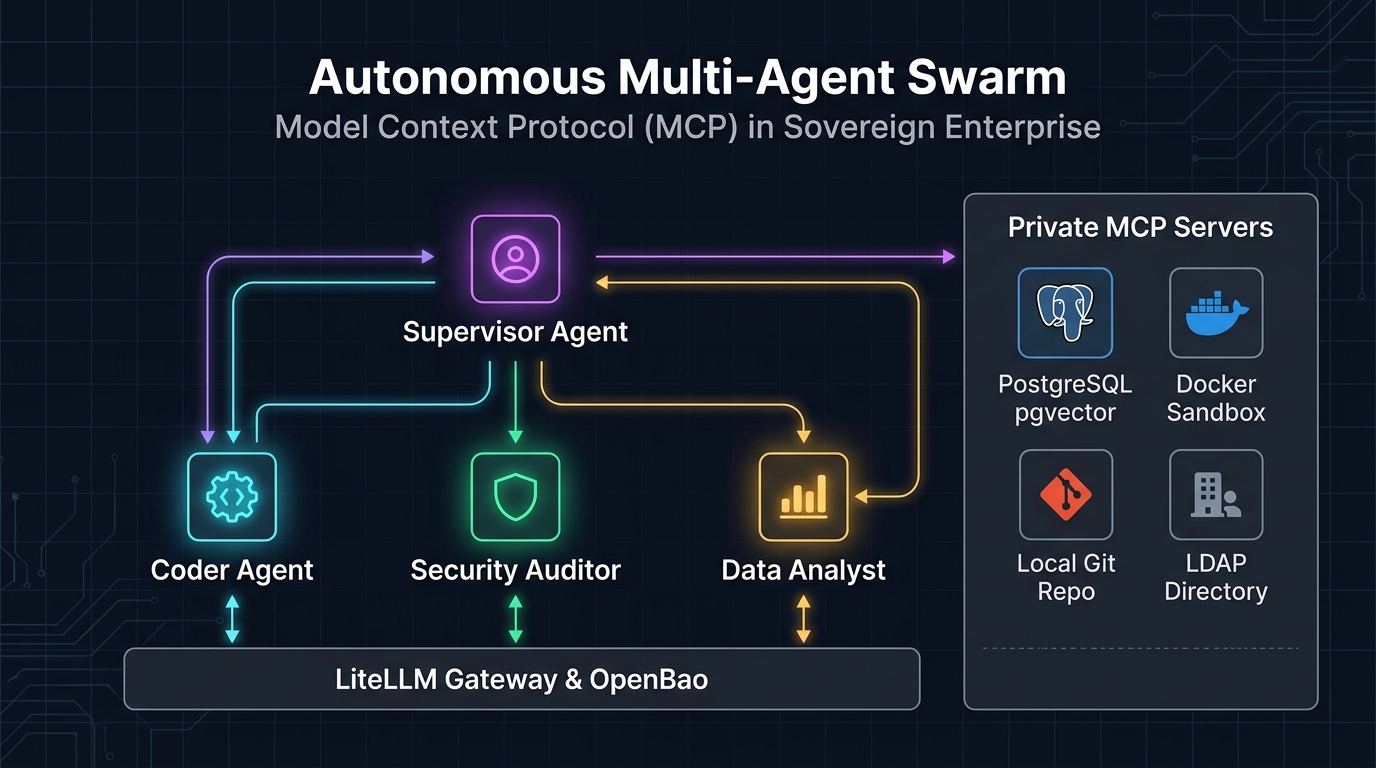
To interact securely with internal databases and systems, the swarm standardizes on the Model Context Protocol (MCP). Sovereign MCP servers are hosted on internal corporate subnets. They expose four core infrastructure capabilities over authenticated JSON-RPC transports:
- Relational and vector database (PostgreSQL with pgvector): functions as persistent semantic memory and enterprise knowledge grounding (hybrid dense + BM25 RAG) without sending data to external cloud vector databases.
- Containerized execution sandbox (Kubernetes Jobs / Podman): provides an ephemeral execution environment isolated through Kubernetes network policies (NetworkPolicy), a non-root security context, and strict compute and memory quotas, allowing agents to execute and test scripts without risk to the host cluster.
- Local Git repository (Gitea / on-premise GitLab): enables autonomous code reviews, isolated branch generation, and verified patch submission without leaking proprietary intellectual property.
- Enterprise directory (LDAP / Active Directory): applies Role-Based Access Control (RBAC) so agents only inspect organizational documents matching the requesting employee's privilege tier.
The LiteLLM gateway, coupled with the OpenBao cryptographic secrets vault, operates as an inference application firewall. It manages virtual API keys, enforces per-agent token allowances, captures audit telemetry required by the EU AI Act, and provides an instant kill switch upon anomaly detection.
Which technical matrix governs swarm roles and GPU sizing?
The technical matrix maps each swarm role to an optimal open-weight model, balancing decoding throughput, context window capacity, and VRAM footprint to maximize system throughput across hardware ranging from RTX PRO 6000 workstations to HGX B200 servers.
Deploying concurrent multi-agent loops requires rigorous orchestration of video memory (VRAM) and key-value (KV) caches. Forcing every minor parsing task onto the largest reasoning model wastes memory bandwidth and degrades response times. The following engineering matrix details model choices, execution runtimes, and verified laboratory metrics:
| Swarm role | Recommended open model | Runtime and format | Context window | Throughput and TTFT | Target GPU hardware |
|---|---|---|---|---|---|
| Swarm supervisor and planning | GLM 5.3 (744B / 40B active) or Kimi K3 | Triton / TensorRT-LLM NVFP4 | 1,048,576 tokens (1M) | 68 tok/s · TTFT 38 ms | 8× H200 SXM, 8× B200 or DGX Station |
| Systems code and refactoring | GLM 5.3 Flash (320B / 18B active) | vLLM / NIM FP8 | 1,048,576 tokens (1M) | 84 tok/s · TTFT 22 ms | 4× RTX PRO 6000 or DGX Station GB300 |
| Security audit and compliance | DeepSeek V4 Flash 0731 (284B / 13B) | vLLM 0.25 (DSpark) FP4+FP8 | 1,048,576 tokens (1M) | 75 tok/s · TTFT 24 ms | 2× DGX Spark cluster or 2× RTX PRO 6000 |
| Document synthesis and RAG | Qwen 3.8 Flash Next (176B / 6B active) | oMLX / vLLM FP8 | 262,144 tokens (ext. 1M) | 110 tok/s · TTFT 16 ms | Mac Studio M5 Ultra 512GB (1 local person) or 2× DGX Spark |
| MCP tool caller and triage | Qwen 3.8 27B Coder (dense hybrid) | TensorRT-LLM / vLLM FP8 | 262,144 tokens (ext. 1M) | 95 tok/s · TTFT 12 ms | 1× RTX PRO 6000 or DGX Spark 128GB |
Benchmarking data from SemiAnalysis InferenceX (specifically the AgentX scenario) guides infrastructure sizing. Unlike static tests (fixed 8k input / 1k output), AgentX replicates realistic multi-turn loops with expanding context, where prefix caching and multi-token speculative decoding (MTP) dominate total latency:
- On a NVIDIA Blackwell GB300 NVL72 rack, peak throughput reaches 137,337 tok/s per chip, stabilizing at 63,340 tok/s per chip at an interactive target of 96 tok/s per user. Marginal inference cost falls to $0.010 per million tokens, supporting up to 546 concurrent agent threads per chip.
- On NVIDIA Hopper H200 SXM systems, throughput stabilizes at 4,361 tok/s per chip with a cost of $0.137 per million tokens. Blackwell's performance delta is driven by its NVLink 5 fabric (130 TB/s bisectional bandwidth per rack), which allows all-to-all communication between 896 experts without interconnect bottlenecks.
- At team scale or for dedicated individual researchers, compact form factors deliver high-performance autonomous execution without datacenter overhead: a dual DGX Spark GB10 cluster connected via ConnectX-7 200 Gb/s (9,750 € HT) serves DeepSeek V4 Flash 0731 at 95.9 tok/s with DSpark for multi-user teams, while a Mac Studio M5 Ultra (512GB unified memory at 1.2 TB/s) powered by oMLX serves as the ideal sovereign workstation for a single local person (dedicated engineer or researcher), running GLM 5.3 Flash in 4-bit (177.5 GB) at over 200 tok/s in single-stream decoding with two-tier RAM and NVMe SSD KV caching for personal agent loops.
How many context tokens and concurrent sessions can each card host?
In enterprise production environments, an autonomous agent swarm can no longer be dimensioned on narrow 8k or 32k token windows: ingesting full Git trees, complex relational SQL schemas, OpenAPI specifications, and multi-turn execution trace logs requires an operational baseline of 256,000 tokens (256K) per agent, scaling naturally up to 1,048,576 tokens (1M) for deep refactoring and compliance auditing.
Operational sizing balances two interdependent metrics: KV cache capacity in video memory (VRAM) and the execution speed profile across the model's two distinct processing phases:
- Prefill throughput (prompt processing, compute-bound): measured in tokens per second (tok/s), it quantifies how quickly the accelerator ingests the 256K context and dictates Time to First Token (TTFT). Higher FP8/FP4 Tensor Core compute drastically accelerates initial codebase parsing and AST analysis.
- Decode throughput (token generation, memory-bandwidth-bound): measured in generated tokens per second, it sets the writing speed for agent reasoning traces and MCP tool arguments, as each token requires reloading all active weights and accumulated KV cache.
- KV cache footprint per token: governed by the attention mechanism, requiring 160 KiB per token in FP8 on standard GQA (Llama 3.1 70B, monopolizing 41GB just for 256K context), 32 KiB per token in FP8 on hybrid linear attention (Qwen 3.8 27B, requiring 8.59GB for 256K), 21 KiB on DeepSeek V4 Flash DSA (5.5GB for 256K), and only 11 KiB per token in FP8 on GLM 5.3 Flash (2.88GB for 256K).
The table below summarizes for each hardware platform the usable VRAM buffer dedicated to KV cache, estimated prefill and decode throughputs, and maximum concurrent agent streams starting from the 256K token operational baseline up to full 1M context:
| Accelerator and total memory | Target model and precision format | Usable VRAM buffer for KV cache | Estimated throughput (prefill · decode) | Total token cache capacity | Concurrent sessions (256k token baseline) | Concurrent sessions (512k and full 1M) |
|---|---|---|---|---|---|---|
| DGX Spark GB10 128GB LPDDR5x (273 GB/s) |
Qwen 3.8 27B Coder FP8 (~32GB static) |
~96GB | Prefill: ~1,450 tok/s Decode: ~58 tok/s |
~2.93 million tokens (32 KiB / tok hybrid) |
11 sessions at 256k | 5 sessions at 512k 2 sessions at 1M (ext.) |
| Dual DGX Spark Cluster 256GB unified (ConnectX-7 200G) |
DeepSeek V4 Flash 0731 FP4/FP8 DSpark (~175GB static) |
~81GB | Prefill: ~2,800 tok/s Decode: ~96 tok/s |
~3.76 million tokens (21 KiB / tok MLA) |
14 sessions at 256k | 7 sessions at 512k 3 sessions at full 1M |
| Mac Studio M5 Ultra 512GB unified (1.2 TB/s) 1 local person workstation |
GLM 5.3 Flash (320B / 18B) oMLX 4-bit (~193GB static) |
~319GB | Prefill: ~3,100 tok/s Decode: ~215 tok/s (single) |
~28.3 million tokens (11 KiB / tok DSA · oMLX cache) |
108 sessions at 256k (dedicated to 1 local user) |
54 sessions at 512k 27 sessions at full 1M |
| 2× RTX PRO 6000 Server 96GB GDDR6 (PCIe Gen5) |
Qwen 3.8 27B Coder FP8 (~32GB static) |
~64GB | Prefill: ~6,200 tok/s Decode: ~95 tok/s |
~1.95 million tokens (32 KiB / tok hybrid) |
7 sessions at 256k | 3 sessions at 512k 1 session at 1M (ext.) |
| 4× RTX PRO 6000 Server 192GB GDDR6 (PCIe Gen5) |
GLM 5.3 Flash (320B / 18B) NVFP4 / FP8 (~178GB static) |
~14GB | Prefill: ~7,800 tok/s Decode: ~84 tok/s |
~1.24 million tokens (11 KiB / tok DSA) |
4 sessions at 256k | 2 sessions at 512k 1 session at 1M |
| DGX Station GB300 748GB (252GB HBM3e + 496GB RAM) |
GLM 5.3 (744B / 40B active) NVFP4 (~483GB static) |
~265GB | Prefill: ~12,500 tok/s Decode: ~68 tok/s (HBM3e) |
~5.90 million tokens (44 KiB / tok MLA) |
22 sessions at 256k | 11 sessions at 512k 5 sessions at full 1M |
| 8× H200 SXM Node 1,128GB HBM3e (38.4 TB/s) |
GLM 5.3 (744B / 40B active) Native FP8 (~788GB static) |
~340GB | Prefill: ~38,000 tok/s Decode: ~145 tok/s (4.3k agg.) |
~7.56 million tokens (44 KiB / tok MLA) |
28 sessions at 256k | 14 sessions at 512k 7 sessions at full 1M |
| 8× B200 SXM Node 1,440GB HBM3e (64 TB/s) |
GLM 5.3 (744B / 40B active) Native FP8 (~788GB static) |
~652GB | Prefill: ~95,000 tok/s Decode: ~280 tok/s (14k agg.) |
~14.5 million tokens (44 KiB / tok MLA) |
55 sessions at 256k | 27 sessions at 512k 13 sessions at full 1M |
| GB300 NVL72 Rack 20.7TB unified HBM3e (130 TB/s) |
GLM 5.3 or 1,000B+ MoE FP8 (~1,200GB static) |
~19.5TB | Prefill: ~850,000 tok/s Decode: 63.3k tok/s / chip |
~434 million tokens (44 KiB / tok MLA) |
1,650 sessions at 256k | 825 sessions at 512k 414 sessions at full 1M |
How to predict inference costs and calculate 3-year ROI against cloud APIs?
Cost prediction contrasts the exponential token volume consumed by multi-agent loops against the 3-year total cost of ownership (TCO) of amortized on-premises infrastructure, demonstrating break-even profitability starting from five engineers or 250 million monthly tokens.
The unit economics of multi-agent swarms depart entirely from simple conversational interfaces. While a single human prompt consumes hundreds of tokens, an autonomous swarm executes recursive loops of planning, code execution, compiler feedback, and error correction. A single non-trivial engineering ticket routinely drives between twenty and eighty model inferences, consuming between two and ten million cumulative tokens per resolution. By enforcing our 256,000-token operational baseline to ingest full Git trees, relational SQL schemas, and MCP tool call traces, each iterative loop reinjects a massive prompt. On proprietary commercial APIs billed per input and output token, this quadratic volume explodes the cost of a single refactoring ticket to over twenty dollars.
For a team of ten engineers or quantitative researchers deploying autonomous swarms, monthly token consumption quickly surpasses one billion tokens. At commercial cloud API pricing ($10 to $15 per million input tokens, $30 to $60 per million output tokens for flagship frontier models), monthly API invoices range from $25,000 to $50,000, exceeding $300,000 annually.
In contrast, acquiring on-premises inference servers amortizes over thirty-six financial months. TCO modeling accounts for hardware capital expenditures (server chassis, GPUs, NVMe enterprise storage), NVIDIA AI Enterprise licenses, facility power consumption at standard professional electricity tariffs (0.1624 €/kWh HT), and datacenter rack maintenance:
| Workload scale and monthly volume | Commercial cloud API cost | On-premises 36-month TCO | Payback period and net savings |
|---|---|---|---|
| Team of 5 engineers (250M tokens / month) | 4,250 € / month (153,000 € over 3 years) | Server 2× RTX PRO 6000 (53,180 € all inclusive) | 12-month payback · Net savings: 99,820 € |
| Department of 25 engineers (2.5B tokens / month) | 38,500 € / month (1,386,000 € over 3 years) | HGX 8× H200 node (429,200 € all inclusive) | 11-month payback · Net savings: 956,800 € |
| Enterprise with 100 staff (15B tokens / month) | 215,000 € / month (7,740,000 € over 3 years) | Cluster 2× HGX B200 (968,500 € colocation) | 5-month payback · Net savings: 6,771,500 € |
Which compliance and sovereignty requirements does the on-premises model satisfy?
The on-premises AI architecture ensures native compliance with GDPR and the European AI Act by retaining confidential records and trade secrets within the enterprise perimeter, eliminating cross-border data transfers and third-party model retraining risks.
With the phased enforcement of the European Artificial Intelligence Act (AI Act) alongside strict oversight from data protection authorities, enterprises face mandatory requirements for logging and traceability. Sending proprietary data, customer records, or financial models through external cloud endpoints exposes organizations to extraterritorial discovery regimes such as the US Cloud Act.
Operating a dedicated on-premises infrastructure guarantees data minimization and cryptographic boundaries. LiteLLM proxy access logs remain encrypted on local drives, vector indices in pgvector reside behind corporate firewalls, and model weights are shielded from unauthorized fine-tuning. This sovereign foundation secures critical enterprise value while unlocking the full productivity of autonomous AI swarms.
Frequently asked questions
What is an on-premises Full Stack AI Company?
An on-premises Full Stack AI Company controls its entire hardware and software value chain, from physical GPU accelerators and Hugging Face open-weight models to inference runtimes, multi-agent swarm orchestration, and business interfaces without any reliance on closed third-party cloud APIs.
How does NVIDIA AI Enterprise secure open-weight model operations?
NVIDIA AI Enterprise provides production-certified NIM container microservices and Triton Inference Server, delivering regular security patches, TensorRT-LLM compilation, and certified hardware validation across Hopper and Blackwell GPU architectures.
How does the MCP protocol protect enterprise internal tools?
The Model Context Protocol (MCP) standardizes interactions between models and tools through isolated local servers, ensuring SQL queries, Git repositories, and execution sandboxes stay strictly within the corporate perimeter without external telemetry leaks.
At what compute volume does on-premises infrastructure beat cloud APIs financially?
Break-even amortization occurs at 250 million monthly tokens or five engineers running autonomous agent loops, cutting token processing unit costs by a factor of four to eight compared to commercial cloud API bills.
Why establish an operational baseline of 256,000 context tokens for agent swarms?
Executing agent swarms requires ingesting complete Git repositories, SQL schemas, OpenAPI specifications, and multi-turn MCP tool traces. Restrictive 8k or 32k token windows cause catastrophic context amnesia, making a 256K baseline (extensible to 1M native on GLM 5.3 Flash and DeepSeek V4 Flash) mandatory for enterprise engineering workflows.
What is the architectural difference between prefill and decode throughput?
Prefill throughput (prompt tok/s) dictates how rapidly the accelerator parses the 256K input context, bound by raw Tensor Core compute (FLOPS) and governing Time to First Token (TTFT). Decode throughput (generation tok/s) dictates the output generation speed of agent reasoning, strictly bound by memory bandwidth (GB/s).
How does a Mac Studio under oMLX compare to enterprise NVIDIA GPU clusters?
A Mac Studio M5 Ultra with 512GB unified memory running oMLX serves as a dedicated local workstation for a single engineer or researcher. It executes 320B-parameter models such as GLM 5.3 Flash locally at over 200 tok/s in single-stream decoding with NVMe SSD cold cache offloading, while multi-GPU NVIDIA rack clusters (DGX, HGX) handle concurrent multi-tenant enterprise traffic.